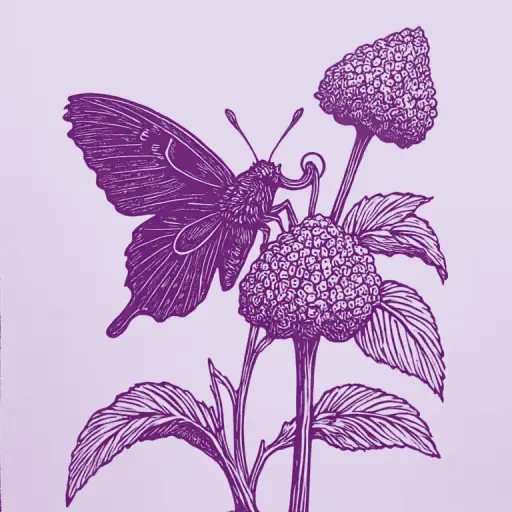
How Butterflies Collect Sweet Nectar from Flowers
- 8 min read
- 59
Butterfly — one of nature's most graceful creations, whose life is closely tied to plants. When we observe how these scaled-winged insects fly from one bud to another, we often wonder: exactly how do they get food? The feeding process of scaled-winged insects is an evolutionary engineering masterpiece.
Instead of ordinary jaws, they have developed a unique mouthpart — the long, flexible butterfly proboscis. With this tool, the insect penetrates the deepest nectar to obtain the sweet liquid. In this article, we will detail how this amazing tool is structured, how the capillary mechanism works to suck up nectar, and the role of flower pollination in the ecosystem.
Anatomical Dissection: How the Proboscis is Structured and Works
To understand how scaled-winged insects skillfully extract sweet liquid from the deepest buds, we need to look into their microscopic world. The insect's unique mouthpart is a masterpiece of evolution. Let's dissect the anatomical structure of this natural tool, which is almost invisible when folded, but instantly transforms into an efficient drinking straw.
Structure of the Butterfly Mouthpart at Rest
The butterfly's mouthpart is a highly specialized and amazing mechanism that allows it to obtain nutrients from various sources. At rest, this tool appears quite inconspicuous because its main part, the proboscis, is folded compactly. It is not a single structure, but a combination of several parts that work in harmony.
The main element we will study is the proboscis. At rest, it is in a coiled tube shape, which can be very long relative to the butterfly's body. Its function is not just for drinking, but to serve as an ideal tool to access liquids hidden deep inside flowers.
Besides the proboscis itself, the mouthpart also includes lips and associated muscles. This supporting structure not only ensures fixation but also provides the necessary thrust to initiate the sucking process. Studying this 'apparatus' at rest helps us understand how complex and efficient the nutritional system of scaled-winged insects is.
How Butterflies Unroll the Spiral Proboscis
The unrolling of the proboscis is an amazing hydraulic process. To straighten the tight spiral, the scaled-winged insect uses its own blood pressure (hemolymph).
This happens as follows:
- Pressure Increase: The butterfly suddenly increases the hemolymph pressure in its head, directing the fluid into the proboscis's internal channels.
- Straightening: Under the action of hydraulic force, the spiral expands and extends forward, like the trumpet of a celebration.
- Fixation: Special oblique muscles inside the proboscis help correct its direction and hold it rigidly while searching for nectar.
When the insect's nutrition is complete, the pressure decreases, and thanks to the natural elasticity of the cuticle, the proboscis immediately coils back into a compact spiral.
Nutrition Physics: Biomechanics of Liquid Absorption
After straightening the proboscis and dipping it into the flower's corolla, the butterfly faces the laws of hydrodynamics. Simply dropping a 'straw' is not enough to lift the thick sweet liquid upwards. The feeding process of scaled-winged insects is a highly complex biomechanical process, where the microscopic size of capillaries combines with the precise work of internal muscle pumps. How does the tiny insect overcome gravity and fluid resistance, making nectar move against the laws of macro-world physics?
Capillary Mechanism and Pharyngeal Pump Action
Nectar absorption is a high-tech physical process. When the butterfly's proboscis is dipped into a flower, the capillary mechanism comes into play. Thanks to the microscopic diameter of the food channels, the sweet liquid spontaneously rises up the tube, overcoming the force of gravity.
However, the capillary effect alone is not enough to feed the insect quickly. To speed up the liquid ascent, the scaled-winged insect activates a powerful pharyngeal pump—a specialized muscular cavity in the head. As the pharyngeal muscles contract, negative pressure (vacuum) is created inside, which literally pulls nectar from the deepest nectar into the digestive system.
Overcoming Resistance When Working with Deep Nectar
When nectar is located deep inside the corolla, the butterfly faces the problem of resistance: the deeper the source, the more energy required to extract it. Evolution and physics have developed efficient mechanisms to overcome this barrier.
- Attack Angle and Geometry: Butterflies do not just
Step-by-Step Process: From Finding Flowers to Collecting Nectar
We have learned how nectar is physically extracted, and we have learned the unique biomechanics of the proboscis. However, the feeding process is not just about physics, but also about a complex ecosystem. To understand how butterflies drink, we need to trace its entire journey: from when it spots a flower to when it leaves it. This journey involves sensory skills, precise positioning, and, no less importantly, the butterfly's role in plant life.
Next, we will see how scaled-winged insects find their food sources using amazing senses. Then we will delve into the process of landing and exploring the flower itself, to understand how this process inevitably leads to pollination.
How Butterflies Find Food with Senses
Searching for food sources for scaled-winged insects is a highly accurate process, involving specialized senses:
- Vision: The butterfly's complex compound eyes are excellent at recognizing color and movement. They are sensitive to the ultraviolet spectrum, so they see specific 'nectar guides' on petals invisible to humans.
- Smell: Delicate antennae capture chemical signals and flower aromas from several kilometers away, directing the insect to its target.
- Taste on Feet: Chemoreceptors located on the butterfly's feet allow it to immediately assess the sweetness and viability of the nectar upon touching the flower surface.
Landing, Flower Exploration, and Plant Pollination Process
After landing on the corolla, the scaled-winged insect fully assesses the food quality using the taste receptors on its feet. Once it is sure of its target, the butterfly straightens its mouthpart. It carefully inserts the flexible butterfly proboscis deep into the bud, searching for hidden nectar to begin sucking.
At this time, the most important ecological process is occurring—flower pollination. While the insect is actively feeding, its fuzzy body inevitably comes into contact with the stamens. Pollen adheres to the scales and is transferred to neighboring plants as the butterfly collects the sweet liquid.
Practical Observations and Unusual Feeding Habits
We have confirmed that the primary and most efficient food source for butterflies is the nectar they obtain from flowers. However, as observations show, life in nature is rarely limited to sweet nectar. Butterflies are highly adaptable creatures, and their diet is much broader than it appears. In this section, we will delve into their diverse eating habits, learning what and how they feed when not on a flower. We will also learn to observe their feeding patterns in their natural environment to see this amazing world from our own perspective.
Unusual Diets: Fruit Juice, Sap, and Other Moisture Sources
Although nectar is the primary and most studied food source, butterflies are incredibly versatile. Their diet extends far beyond just sweet nectar. Depending on the species and life stage, butterflies can utilize entirely different sources of moisture and nutrients.
1. Non-Floral Sources:
- Plant Juices: Many butterfly species do not just consume nectar, but also juices from damaged or ripe fruits or trees. These juices can contain not only sugars but also other mineral components necessary for sustaining life.
- Sap and Minerals: Some butterflies can consume tree sap or even mineral salts, especially when they require specific micronutrient profiles not found in nectar.
- Decaying Organics: In some cases, particularly for larvae (caterpillars), food can include decaying plant or animal organic matter. This is particularly evident in certain groups of insects that are not classic nectar feeders.
2. Practical Tips for Observers:
To see unusual feeding patterns in action, you need to shift your observational focus. Do not limit yourself only to flower meadows. Look for:
- Damaged Areas: Search for butterflies resting on branches where bark damage or ripe fruit is visible. They may be using these spots as a source of moisture.
- Feeding Trails: If you see a butterfly lingering for a long time over a specific bush but not landing on a flower, check if there are any watery or damaged leaves or fruit there.
- Time of Day: In the morning or late afternoon, when nectar-feeding insect activity might be related not only to flowering but also to seeking any available moisture.
Remember, observing diet is not just about learning "how," but also "why." The diversity of food sources demonstrates the high level of adaptation butterflies possess to various environmental conditions.
How to Observe Butterfly Diets in Nature Yourself
Observing butterfly diets requires patience and an understanding of their natural cycles. To observe the process of collecting nectar or other moisture sources as effectively as possible, follow these practical recommendations:
- Location and Timing Selection: The ideal spot is a meadow or garden with various types of plants. The best time is in the morning (after the dew, when butterflies are most active) or in the late afternoon. Avoid the peak heat, when activity may decrease.
- Equipment: For detailed observation, binoculars (preferably with good zoom) and, if possible, a camera with a telephoto lens are necessary. This will allow you to capture the smallest details: how the butterfly lands, how it unfurls its proboscis, and how the capillary mechanism works.
- Observation Method: Do not try