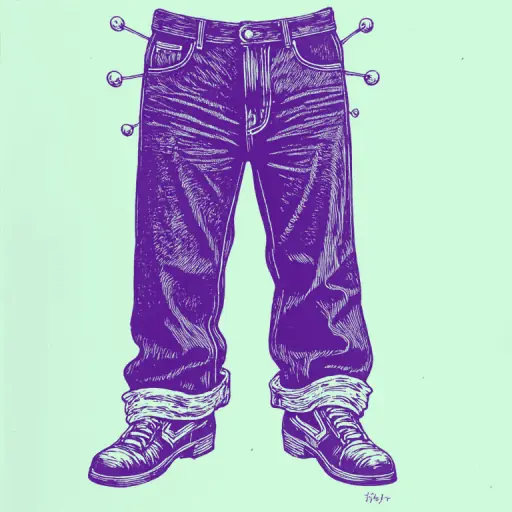
How to neatly and discreetly cuff pants with a safety pin
- 10 min read
- 5
If you find that your favorite jeans or trousers are too long, you shouldn't panic. This is a common problem, especially when you buy clothes in a store and have to wait at home until you can take them to the tailor. In such situations, the safety pin becomes an indispensable lifesaver. It allows you to quickly and temporarily shorten the hem of the leg, creating a neat and stylish roll-up without using a sewing machine and without the risk of damaging the fabric. The most important thing is to remember that this is a temporary solution and that it requires care to look as natural as possible.
Why Pins Are the Perfect Lifehack?
- Speed: This is the fastest way to make an emergency length correction. You don't have to wait for glue to dry or for you to find matching clips.
- Availability: Safety pins are always on hand and require no special tools.
- Versatility: This method works with most dense fabrics—denim, thick cotton, etc.—that hold the fold shape well.
How Does It Work?
The principle is to create a controlled, symmetrical fold that is then secured with pins. It is not just "pinning"—it is an imitation of a temporary stitch that visually holds the fold in place until you can secure it in a more reliable way (e.g., with an iron or glue).
I. Preparation Phase: What You Need to Know Before Starting
So, we know that safety pins are the perfect lifesaver when there is no time or opportunity to go to the tailor. But for this lifehack to work flawlessly, you need to know not only "how" but also "why." In this section, we examine the theoretical basis: from the ideal width of the roll-up to understanding why safety pins can become your best friends in the wardrobe. This helps you avoid mistakes and achieve a maximally natural, inconspicuous result.
Why Safety Pins Are a Good Lifehack (Context and Audience Understanding)
First, it is important to understand that the safety pin is not just a "temporary crutch," but a real wardrobe lifesaver. This lifehack is ideal for those who have encountered a sudden problem: the trousers are a few centimeters too long, or you want to quickly "play with the style" without having an iron or thread handy. The main advantage of the pin is that it enables the effect of a temporary and invisible roll-up without the risk of damaging the fabric or destroying the seam. This is an ideal solution for emergencies when there is no time for a full trip to the tailor, but the outfit should look thoughtful and stylish. The pin allows you to secure the fold and thus imitate a neat, deliberate roll-up that looks much better than just "folded-up" trouser legs. It is a quick, safe, and very aesthetic method to correct the length immediately and give the outfit a fashionable accent.
Rules for the Perfect Roll-Up (Considering Fabric Type and Ideal Width)
For the temporary roll-up to look natural and neat, it is important to adapt the parameters to the specific garment:
- Ideal Width: A general guideline is 2–4 cm. A fold that is too narrow looks messy, while an excessively wide fold weighs down the silhouette.
- Thin and Suit Fabrics: Only single inward folds are suitable for these. A double fold creates unnecessary volume, and heavy fastenings pull the hem down. Use only the thinnest safety pins.
- Denim and Thick Cotton: These hold the shape excellently. They can be rolled both inward and outward. The dense texture reliably conceals the pin fastening point.
- Elastane Fabrics: These require minimal tension during fastening to avoid a "zigzag" effect.
II. Step-by-Step Guide: How to Secure the Roll-Up Invisibly with a Pin
So, we know the ideal rules and parameters for a perfect roll-up. But how do you translate this knowledge into action? In this phase, we move from theory to practice. We will detail how to properly prepare the material and, most importantly, learn the fastening technique so that the roll-up looks maximally natural and invisible. No sewing skills required—just simple but precise steps.
Step 1. Preparation and Laying Out the Material (Measuring and First Fold)
First, put on the trousers or jeans with the shoes you intend to wear—this is crucial for accurate measurement. Stand in front of the mirror and determine how many centimeters you need to shorten the leg hem.
Carefully fold the excess fabric inward (to form an inward roll-up), not outward. This ensures the invisible stitch. Smooth the resulting fold carefully by hand along the entire circumference of the leg hem to avoid distortions and creases. The first fold is ready for fastening.
Step 2. Fastening Technique with the Pin (Securing and Finishing)
In this phase, we move from theory to practice. Remember that the goal is not just to fasten, but to do so as unobtrusively as possible. Use safety pins to secure the roll-up (ideally, they should be long enough to go through the entire fabric thickness but not so long as to touch the skin).
Fastening Technique:
- Insert Pin: Carefully guide the pin along the fold line, parallel to the edge of the roll-up. It is important that the pins go through both folded fabric parts to ensure an even and secure hold.
- Placement: Distribute the pins evenly along the entire length of the roll-up. Do not place them too close together, as this would look messy. Spacings of 3–5 cm are ideal.
- Finishing: After fastening all the pins, do not pull them out. Carefully run an iron (on a minimal temperature suitable for the fabric) directly over the area secured with pins. The heat helps to "seal" the fold and gives it additional stability.
Important: Ensure that the pins do not stick out into unsecured fabric areas, as this can be conspicuous and damage the material.
III. Fastening Options and Corrections (Quality Enhancement and Stability)
Even a correctly fastened pin requires final finishing to ensure the trousers look flawless. In this phase, we bring the temporary roll-up to perfection. We examine how to achieve absolute invisibility of the crease lines and securely fix the result so the construction doesn't fall apart at the wrong moment.
How to Achieve Maximum Invisibility: Gentle Alignment with Pins/Webbing
To achieve maximum invisibility, the roll-up must look as if it was originally designed that way. The main secret is not just pinning, but the gentle alignment of the fold. If you are using a safety pin, it should fix not only the edge but the entire structure of the fold.
Alignment Technique:
- Geometric Check: Ensure the fold is symmetrical and has the same width on both sides. An unevenness immediately reveals the "trick."
- Ironing (Optional): If possible, lay the trouser legs on an iron and carefully iron only the area being rolled up. Heat and steam help the fold to "settle in" and become as flat as possible, which is crucial for invisibility.
- Fixing with "Webbing": If ironing is not possible, use a thin but stable net (or a piece of soft cloth). Run this net along the roll-up line to give the fold extra stiffness and maintain its shape. In this case, the safety pins only serve as additional reinforcement and not as the primary fixation.
Remember: The smoother and more even the fold, the less noticeable your temporary "roll-up" will be.
How to Permanently Fix the Roll-Up: Reinforcement Techniques (Ironing or Temporary Aids)
To ensure the temporary roll-up with safety pins lasts all day and maintains its shape, use simple reinforcement tricks:
- Hot Iron: Be sure to iron the folded area through a damp cloth or gauze. This creates a stiff edge that takes the tension off the pins and prevents the trousers from sagging.
- Double-Sided Tape for Clothing: Apply a small piece of tape (or specialized tape for body and fabric) between the fabric layers next to the pin. This prevents the material from slipping and fixes the roll-up in a static position.
IV. Stylist Tips: Myths, Dangers, and Alternatives
We have learned how to achieve a perfect, invisible roll-up with safety pins, and we have even learned how to fix it permanently. However, before we move on to the final look, it is important to pay attention to safety and consider other options. In this section, we discuss how to handle safety pins safely and compare this trick with other popular methods for cuffing trouser legs. This allows you to choose the most suitable and safest method for your wardrobe.
🛡️ Safety First: Rules for Handling Pins and Fabric (Warnings)
The use of a safety pin is a great trick for clothing as it allows trousers to be temporarily shortened without sewing. However, to avoid damaging the fabric and preventing injuries, observe three important rules:
- Choose High-Quality Metal. Only use sturdy safety pins with a reliable clasp. Cheap or old pins can spring open while walking and injure your foot.
- Assess the Fabric Type. The method is safe for thick jeans and cotton, but on delicate materials (silk, thin knits), the pin leaves unsightly marks and holes.
- Avoid Moisture. Never wash trousers with safety pins. The metal oxidizes quickly and leaves rust stains on the fabric that are difficult to remove.
➕ Method Comparison: When are Clips, Ironing, or Pins Better?
The choice of method depends on the fabric type and your goals:
- Safety Pins are ideal for a quick, temporary, and inconspicuous fastening of thick fabrics (denim, heavy cotton) on the go.
- Ironing and Tape are essential for thin suit trousers where an absolutely flat and invisible hem is required.
- Clothing Clips are suitable for multiple length adjustments on loose jeans when speed is more important than the invisibility of the fastening.
Image Fixing: Summary and Styling Tips for the Roll-Up
In summary, we have learned how to technically fix the roll-up with a safety pin, and we have examined many stylish variations—from the classic pinroll to creative ties. But remember: the roll-up itself is just the foundation. For it to become part of your unique look, you must know how to stylistically "refine" it.
Three Main Rules for the Perfect Finish:
- Focus on the Shoes: The roll-up must never "compete" with the shoes. If you have chosen robust boots with a thick sole, opt for a more voluminous, "work-oriented" roll-up. For elegant sneakers or loafers, a narrow, neat pinroll is ideal. This rule is the foundation of the wardrobe.
- Balance and Symmetry: Regardless of which fastening method you used (pins, iron, or clips), always check the symmetry. The roll-ups must be the same width and height on both sides. A slight asymmetry immediately reveals sloppiness.
- Details Make the Difference: Don't hesitate to use accessories! If you want the roll-up to look not just shorter but stylish, add an accent. This could be decorative brooches, chains, or even a striking belt wrapped around the ankle band. This transforms a simple trick into a thoughtful fashion statement.
Final Expert Advice: Remember that safety pins are a temporary, "emergency" method. Use them for quick fixes or to create a unique, casual look. For daily wear, if you want the roll-up to look perfect and last all day, always prefer ironing or, if possible, a professional tailor. Style is not just what you wear, but how you present it.