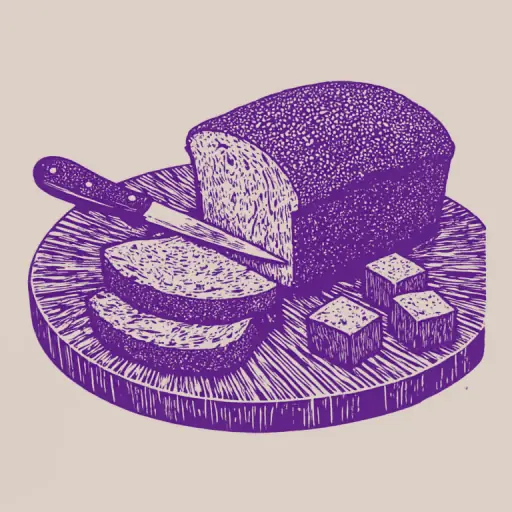
How to Cut Bread for Croutons Properly So the Pieces Don't Crumble
- 8 min read
- 61
Making perfect croutons is not just about frying; it is the art of properly preparing the raw ingredients. To make your beer snacks, soup additions, or hearty breakfasts look professional and taste as good as possible, you need to know several basic rules. The main secret lies in choosing the right tool and properly pre-treating the bread. We will explore how to achieve the ideal texture so that the pieces are crispy on the outside but do not crumble or fall apart when served. In this guide, we will give step-by-step advice on how to cut any type of bread—from dense Borodinsky to airy baguette—and which shapes to choose depending on the dish.
Preparation: Choosing the Tool and Texture Secrets
For homemade croutons to have the perfect shape—with a appetizing crust on the outside and a tender crumb inside—it is important to start correctly. The secret to flawless cutting without a pile of crumbs lies not in dexterity, but in proper preliminary preparation. At this stage, two factors play a decisive role: choosing the right kitchen tool and the physical condition of the loaf itself. Let's examine how these basic nuances affect the texture of the future snack and why a regular chef's knife often fails here.
Which Knife is Best for Cutting Bread: Advantages of a Serrated Knife and a Sharp Blade
Choosing the right tool is 90% of the success. To get neat pieces without deforming the crumb, forget dull, universal knives.
- Serrated Knife (Serraitor): The ideal choice for fresh bread with a crispy crust. The toothed blade easily "saws through" the hard crust without crushing the delicate crumb. Movements should be sawing, without heavy downward pressure.
- Sharp Chef's Knife: Suitable for slightly stale, dense rye or Borodinsky bread. The main condition is that the blade must be razor-sharp to cleanly slice the fibers, not tear them.
Preparing the Loaf: Why Fresh Bread Crumbles and How to Prepare It (Freezing, Drying)
Fresh bread crumbles due to high moisture and the elasticity of the crumb: under the pressure of the blade, it gets crushed and tears. To get neat pieces, it is best to use yesterday's or slightly stale bread.
If you only have a soft, fresh loaf, prepare it using simple chef hacks:
- Freezing: Place the bread in the freezer for 15–20 minutes. The crumb will firm up, the moisture will be locked in, and the knife will glide smoothly.
- Drying: Cut the bread into large slices and leave them on the counter for 10–15 minutes. The crust will slightly dry out, which will facilitate further cutting into sticks or cubes.
Basic Rules for Perfect Cutting Without Crumbs
Once the loaf is properly prepared, the most critical moment arrives—the actual work with the knife. To get neat pieces that will toast evenly and maintain the perfect balance of soft core and crispy crust, it is important to follow basic technique. The secret lies in the correct distribution of effort, precise calculation of each slice's geometry, and systematically removing excess material. Let's examine these fundamental steps that will save your table from a pile of crumbs and your future snack from deformation.
Optimal Slice Thickness for Juicy and Crispy Croutons
Slice thickness is the main secret to the correct texture, where the crust is appetizingly crispy and the center remains soft and juicy.
- Ideal Standard (1–1.5 cm): This is the sweet spot for classic garlic croutons. At this thickness, the bread absorbs the aromatic oil well but does not dry out completely.
- Less than 1 cm: Only suitable for small breadcrumbs in soup. Such thin pieces will quickly turn into hard, over-dried croutons in the pan.
- More than 2 cm: The slice will absorb excess oil and remain too moist inside, depriving the snack of its signature crispness.
For dense Borodinsky or rye bread, it is best to stick to a thickness of exactly 1.2 cm.
Step-by-Step Algorithm: How to Neatly Trim Crusts and Dice the Crumb
To get perfect pieces without deforming the crumb, follow a simple algorithm:
- Slice Preparation. Lay the prepared slice of bread flat on a stable wooden or plastic board.
- Trimming Crusts. Take the serrated knife. Holding the slice down with your fingers, carefully trim the hard crusts from all four sides using gentle sawing motions without heavy pressure. This ensures even toasting of the croutons, as the crusts always brown faster than the crumb.
- Dicing the Crumb. Lightly press the cleaned slice with your palm. Gently loosen it into longitudinal strips using smooth "forward-backward" motions, and then, if necessary, into cubes. The main thing is not to press down on the knife from above to maintain the airy texture and get neat pieces.
Cutting Shapes Depending on Purpose
Cutting geometry is not just a matter of aesthetics; it is the foundation of the correct texture of the finished dish. The shape of the pieces directly determines how the bread will absorb oil, spices, and sauces, and how evenly it will toast. Choosing the right format allows you to achieve the perfect balance of a crispy exterior and a tender interior.
Depending on the culinary task, whether it is a savory snack for beer or a light addition to a first course, several classic bread cutting options are traditionally used.
Thin Sticks—The Ideal Format for Garlic Croutons with Beer
Thin sticks are the gold standard for beer snacks. This shape provides the perfect balance: a crispy crust on the outside and a slightly soft crumb inside.
To get neat pieces, follow this simple scheme:
- Base Preparation: Cut Borodinsky or rye bread into slices. The optimal slice thickness is 1–1.2 cm.
- Crust Removal: Trim the hard outer crusts so the croutons toast evenly.
- Shaping: Divide each slice lengthwise into uniform sticks about 1 cm wide and 5–7 cm long.
Use a sharp serrated knife so that the fibers are not crushed, and the garlic croutons maintain a clear geometry during frying.
Cubes and Slices for Soups, Salads, and Hearty Egg Breakfasts
For soups and salads (such as the famous Caesar), neat cubes are the ideal shape. The optimal size is from 1x1 cm to 1.5x1.5 cm. This cut allows the croutons to hold their shape, look beautiful on the plate, and not instantly dissolve in the broth. Use a sharp serrated knife so the crumb is not crushed.
If you are making a hearty breakfast, such as classic egg croutons, cut the bread into wide slices about 1.5 cm thick. This thickness guarantees that the crouton will absorb the egg-milk mixture well but will retain a soft, juicy texture inside after frying.
Nuances of Working with Different Bread Varieties
Choosing the right bread is half the battle, as it determines both the taste and the texture of the finished croutons. Different bread varieties have unique densities and flavor profiles, requiring a special approach to cutting. We have already discussed universal rules, but now we will delve into the specifics of working with the most popular bread types: from dense rye to airy baguette. Remember that every loaf requires its own cutting "algorithm" to achieve the perfect, non-crumbling shape.
How to Properly Cut Dense Rye and Borodinsky Bread
When working with dense, rich varieties, such as Borodinsky or other rye bread, the approach to cutting must be more deliberate than when working with a soft loaf. These varieties have a dense, often hard structure, making them an ideal base for savory snacks, especially with beer. The main secret is not to try to cut them into overly thin, "cigarette-like" slices. The density of rye bread requires the slice thickness to be at least 1 cm so that the croutons maintain their structure and do not fall apart during frying.
Cutting Tips:
- Crusts: Be sure to trim the top, darkest crust. It can be too hard and may not toast evenly, which will ruin the texture of the entire piece.
- Shape: Cut the crumb into rectangular sticks or cubes. If the croutons are intended to be served with a filling (such as cheese or sour cream), it is better to make them wider so they can "hold" that filling.
- Tool: Both a sharp knife and a serrated knife will work here, but the main thing is not to exert excessive force. Cut confidently, but do not tear the bread.
Thanks to its richness, rye croutons absorb the aromas of garlic, herbs, and spices excellently, giving the dish a deep, "piney" or spicy note.
Nuances of Cutting Airy Wheat Loaf or Baguette
Unlike dense rye, airy wheat loaf or baguette deforms easily during cutting. To preserve its porous structure and avoid excessive crumbs, follow these recommendations:
- Use only a serrated knife: Make light sawing motions without downward pressure to avoid crushing the delicate crumb.
- Use yesterday's bread: The freshest baguette will inevitably crumble, while a slightly dried (or pre-frozen for 10 minutes) one will cut perfectly evenly.
- Increase thickness: For airy dough, the optimal size for a slice or cube is 1.5 cm. Thinner pieces will burn quickly or turn into hard crumbs.
Conclusion
Proper cutting is half the battle in making perfect croutons. By choosing the right serrated knife, slightly preparing the bread, and maintaining an optimal thickness of 1–1.5 cm, you will forget about crumbs and deformed slices forever. Experiment with shapes for different dishes, and your homemade croutons will always be impeccable on the outside and tender on the inside!