How to Distinguish Yin and Yang Using Simple Energy Balance Rules
- 14 min read
- 73
Modern life demands constant movement from us, but Eastern wisdom reminds us: true strength lies in balance. Ancient Chinese philosophy is built on the concept of Yin-Yang dualism—the teaching that all existence consists of two opposite yet complementary forces. Yin symbolizes the feminine principle, passivity, tranquility, cold, and darkness, while Yang embodies the masculine principle, activity, dynamism, warmth, and light.
Understanding the difference between Yin and Yang is not just theoretical knowledge, but a practical tool for self-knowledge and harmonizing life. The balance of energies determines our physical health in Traditional Chinese Medicine, influences character, dictates home arrangement according to Feng Shui, and even reflects in our appearance.
In this guide, we will explore how to learn to distinguish these energies without error, determine their predominance within ourselves, and use simple rules to achieve the inner harmony of opposites.
Step 1: Studying the Fundamental Differences and Symbolism of Yin and Yang
To learn to recognize the manifestations of Yin and Yang in daily life without error, it is necessary to turn to the origins of ancient Chinese philosophy. At the core of this teaching lies a simple yet profound truth: every aspect of our reality is woven from the interaction of two fundamental forces. They do not compete with each other but continuously flow into one another, creating the dynamic equilibrium of the Universe.
Understanding this duality begins with the ability to see the polar properties of things and decipher ancient symbols that have helped sages find harmony for centuries. Let's examine the basic guidelines that will serve as your compass in the world of polar energies.
Basic Table of Opposites: Light, Darkness, Tranquility, and Movement
To learn to distinguish these energies without error, it is important to start with their fundamental physical and natural manifestations. In Chinese philosophy, the entire diversity of the Universe is reduced to the dynamic balance of two primordial forces. Yin represents the passive, hidden, and receptive state, whereas Yang is active, manifested, and giving.
Below is a basic table that will help you instantly classify any phenomena around us:
| Characteristic | Yin (Feminine Principle) | Yang (Masculine Principle) |
|---|---|---|
| Light Regime | Darkness, night, moonlight | Light, day, sunlight |
| Dynamics | Tranquility, passivity, static | Movement, activity, dynamism |
| Temperature | Cold, coolness | Warmth, heat |
| Direction | Inward (contraction, depth) | Outward (expansion, ascent) |
| Moisture | Wet, damp | Dry, dryness |
| Form | Soft, pliable, round | Hard, solid, angular |
These opposites do not fight to destroy each other; rather, they cyclically replace one another, just as day replaces night. Understanding this basic duality is the first step toward consciously managing one's own energy and harmonizing one's space.
The Secret Meaning of the Taijitu Symbol: Why There is Always Black in White, and Vice Versa
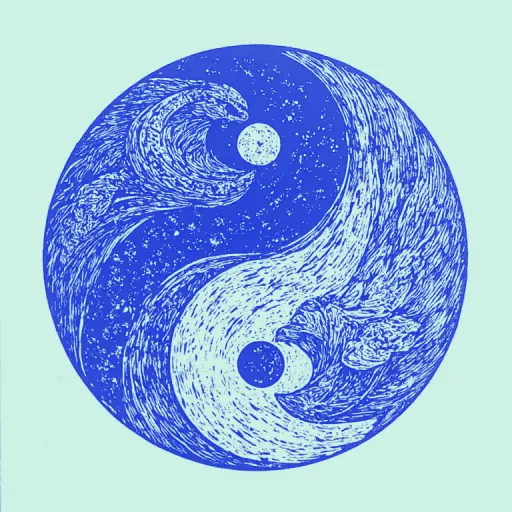
The Taijitu symbol, known in the West as the Yin-Yang symbol, represents not a static picture, but a dynamic model of the Universe. The outer circle symbolizes the infinite Tao, and the smooth S-shaped line inside shows that there is no rigid boundary between opposites—they continuously flow into one another.
The main secret of the symbol lies in the contrasting dots:
- White dot in a black field (Yang within Yin): means that even in the deepest passivity, cold, or darkness, the seed of activity and light is already maturing. For example, on the winter solstice, when the night is longest, a new cycle of light is born.
- Black dot in a white field (Yin within Yang): reminds us that at the peak of activity, heat, or triumph, tranquility and decline inevitably arise.
These dots prove that absolute Yin or Yang in its pure form does not exist. The forces do not fight to destroy each other but complement each other harmoniously, maintaining the eternal balance of life.
Step 2: Testing Ourselves—How to Determine the Predominant Energy in Character
Understanding the cosmic balance of the Taijitu gains true value when we project it onto our own personality. Each of us carries a unique pattern of forces, where passive and active principles intertwine in different proportions, determining temperament, habits, communication style, and reaction to life's challenges. The predominance of one energy is not a disbalance, but your individual nature, defining strengths and areas for growth.
To understand which force guides you through life, it is enough to analyze your daily behavioral patterns, thinking habits, and methods of restoring energy. Let's examine two polar psychological portraits that will help you recognize your dominant qualities without error and see in which direction your internal scales are tilted.
Portrait of a Person with Dominant Yin Energy: Intuition, Softness, and Contemplation
A person with dominant Yin energy is a natural contemplator, a deep analyst, and a sensitive empath. If this principle predominates in your character, you most likely restore your energy in silence and solitude, rather than in noisy company, and prefer to listen rather than speak.
Key markers of the Yin type:
- Intuitive perception. You often make decisions based on inner intuition and subtle premonitions, rather than dry logical calculation.
- Softness and diplomacy. In conflict situations, you strive to smooth over sharp edges, seek compromises, and genuinely sympathize with others.
- Need for tranquility. You are more comfortable observing processes from the sidelines, analyzing, and planning, rather than rushing into a fight first.
- Flexibility. You know how to adapt to circumstances, gently circumventing obstacles, much like water.
People with pronounced Yin often find themselves in creativity, psychology, and the arts. However, with an excess of this energy, softness can turn into indecisiveness, apathy, and a tendency toward melancholy.
Portrait of a Person with Dominant Yang Energy: Logic, Leadership, and Drive
If Yin is the quiet depth of a lake, then Yang is the turbulent mountain stream. A person with dominant Yang energy, embodying the active masculine principle, is always oriented toward the external world, action, and concrete results.
An pronounced Yang psychological type can be recognized by the following characteristics:
- Logic and rationalism. Instead of intuitive premonitions, such a person relies on dry facts, structural analysis, and cause-and-effect relationships.
- Leadership and initiative. Yang personalities do not wait for change; they create it themselves. They easily take responsibility and confidently lead the team.
- High dynamism. Their life is filled with movement. They make decisions quickly, prefer active sports, and cannot tolerate routine.
- Drive and directness. In communication, they value specifics, speak openly, and firmly defend their boundaries.
However, without proper energy balance, an excess of Yang can turn into excessive aggression, stubbornness, and rapid fatigue due to an inability to relax in time.
Step 3: Learning to Distinguish Yin and Yang in Appearance and Style
The internal balance of energies inevitably projects onto our external appearance. Ancient Chinese philosophy asserts that the body is the visible form of the spirit; therefore, Yin and Yang leave their unique imprints on facial features, body proportions, and even the way a person moves. By learning to read these markers, you can instantly determine the dominant energy in a conversational partner and gain a deeper understanding of your own nature.
The external manifestation of polar forces is not merely genetics, but a subtle language of visual harmony. Understanding how soft, rounded Yin lines interact with sharp, angular Yang structures allows one not only to decipher a person's natural code but also to consciously adjust one's image using clothing, textures, and accessories.
Analyzing Facial Features and Body Lines: Soft Yin Forms vs. Hard Yang Angles
The human body is the direct material embodiment of the cosmic forces of Yin and Yang. To determine which energy dominates your constitution, it is sufficient to analyze the geometry of your face and silhouette.
Yin Markers (Softness and Roundness):
- Face: Round or oval contour, soft cheeks, full lips, large round eyes, and a neat, slightly rounded nose.
- Body: Smooth curves, a defined waist, sloping shoulders, soft lines, and fluidity in movement.
Yang Markers (Hardness and Angles):
- Face: Sharply defined cheekbones, a determined square or pointed chin, thin lips, a straight or large nose with a hump.
- Body: Tall stature, long limbs, straight and broad shoulders, pronounced bone structure, and an angular silhouette.
Most people present a unique mix of these characteristics, but identifying the dominant vector helps in understanding one's natural constitution.
Selecting Wardrobe and Fabric Textures to Harmonize the Natural Type
Harmonizing one's natural type is based on the principle of compensation or gentle accentuation of natural lines. Clothing is the simplest tool to correct the balance of energies in one's external appearance.
- Yin Wardrobe (to soften excess Yang or support natural softness): Choose flowing, tactilely pleasant fabrics—silk, chiffon, cashmere, velvet, and fine knitwear. Soft lines, gentle draping, rounded collars, and the absence of stiff seams are favored in cut.
- Yang Wardrobe (to structure excess Yin or express natural strength): Prefer fabrics that hold their shape—leather, heavy denim, tweed, stiff cotton. Opt for straight cuts, clear geometric lines, sharp lapels, and contrasting color combinations.
If Yin predominates in your appearance, adding one Yang detail (such as a structured jacket over a light dress) instantly pulls the look together. Conversely, a rigid Yang silhouette becomes more harmonious when softened with a silky scarf.
Step 4: Bringing Order to Space According to Feng Shui Principles
Harmonizing one's personal style and appearance is only the first step toward creating a holistic balance. Our internal state is inextricably linked to the space in which we spend most of our time. The ancient Chinese art of Feng Shui views the home as a living organism, where every corner, piece of furniture, and flow of light directs the currents of Qi energy. If the balance between active and passive principles is disrupted in the interior design, it inevitably affects our well-being, productivity, and sleep quality.
To transform your dwelling into a true source of strength and inspiration, it is necessary to learn to see the manifestations of Yin and Yang in surrounding objects. The proper distribution of these energies in space allows for the creation of zones for effective work and deep relaxation, bringing order not only to rooms but also to thoughts.
Yin and Yang Zones in the Home: How to Properly Distribute Room Functions
According to ancient Chinese Feng Shui philosophy, any living space is divided into zones of activity (Yang) and zones of rest (Yin). The proper distribution of room functions helps harmonize the flow of Qi energy, maintaining energy balance in the home.
The entrance door and the front part of the house are traditionally considered Yang. Movement, light, and dynamism predominate here. This zone is ideal for placing:
- The living room—the center of socializing, games, and family gatherings;
- The kitchen and dining area—places where fire burns and life bubbles;
- The home office—a space requiring concentration and active mental activity.
The depth of the house, its rear section, belongs to the Yin sphere. This is the realm of silence, darkness, and passivity. This is where you should place:
- The bedroom—for deep restoration of strength and complete sleep;
- The bathroom—a zone of relaxation and cleansing.
If these zones are mixed up—for example, furnishing the bedroom right by the entrance—sleep will become restless, and stagnation will settle in the living room at the back of the house.
Interior Correction Methods: Balancing Light, Colors, and Textures
To create a harmonious space, it is important to correctly combine three key elements: light, color, and textures.
- Lighting. Yang is bright sunlight and directed beams. Yin is soft, diffused twilight. To balance them, use dimmers and multi-level lighting scenarios: chandeliers (Yang) for activity and floor lamps or candles (Yin) for relaxation.
- Color Palette. Yang colors are warm, saturated, and light (white, yellow, red). Yin colors are cool, dark, and deep (blue, gray, black). The classic Feng Shui rule for living rooms: about 60% light Yang tones for the base and 40% dark Yin accents for coziness.
- Textures and Materials. Yang is expressed through smooth, glossy, and hard surfaces (metal, glass, polished wood). Yin manifests in soft, matte, and textured fabrics (velvet, wool, rugs, clay).
If the living room is too noisy and uncomfortable (excess Yang), add heavy curtains and a fluffy rug (Yin). If it is difficult to wake up in the bedroom (excess Yin), hang a mirror with a metal frame or add a bright painting (Yang).
Step 5: Applying Energy Balance Rules in Daily Life and Health
Harmonizing the external environment is only half the journey to true equilibrium. Our body and mind are a microcosm where the same fundamental forces of nature interact continuously. In traditional Chinese philosophy, human health directly depends on the dynamic balance of Yin and Yang: an excess or deficiency of either principle is instantly reflected in one's well-being, energy level, and mood.
Transferring ancient principles into daily routine allows for the gentle regulation of internal processes without harsh imposition on the body. A conscious approach to distributing forces helps switch between active action and deep recovery in time. Let's explore how to tune your biological rhythms in accordance with the laws of nature and avoid common misconceptions along the way.
Lifestyle Regulation According to TCM: Proper Nutrition, Physical Exercise, and Adequate Rest
Traditional Chinese Medicine (TCM) views health as a dynamic balance of Yin and Yang. To maintain this balance, it is important to synchronize daily habits with natural rhythms.
- Proper Nutrition: All foods are categorized by their energetic properties. Yang foods (ginger, garlic, red meat, spices) warm and accelerate metabolism. Yin foods (cucumbers, greens, seafood, citrus fruits) cool and soothe. If you have an excess of heat (Yang), choose Yin foods; if you are sluggish and cold (Yin), choose Yang foods.
- Physical Exercise: Active workouts (running, strength training) generate Yang energy. Gentle practices (Qigong, yoga, stretching) accumulate Yin. The ideal balance is to combine intense exercise in the first half of the day with relaxing practices in the evening.
- Adequate Rest: Sleep is the primary way to replenish Yin energy. TCM recommends going to bed before 11:00 PM, as the time from 11:00 PM to 1:00 AM is considered the peak of Yin, necessary for the deep restoration of organs and the nervous system.
Common Mistakes in Seeking Balance and Myths About the Opposition of Two Principles
Understanding the practical aspects of Eastern medicine is often clouded by misinterpretations of the essence of the ancient teaching. In striving to achieve energetic balance, we easily fall into the trap of mental patterns. Here are three main misconceptions that prevent the achievement of harmony between opposites:
- The Myth of the Struggle Between Good and Evil. Unlike Western dualism, Chinese philosophy does not divide the world into "good" and "bad." Yin (darkness, passivity) and Yang (light, activity) are not enemies but complementary forces. One cannot exist without the other.
- The Illusion of Static Equilibrium. The mistake is to think that perfect balance is a fixed 50/50 proportion. Life is dynamic. A healthy body is constantly switching: Yang is active during the day, and Yin dominates at night. Trying to fix the balance permanently leads to stagnation.
- Rigid Gender Division. Although Yin is traditionally described as the feminine principle and Yang as the masculine principle, these concepts are much broader than biological sex. Both energies are present in every person. Trying to completely suppress the "alien" energy within oneself destroys personal integrity.
Recognizing these misconceptions helps move away from rigid frameworks and begin perceiving Yin and Yang as a flexible tool for self-knowledge.
Conclusion
Understanding the nature of Yin and Yang is not just about mastering the theoretical foundations of Eastern thought; it is a practical tool for fine-tuning your daily reality. By learning to correctly distinguish the manifestations of these energies in your own body, character, surrounding space, and habits, you gain the key to consciously managing your physical and mental state.
The main lesson that great Chinese philosophy teaches us is that absolute static equilibrium does not exist. The true harmony of opposites is not a fixed point, but a continuous, living dance. In it, activity and passivity, dynamism and tranquility, smoothly and inevitably succeed one another, much like day and night, inhalation and exhalation.
To maintain this natural energy balance, it is enough to follow simple guidelines:
- Develop Sensitivity: Switch between Yang drive and Yin restoration of strength in time.
- Harmonize the Environment: Use Feng Shui principles and color accents to create zones for activity and rest.
- Synchronize with Nature: Adjust diet, sleep, and physical activity according to the seasons.
May the concept of Yin-Yang become not a rigid set of dogmas for you, but a flexible compass on the path to longevity, health, and a deep inner peace.