How to Feel and Understand Qi Energy Flow in Your Body and Where Blockages Originate
- 13 min read
- 60
The concept of Qi energy (or Chi) forms the foundation of Traditional Chinese Medicine and Eastern philosophy. Qi is not merely an abstract "life force," but a subtle substance that permeates all living things—a kind of bioelectrical adhesive that connects our physical body, our emotions, and our mind. In ancient texts, it is referred to as the "breath of the universe."
When Qi flows freely and harmoniously, a person experiences an energy boost, mental clarity, and emotional stability. However, under the influence of stress, a sedentary lifestyle, or poor nutrition, energy blockages develop in the body. The stagnation of Qi inevitably leads to physical ailments and chronic fatigue.
Understanding the nature of this energy is the first step toward consciously managing one's health. Modern research increasingly establishes a connection between the circulation of Qi and the function of the nervous system and the body's bio-currents, thereby confirming the wisdom of ancient Qigong practices.
Understanding Circulation: How and Through Which Channels Qi Energy Flows
To perceive and direct the life force, one must understand the fundamental laws of its movement. In Traditional Chinese Medicine, the human body is viewed not just as an aggregation of organs, but as a complex, dynamic energy system. The circulation of Qi is a continuous, strictly ordered process. Just as blood flows through the blood vessels and nourishes every cell, invisible energy flows move along special internal routes that permeate our entire being.
Understanding this internal topography is the first step toward successful practical work with the body. We must discover how this hidden network is structured, by what laws the life force is distributed, and how the ancient teaching of polarities corresponds to modern scientific concepts of bioelectrical processes in the organism.
Map of Energy Meridians in Traditional Chinese Medicine
Traditional Chinese Medicine views the human body as a complex map, traversed by invisible yet palpable pathways—the Energy Meridians (the Jing-Luo system). Along these channels, the life force Qi circulates continuously, nourishing the organs and the entire life function of the body.
There are 12 Primary Paired Meridians, each directly connected to a specific internal organ (e.g., Lung, Heart, Liver, or Kidney Meridians). They run symmetrically on the left and right sides of the body. Additionally, two "marvelous" unpaired channels play a key role in Qigong practice:
- Du-Mai (Middle Back Meridian) – regulates and directs Yang energy;
- Ren-Mai (Anterior Midline Meridian) – is responsible for the accumulation and distribution of Yin flows.
At the intersection points of these paths with the skin are biologically active points. Energy accumulates and bio-currents are regulated through these points. Understanding this map allows one to precisely determine where the movement of the life force is disrupted.
Yin and Yang: Balance of Polarities and Bioelectricity in the Body
The movement of Qi along the meridians is determined by the fundamental law of polarity—the interaction of Yin and Yang. Yin symbolizes rest, cold, passivity, and internal structure, while Yang represents movement, heat, activity, and external manifestation. In the human body, these principles exist in a continuous dynamic balance.
Modern science finds astonishing parallels between this concept and biophysics. The flow of Qi is analogous in many ways to the bioelectrical impulses running through the nervous system and connective tissue (fascia):
- Yang component corresponds to excitation processes, sympathetic tone, and positive electrical potential.
- Yin component is associated with inhibitory processes, parasympathetic activity, and negative charge.
Health is the unimpeded flow of these micro-currents. When the balance of polarities is disturbed, a "short circuit" or blockage occurs in the body. Awareness of Qi as bioelectricity helps to understand why mental concentration in Qigong practice can physically alter the electrical conductivity of the skin at acupuncture points and restore the conductivity of the channels.
Preparation for Practice: How to Create Conditions for Sensing Energy
Understanding the theoretical foundations of Qi circulation is only the first step. To translate this knowledge into the level of personal experience and truly feel the movement of the life force, the body and mind must be prepared. In the hustle and bustle of daily life, our receptors are overloaded by external stimuli, and muscles are hardened by habitual tension. In such a state, it is practically impossible to perceive the subtle bio-currents, just as one cannot hear a whisper in a loud crowd.
The Qigong practice requires the creation of a special inner space—stillness and high sensitivity. The tuning of this perception instrument is based on two crucial pillars: deep physical relaxation, which opens the channels for free energy flow, and conscious breathing, which acts as the main catalyst and accumulator of Qi.
Deep Relaxation and Alignment with Inner Sensations
To feel the subtle bio-currents of Qi, the brain must be shifted from an active mode to a state of contemplation. In Traditional Chinese Medicine and Qigong, this process is described using the terms Fansun (active relaxation) and Tin (inner listening). Normal muscle tension blocks the sensitivity of the nerve endings and literally suppresses the weak signals of the life force.
To align yourself, perform the following steps:
- Assume a resting posture. Sit on the edge of a chair or lie on your back. The spine should be straight, but without excessive tension.
- Relax the facial muscles. Relax the jaw, forehead area, and tongue by lightly pressing the tip against the upper palate to close the energy context.
- Direct attention inward. Close your eyes and mentally travel through the body from the crown of the head down to the feet, releasing residual tension with each exhale.
When the physical body is completely relaxed and the mind is calm, you will begin to perceive barely perceptible warmth, tingling, or pulsing—these are the first signs of free Qi flow.
Breathing Exercises for Energy Activation and Accumulation
Breath is the most important bridge between the outer world and the inner life force. To activate and accumulate Qi, Traditional Chinese Medicine recommends learning diaphragmatic breathing (abdominal breathing), also known as "belly breathing."
- Lower Breath (Xia Dan Tian): Sit upright and place your palms on your lower abdomen (about two to three fingers below the navel). Inhale slowly through the nose, expanding your belly like a balloon. As you exhale, gently draw the front abdominal wall toward your back. This exercise awakens prenatal energy and accumulates it in the body's main reservoir.
- "Four-Count" Breathing: Inhale for a count of 4, hold your breath for a count of 4, exhale for a count of 4, and hold your breath again. This rhythm harmonizes Yin and Yang, stabilizes the bio-currents, and supplies oxygen to the blood, transforming the inhaled air into true Qi (Zhen Qi).
Practice this for 5–10 minutes. You will feel a pleasant warmth in your lower abdomen—a clear sign that energy accumulation has begun.
Practical Guide: Feeling Qi Flow with Your Hands
The transition from theoretical understanding and breath preparation to direct perception is a crucial step in Qigong practice. When your mind is calm and your breath is even, the life force accumulated in the lower Dantian is ready to manifest on a physical level. Our palms and fingers possess an extremely high concentration of nerve endings and acupuncture points, making them ideal "receivers" for picking up subtle electromagnetic vibrations and heat waves.
In this section, we move to practical methods that help you awaken tactile sensitivity and literally touch the circulating energy. By directing your focus to specific areas, you learn to convert internal bioelectricity into distinct physical sensations, making invisible forces tangible.
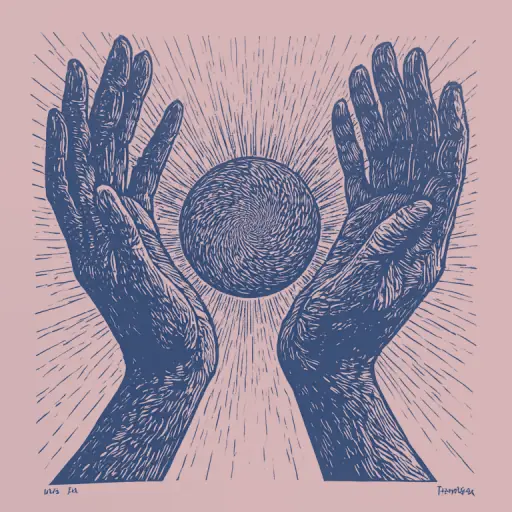
Qigong Exercise "Energy Ball" Between the Palms
The classic "Energy Ball" exercise is ideal for the first encounter with Qi circulation. The palms have a high concentration of active points, including the Lao Gong point ("Work Palace") in the center of the palm, through which life force emanates.
Step-by-Step Instructions:
- Activation: Rub your palms together intensely for 20 seconds until strong warmth is generated.
- Positioning: Hold your palms 10–15 cm apart at chest height, keeping your elbows relaxed.
- Movement: Slowly bring your hands together and then apart by 2–3 cm. The palms move slightly apart on inhalation, and they draw closer on exhalation.
- Concentration: Direct all your attention to the space between your hands.
Gradually, you will feel an elastic resistance reminiscent of a magnetic field, tingling, or warmth. This physical sensation of bioelectricity is your accumulated Qi energy.
Meditative Body Scan to Fixate Bioelectricity and Warmth
Apply the sharpened sensitivity of your palms to your entire body. The meditative scan is a classic method of Traditional Chinese Medicine that allows one to direct inner attention (Yi) to consciously perceive and accompany the life force (Qi).
Perform the practice sequentially:
- Starting Position. Assume a comfortable seated posture with a straight back or lie on your back. Close your eyes and perform several deep abdominal breathing cycles.
- Starting Point. Focus your attention on the crown of the head. Imagine a gentle wave of warm light slowly sinking downward.
- Descending Flow. Guide this focus over the face, neck, shoulders, and arms down to the fingertips. Register every micro-movement: tingling, pulsing of the vessels, feeling of expansion, or slight bioelectricity.
- Central Scan. Allow the attention to sink along the spine and across the chest into the abdominal area (lower Dantian). The warmth should accumulate most distinctly here.
- Grounding. Guide the flow through the hips and lower legs down to the feet, feeling a slight humming in the soles of your feet.
Where the attention flows unimpeded, you will feel a pleasant flow of heat. Areas where coldness, numbness, or "emptiness" are felt indicate potential energy blockages.
Diagnosing Blockages: How to Determine Where Qi is Stagnating
When we master the ability of the fine body scan, the true map of our inner state opens up to us. In ideal balance, life force flows uninterrupted, like a pure mountain stream. However, stress, suppressed emotions, and physical overexertion create artificial dams on this natural flow. In Traditional Chinese Medicine, such hindrances are referred to as Qi stagnation.
Discovering these invisible barriers is the first step toward restoring health. Our body constantly sends signals to draw attention to blocked areas. To restore harmony, one must learn to decipher these bodily cues and recognize markers for energy imbalances on both physical and psychoemotional levels.
Physical and Emotional Signs of Energy Blockages in the Body
When the free flow of life force is disrupted, the body and psyche react immediately to the resulting congestion. In Traditional Chinese Medicine, Qi stagnation is not viewed as an abstract concept but as a concrete pathological process with clear markers.
Physical Manifestations of Stagnation:
- Creeping pain and heaviness. Unlike a physical injury, discomfort from Qi stagnation often migrates, manifesting sometimes in the shoulders, sometimes in the upper abdomen.
- Pressure sensation. A feeling of a "lump in the throat," bloating, or tightness in the chest frequently occurs.
- Chronic muscle tension. Tension in the neck and jaw area is a classic sign of blockage in the Qi channels.
Emotional Manifestations of Stagnation:
- Irritability and Anger. Qi stagnation (especially in the Liver meridian) robs the person of mental flexibility and triggers outbursts of anger or suppressed resentment.
- Apathy and Feeling of Dead End. The psyche loses its plasticity; a feeling of spiritual "inertia" and the inability to move forward arises.
Recognizing these signs is the first step toward restoring Yin-Yang balance.
Self-Investigation of Blocked Meridians and Acupuncture Points
When transitioning from theory to practice, you can locate energy blockages using simple yet profound self-diagnosis methods that have been used for centuries in Traditional Chinese Medicine.
- Palpation Method of "A-Shi" Points: In Eastern practices, these are referred to as "tender points." Slowly run your finger along the meridian line (e.g., the Lung meridian on the inner arm) and apply light pressure to the tissue. If you feel a sharp, pulling, or pressing pain at a specific spot that is unrelated to a physical injury, this is a clear sign of vital energy stagnation.
- Temperature Scan: Pass an open hand a few centimeters above the body along the course of the channels. Areas with pronounced cold indicate a Qi deficiency, while heat or tingling points to an excess and an acute blockage.
- Diagnostic Tapping: Gently tap the channels with the cupped palm like a "boot." At blockages, the tap will sound dull, and the body will react with internal resistance.
Harmonization Methods: How to Clear Blockages and Restore Qi Flow
After we have discovered areas of stagnation and identified the affected meridians, we move to the main section of the practice: restoring the natural Yin-Yang balance. In Traditional Chinese Medicine, clearing blockages is compared to removing obstacles in a river's flow: once the obstacle is removed, the vital energy Qi flows forward, bringing health to the body and clarity to the mind.
Harmonizing the flow requires a holistic approach. We must not only resolve short-term tensions but also realign the entire energy system of the body. For this, methods of gentle physical intervention and deep inner work, proven over centuries, are employed to release blocked resources and strengthen the fundamental source of our vital energy.
Channel Unblocking through Dynamic Qigong and Self-Massage
To eliminate vital energy stagnation, Traditional Chinese Medicine suggests moving from static contemplation to gentle movement. Dynamic Qigong and self-massage effectively "break through" blocked areas of the meridians.
Dynamic Qigong Training: "Shaking"
Stand upright, relax your shoulders, and begin to gently bounce on your knees, creating a vibration throughout the body. This simple exercise directs stagnant, pathogenic energy (Xin Qi) through the feet into the earth, creating space for fresh currents.
Tapping Method (Paida)
Walk along the main channels with light palm taps. Tap the outer (Yang) side of the arms from top to bottom and the inner (Yin) side from bottom to top. This activates Qi circulation and stimulates the bio-electrons.
Kidney Energy Replenishment
The kidneys store the original energy (Yuan Qi). To strengthen this, rub the area of the lower back daily with your palms until you feel deep warmth. Strong Kidney Qi nourishes the entire body and strengthens the protective energy (Wei Qi), preventing the formation of new blockages.
Rules for Preserving Vital Energy and Replenishing Kidney Qi
In Traditional Chinese Medicine, the kidneys are referred to as the "foundation of vital energy" and the main reservoir of prenatal energy (Jing). Once the channels are cleared of blockages, it is extremely important to prevent this fundamental loss of resources. Replenishing and preserving Kidney Qi requires a conscious change in daily habits.
Golden Rules for Preserving Kidney Energy:
- Protection from Cold: The lower back and feet must always be kept warm. Cold penetrates directly through the Yongquan point on the sole of the foot and instantly depletes the Yang aspect of the kidneys.
- Emotional Control: Fear and chronic worry directly affect the kidneys and block their circulation. Meditation and grounding exercises help transform anxiety into tranquility.
- Balance Between Activity and Rest: Excessive physical labor, chronic sleep deprivation, and emotional exhaustion deplete the essence (Jing), which is difficult to restore.
Methods for Replenishing Kidney Qi:
- Nutrition: Incorporate dark-colored foods (black sesame, black beans, seaweed) and warm, thermally prepared meals into your diet.
- Hand Warming: Rub your palms until they feel very warm, and place them on your lower back. Perform gentle circular movements and mentally direct the warmth inward.
- Breathing through the Mingmen Point: While inhaling, direct your attention to the point in the lower back (opposite the navel) and visualize the kidneys filling up with strength.