How to interpret the meaning of the snake as a symbol in different cultures and myths?
- 15 min read
- 87
The snake is perhaps the most mysterious and multifaceted archetype in world culture and astrology. This chthonic creature simultaneously inspires awe and wonder, embodying polar meanings: wisdom and cunning, life and death, poison and healing. Unlike other totems, the snake image does not lend itself to a single interpretation. For some, it is a symbol of temptation and original sin; for others, it is the embodiment of eternal renewal through shedding its skin and awakening the inner energy of kundalini.
Understanding this symbol requires a deep dive into mythology, religion, and esotericism. In this article, we will decipher the secret messages of the snake image, whether it is the ancient Ouroboros, the medical staff of Asclepius, an elegant piece of jewelry, or a tattoo on the body. By mastering these keys, you can harness the power of this ancient symbol for personal transformation.
Step 1: Analyzing the Basic Duality of the Symbol (Poison and Medicine)
Grasping the snake symbolism is impossible without accepting its fundamental paradox. In esoteric teachings and astrology, this image represents the ultimate duality of existence, where opposites not only coexist but constantly flow into one another. The snake simultaneously carries deadly threat and saving healing, acting as both destroyer and creator in one form.
This dualism is clearly illustrated by the concept of "poison and medicine": the same substance, depending on dosage and intent, can both kill and bring back to life. This polarity also defines our perception of the snake. On one hand, it is associated with higher knowledge and cyclical rebirth; on the other, it embodies primal fear, chaos, and the hidden threat lurking in the darkness.
Wisdom, Immortality, and Renewal Through Skin Shedding
The snake's ability to shed its old skin has made it a universal symbol of rejuvenation, regeneration, and eternal life. Unlike other creatures, the snake seems to be reborn, leaving behind a worn past. This process is a powerful metaphor for deep personal transformation, spiritual rebirth, and overcoming time.
In esoteric traditions and astrology, this phenomenon is linked to the cyclical nature of existence. The snake symbolizes:
- Renewal: The readiness to painlessly cast off outdated beliefs, habits, and toxic attachments.
- Immortality: The continuous life cycle, where physical decline or crisis is merely a transitional phase before a new start.
- Deep Wisdom: The accumulation of experience, knowledge of the hidden mysteries of the universe, and the ability to adapt flexibly to any change.
By observing the reptile emerging from its old covering renewed and radiant, ancient peoples saw in it the earthly embodiment of eternal youth. This symbol teaches us not to fear crises, because behind every shedding of "old skin" comes the acquisition of new strength.
Chthonic Danger, Cunning, and Primal Chaos
The other side of the snake archetype is rooted in the primal fear of the unknown. As a chthonic creature inhabiting the crevices of the earth and the underworld, the snake embodies the primal chaos from which the Universe arose, and the power capable of destroying this world. In astrology and esotericism, this aspect is linked to uncontrollable instincts, dark lunar energy, and hidden threats.
The snake's cunning manifests in its silent movement and sudden, deadly strike. This image is closely related to poison—a substance that brings instant death. In mythology, snakes often guard the boundaries between the world of the living and the dead, acting as ruthless guardians. Symbolizing blind passion, temptation, and destruction, the serpent reminds us of the fragility of order in the face of chaos. Understanding this shadow side is necessary for a complete deciphering of the symbol, because without the destruction of the old, new creation is impossible.
Step 2: Interpreting the Snake Through the Prism of World Religions and Myths
Moving from the abstract duality of the snake archetype to specific historical epochs, we inevitably encounter how deeply this image is woven into the sacred fabric of human history. Depending on geography and religious consciousness, the snake has undergone amazing metamorphoses: from the greatest deity bestowing life and guarding the secrets of the universe, to the absolute embodiment of evil and original sin.
World religions and ancient myths have recorded this dualism in sacred texts and temple reliefs. To understand why this symbol evokes such polarized emotions—from sacred reverence to panic—it is necessary to trace its path through the key spiritual traditions of humanity. Let's examine how great civilizations of the past interpreted the image of the snake and how these views shaped our modern perception.
The Snake in Christianity: A Symbol of Temptation and the Fall
In Christian tradition, the image of the snake underwent a radical transformation, becoming the main embodiment of evil, cunning, and the fall from grace. According to the Book of Genesis, it was the serpent-tempter, hiding Satan, who seduced Eve to eat the forbidden fruit from the Tree of Knowledge of Good and Evil. This narrative forever cemented the reptile's status as a symbol of original sin, spiritual blindness, and carnal temptation.
Nevertheless, the Christian symbolism of the snake is deeper than it first appears. The Bible also contains other, paradoxical interpretations:
- The Bronze Serpent of Moses: Raised on a pole in the wilderness, it healed the bitten Israelites, which in the New Testament is interpreted as a prefiguration of Christ's crucifixion, conquering death.
- The Call to Wisdom: Jesus himself called his disciples: "Be wise as serpents and innocent as doves" (Matt. 10:16), pointing to the creature's perceptiveness and caution.
Thus, even within the strict framework of Christianity, the snake retains its dual nature, wavering between diabolical cunning and saving wisdom.
The Snake Cult in the Ancient East, Egypt, and Ancient Greece
Unlike the biblical tradition, ancient civilizations saw the snake not as an enemy, but as a powerful patron and guide of cosmic forces.
- Ancient Egypt: Here, the cobra—the Uraeus—adorned the headdresses of the pharaohs. It symbolized divine power, royal majesty, and protection from enemies. The goddess-cobra Wadjet was considered the patroness of Lower Egypt, and the serpent Mehen guarded the solar deity Ra in his nightly journey.
- Ancient East and Mesopotamia: In Sumerian-Akkadian tradition, the snake was associated with fertility, eternal life, and subterranean fresh waters. It served as a symbol of transformation, capable of renewing life force.
- Ancient Greece: The Greeks associated the snake with wisdom and prophecy. Python guarded the Oracle of Delphi until it was defeated by Apollo. Later, the snake became the faithful companion of Asclepius, the god of medicine, symbolizing healing through the ability to shed its skin.
In an astrological context, these ancient cults reflect the influence of Pluto and Scorpio—archetypes of deep transformation, death, and subsequent rebirth.
Step 3: Interpreting Key Graphic Symbols with the Snake
From grand myths and ancient religious doctrines, the image of the snake has systematically evolved into concise graphic symbols that have become humanity's universal visual codes. These signs have transcended local beliefs to become powerful archetypes that we encounter daily in modern culture, science, and design.
The geometric plasticity of the snake's body has allowed for the fixation of complex philosophical concepts in graphics—from the infinity of cosmic cycles to the fine line between healing and death. Below, we will examine two key graphic symbols that have maintained their sacred and practical significance throughout millennia.
Ouroboros: What does the snake biting its tail mean
One of the deepest and most captivating graphic symbols in human history is the Ouroboros—a snake biting its own tail. This ancient sign personifies infinity, the cyclical nature of time, and the inseparable connection between creation and destruction.
In esoteric teachings, alchemy, and astrology, the Ouroboros is interpreted through several key aspects:
- Eternal life and cyclical renewal: Just as a snake regularly sheds its skin, the universe goes through constant cycles of death and rebirth. The end of one phase always heralds the beginning of another.
- Unity of opposites: The circular form of the symbol reflects the merging of beginning and end, life and death, active and passive principles into a single cosmic order.
- Alchemical transformation: Alchemists used this image to denote a closed process of element purification (opus circulare), where matter must 'die' to be reborn as the philosopher's stone.
In Carl Jung's analytical psychology, the Ouroboros became the archetype of individuation and the wholeness of the human psyche, reminding us that any internal crisis contains the potential for spiritual rebirth.
Medical Emblem: The history of the Rod of Asclepius and the Bowl with a Snake
From the cosmic cycle of the Ouroboros, we move to an earthly, yet equally profound symbol—the medical emblem. Two key graphic signs form its basis: the Rod of Asclepius and the Bowl with a Snake (the Hygieia vessel).
- Rod of Asclepius—this is a gnarled wooden staff entwined by a single snake. In ancient Greek mythology, Asclepius, the god of healing, used it as a symbol of wandering and support for restoring strength. The snake here symbolizes wisdom, healing, and eternal renewal through its ability to shed its skin. It is important to distinguish it from the Caduceus of Hermes (with wings and two snakes), which is historically associated with trade and diplomacy.
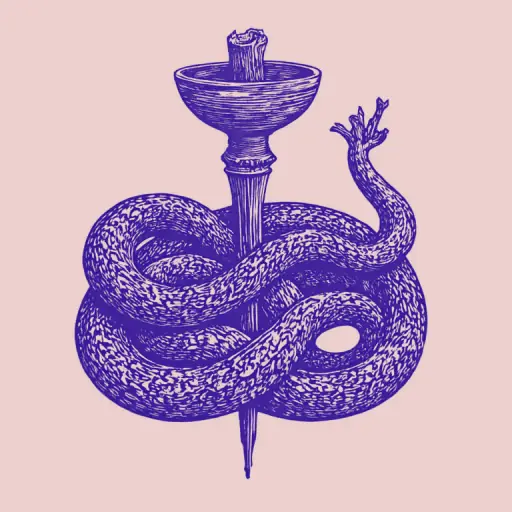
- Bowl with a Snake—this is an attribute of Hygieia, Asclepius's daughter and goddess of health. This symbol became the emblem of pharmacy. It vividly illustrates the main principle of medicine: snake venom heals in small doses but kills in large ones. The bowl represents the vessel for storing this precious medicine, which requires wise and careful handling.
Step 4: Decoding the Personal and Gendered Meaning of the Symbol
Moving from macrocosmic myths and universally accepted medical emblems, we transition to the deeply personal, psychological, and sacred dimension of the snake symbol. In astrology, esotericism, and depth psychology, the snake ceases to be merely an external sign—it becomes a mirror of our inner nature, reflecting the hidden facets of the human psyche and gender identity.
This ancient archetype is closely linked to deep instincts, personality transformation, and the awakening of hidden bodily reserves. By viewing the snake as a personal totem, we connect with the forces that govern our unconscious impulses, intuitive knowledge, and inner strength, dividing this experience into subtle aspects of femininity and powerful flows of life energy.
What the snake symbolizes for women: intuition, power, and fertility
In female symbolism, the image of the snake unfolds with particular depth, linking earthly fertility with sacred intuition. Historically, the snake accompanied great goddesses—from the Cretan Goddess with snakes to Ishtar and Hecate. It symbolizes not passive femininity, but primordial power, wisdom, and mastery over the mysteries of life and death.
The connection between the snake and woman is built on three key aspects:
- Intuition and secret knowledge: The snake, gliding across the earth, catches the subtlest vibrations. For a woman, this symbol signifies an acute 'sixth sense,' the ability to see hidden motives, and the capacity to trust her inner voice.
- Cyclicality and fertility: The regular shedding of skin connects the snake to lunar cycles and the female nature. It is a symbol of eternal renewal, rejuvenation, and the ability to regenerate after any life crisis.
- Sacred power: Unlike direct masculine strength, a woman's 'serpentine' power is flexibility, magnetism, the ability to wait, and to act softly yet uncompromisingly.
Integrating this symbol helps a woman embrace her shadow side, transforming natural instincts into a source of personal strength and creative energy.
Kundalini and inner energy: the snake as a totem of spiritual power
In Eastern philosophy and esoteric practices, the snake symbolizes Kundalini—a powerful, dormant life and spiritual energy within every human. It is traditionally depicted as a snake coiled in three and a half turns at the base of the spine, in the area of the Muladhara root chakra.
The awakening of this 'serpentine power' symbolizes the beginning of deep inner transformation. Ascending up the central energy channel and sequentially activating key chakras, the Kundalini snake purifies the mind, burns away illusions, and expands consciousness.
As a totem of spiritual power, the snake offers practitioners the following guidelines:
- Self-knowledge: Immersion into one's own mental depths to unlock hidden potential.
- Balance of polarities: Harmonizing masculine and feminine principles (the Ida and Pingala flows), which wrap the central channel like two snakes.
- Spiritual evolution: Overcoming ego limitations for the sake of merging with higher cosmic consciousness.
This symbol reminds us that true strength does not come from the outside—it is hidden within us, awaiting the moment of its awakening and ascent.
Step 5: Applying the Snake Symbolism in Tattoos, Jewelry, and Design
Transferring sacred symbols into the material world is the oldest way to ground spiritual energy and declare one's inner strength. When we choose the image of a snake for adorning our body or space, we are not merely following a fleeting aesthetic trend. We are entering into a conscious resonance with the archetype of transformation, protection, and wisdom, making it an active part of our daily reality.
In contemporary visual art, the snake motif is experiencing a true renaissance. Whether it is a permanent drawing on the skin, an elegant ring winding around a finger, or an accent detail in interior design—this symbol instantly captures the eye. It communicates to others a readiness for renewal, mental flexibility, and a hidden power capable of protecting personal boundaries and emphasizing the unique status of its wearer.
How to Interpret the Meaning of a Snake Tattoo on the Arm and Other Body Parts
The placement of a snake tattoo determines its hidden message and energetic influence on a person's life. In the art of body painting, the meaning of a snake tattoo combines wisdom and cunning, readiness for defense, and internal rebirth.
- On the arm (forearm, wrist, shoulder): The most popular placement. A snake wrapping around the arm symbolizes control over one's destiny, composure, and readiness to act. On the right arm, it emphasizes active power and protection; on the left, it signifies intuition and hidden motives.
- Along the spine: A direct reference to Kundalini energy. Such a tattoo signifies spiritual awakening, gaining inner strength, and protection against betrayal.
- On the thigh or leg: Symbolizes earthly power, moving forward, and a chthonic connection to nature. It is often associated with grace, temptation, and sexual energy.
- On the chest or collarbone: Embodies heart healing, protection of vulnerable feelings, or a deep personal secret.
When interpreting a design, details are important: a snake shedding its skin signifies renewal and victory over the past, while a reptile coiling around a dagger indicates struggle, spiritual resilience, and triumph over difficulties.
The Snake Motif in Jewelry and Modern Decor
The transition from body art to tangible objects allows one to literally surround oneself with the protective energy of this ancient totem. In jewelry art, the snake is a synonym for luxury, magnetism, and hidden power. Rings and bracelets wrapping around fingers and wrists do not just attract attention; they function as personal talismans. Legendary brands, such as Bvlgari with its iconic Serpenti collection, have long transformed this image into a symbol of eternal youth, wisdom, and sensuality.
From the perspective of astrology and esotericism, wearing such jewelry has practical significance:
- Snake rings on the index finger enhance leadership qualities and authority, while on the pinky or ring finger, they awaken intuition and creative potential.
- Bracelets wrapping the wrist help control the flow of personal energy and protect against manipulation.
- Pendants and necklaces (especially in the form of an Ouroboros) promote spiritual renewal and remind one of the cyclical nature of life processes.
In modern interior design, the snake motif is used to create an atmosphere of mystery and sophistication. Statuettes, hardware, wallpaper prints, or textiles bring the energy of transformation into a space. This decor is excellent for offices and living rooms, helping to concentrate attention and make balanced decisions.
Conclusion: How to Harness the Power of the Snake Symbol
Integrating the power of the snake into daily life requires awareness and respect for this ancient archetype. As an astrological and esoteric symbol, the snake helps us navigate periods of deep transformation and unlock hidden potential.
Here are several practical ways to align with the snake's energy:
- Conscious Transformation ("Shedding Skin"): Use the image of the snake during life crises. When old behavioral patterns no longer work, visualize yourself shedding old skin, making way for a renewed, strong self. This is especially relevant during periods of strong Pluto or Scorpio influence in your horoscope.
- Activating Intuition Through Jewelry: Wear snake-shaped rings or bracelets on the left (receiving) hand to enhance receptivity, develop intuition, and inner vision. If you need active protection and self-confidence, wear them on the right hand.
- Working with Kundalini Energy: Practice meditations focused on chakra opening, visualizing the gentle ascent of creative energy from the coccyx up the spine. This helps strengthen health and boost overall vitality.
Remember that the snake does not tolerate haste. When invoking its power, strive for composure, wisdom, and strategic planning. Allow this ancient totem to be your guide on the path to self-knowledge and personal evolution.