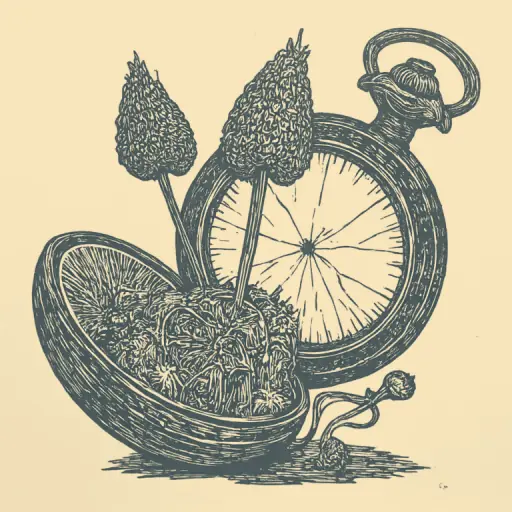
How to Live Outside of Time and Learn to Feel Every Moment
- 15 min read
- 71
The modern world is subject to the dictate of the second hand. We are constantly rushing, trying to keep up with the accelerating rhythm of megacities, and unknowingly missing life itself. The syndrome of haste has become a chronic diagnosis of our society, breeding stress and the fear of passing years.
But what if time is merely a mental construct, the boundaries of which can be expanded?
Living outside of time does not mean ignoring reality or being late for appointments. It is a special art of perception that allows us to bring focus back to the point of "here and now." Drawing on ancient philosophy, modern spiritual practices, and the psychology of mindfulness, we can learn to slow down the subjective flow of time and touch eternity in every moment.
In this guide, we will explore how to free ourselves from the yoke of deadlines, overcome the fear of aging, and restructure our thinking to achieve true inner freedom and learn to truly taste life.
What does it mean to "live outside of time" and why are we constantly rushing?
Each of us has at least once caught ourselves thinking that the clock hands are moving too fast, and days are merging into an endless series of deadlines. But what if time is not an objective prison, but merely a way our mind organizes chaos? Living outside of time does not mean ignoring reality. It is a special state of mind in which we free ourselves from the dictate of the second hand and reclaim control over our own perception.
To understand how to make this internal transition, we must figure out why linear time has become our main trap. We are accustomed to measuring life by external clocks, forgetting that the true depth of the moment is revealed only when we slow down our inner race.
The Concept of Psychological Time and the Syndrome of Haste
Understanding what it means to "live outside of time" requires not only philosophical reflection but also an analysis of the mechanism of our perception itself. Our consciousness is essentially a chronometer that constantly measures changes: from the transition from day to night to the aging of the body. This is psychological time—a subjective construct that gives life a linear, arrow-like course. We perceive time as a resource that needs to be spent, and this "currency" generates a constant feeling of deficit and, consequently, the syndrome of haste.
The syndrome of haste is not just a desire to make it; it is a deeply rooted anxiety that we are "losing" time by not using it as effectively as possible. We live constantly looking at the clock, planning the next step, rather than living the current moment. Philosophy and psychology offer a radical paradigm shift: time is not an objective, relentless river, but rather an instrument of our attention. When we disconnect from this instrument, we begin to feel not "in the flow of time," but part of an eternal, cyclically repeating existence.
The key shift in thinking is moving from the question "How can I make it?" to the question "What am I feeling right now?" This is the first step toward freeing ourselves from the dictate of the second hand.
Philosophy and Science of Escaping the Second Hand
The philosophical view of time differs radically from the physical one. If science (such as Einstein's theory of relativity) describes time as a measurable, stretchable coordinate, philosophy and spiritual teachings offer a concept where time is merely an illusion created by our limited consciousness. In this context, "living outside of time" means not physical movement, but a change in the level of perception.
For many Eastern philosophies (such as Advaita Vedanta) and mystical traditions, true reality (Brahman) exists outside of temporal dimensions. Time, in this sense, is a function of matter (Maya). Our feeling that we are "rushing" or that "time is running out" is a consequence of attachment to the cyclical, linear flow of events.
How to apply this?
- Decentralization of Time: Instead of perceiving life as a race from a "beginning" to an "end" (death, deadline), it is necessary to shift the focus to the process of being. Realize that you are not "moving through time," but existing in every moment.
- The Concept of Eternity: Spiritual practices teach that the true "Self" (consciousness) is not subject to biological time. This allows one to perceive current difficulties or successes not as temporary points, but as part of a continuous, eternal flow of experience.
- Connection to the "Eternal Now": The goal is not to stop time, but to learn to dwell in a state that philosophers call the "Eternal Now" (or "Nirvana"). This is a state where the past and future lose their emotional power, leaving only the pure, unadulterated moment of awareness. This is the key to slowing down the subjective pace of life.
The "Here and Now" Practice: How to Bring Focus to the Present Moment
The transition from the philosophical understanding of time's illusion to its practical experience requires changing our daily cognitive habits. If eternity is not an endless series of seconds, but the depth of the current moment, then our attention is the main bridge to it. By directing it to the point of "here and now," we literally stop the internal chronometer that forces us to chase an elusive future or cling to a past that has gone by.
Mastering this state does not require leaving the world. It is enough to readjust the filters of perception and incorporate simple mental habits into the routine. Below, we will examine specific tools that will help regain control over your attention and teach you to subjectively slow down the passage of time in any, even the most chaotic day.
Mindfulness as the Main Tool for Attention Management
Mindfulness is not just a popular psychological practice, but a fundamental tool for readjusting our perception of time. In a state of constant haste, our mind wanders chaotically between regrets about the past and anxieties about the future. This mental noise creates the illusion of a rapid passage of seconds. Mindfulness brings the focus of attention back to the only real point of existence—the "here and now."
By directing attention to immediate sensory experience without judgment or evaluation, we literally stop the internal chronometer. In this moment, psychological time freezes. We begin to notice our breath, physical sensations, sounds, and smells. This slowing down of life's pace is not just rest, but a qualitative transition into a timeless existence, where every moment gains the depth of eternity. Regular training of attention frees us from the dictate of the second hand.
Daily Exercise for Slowing Down the Perception of Time
To solidify the skill of managing the internal chronometer, perform the daily exercise "Chronos Pause." It takes only 5 minutes, but it radically changes the subjective perception of time.
Practice Algorithm:
- Stop. At any point in the day, interrupt your current activity for one minute. Take three deep, conscious breaths.
- Sensory Decomposition. Slowly fix and name to yourself:
- Three physical sensations (the contact of clothing with skin, the warmth of the air, the weight of the body);
- Three subtle sounds (the hum outside the window, your own breathing, the rustling of leaves);
- Three visual details (the texture of the table, the play of shadows on the wall, a glint of light).
- Stretching. Imagine that the seconds between breaths are expanding, turning into deep lakes of tranquility.
This exercise overloads the brain with new sensory information. When consciousness fixes on many small details, subjective time slows down, returning you to the eternal present.
Mental Techniques for Changing the Subjective Flow of Time
Having mastered physical slowing through the senses, we approach the main barrier on the path to timeless existence—our mind. The subjective flow of time is determined not so much by the ticking of clocks as by how our brain processes information and constructs expectations. If consciousness is overloaded with anxious thoughts about the future or regrets about the past, seconds compress, turning life into a continuous race.
To truly change the perception of time, it is necessary to reconfigure the internal filters of attention. Mental techniques allow us to transform the abstract category of time from an external enemy into an internal space of freedom. We will learn to work with mental settings that free thought from rigid frameworks and open access to the deep, qualitative experience of every moment.
Deconstructing Haste: How to Refuse the Dictate of Rigid Plans and Deadlines
Rigid planning turns our lives into a conveyor belt where every moment is subservient to a future result. To regain freedom from time, it is necessary to deconstruct the haste. This does not mean a complete abandonment of obligations, but rather a change in attitude toward them.
Instead of linear time (Chronos), which measures deadlines, turn to the concept of Kairos—the time of qualitative action, the opportune moment.
Practical steps for deconstructing haste:
- Buffer Zones: Leave up to thirty percent of the day free from any plans. This is space for spontaneity and living in the "here and now."
- Focus on the Process, Not the Deadline: Shift attention from anxiety about deadlines to the quality of the current action. When you are completely immersed in a task, psychological time slows down.
- Prioritizing "Being" Over "Doing": Ask yourself: "Why am I rushing?" Often, haste is merely a habit of the mind masking the fear of missing something important.
By refusing the dictate of rigid schedules, we open the door to timeless existence, where every moment gains intrinsic value.
Meditation and Spiritual Practices for Feeling Connected to Eternity
Meditation is a direct path to overcoming the illusion of linear time. When we close our eyes and direct our attention inward, psychological time begins to slow down, giving way to pure presence.
To touch eternity, use two deep spiritual practices:
- "Space Between Thoughts" Meditation: Focus on the pauses between inhalation and exhalation, as well as between arising thoughts. In these micro-seconds of silence, there is no past or future—only pure "here and now."
- "Inner Observer" Practice: Detach from your mind. Recognize yourself not as a stream of thoughts and plans, but as an eternal witness observing this stream.
These spiritual practices change our perception of time. The syndrome of rushing dissolves when you realize: external clocks may rush, but your true depth always resides in the absolute peace of timeless existence.
Being Outside of Time in Daily Life: A Lifestyle Concept
Transferring the deep experience of eternity from a meditative state into the hustle of daily life is a step from contemplative philosophy to the practical art of living. Being outside of time in everyday life means transforming mindfulness from a temporary practice into a constant system of coordinates that defines our daily routine, habits, and choices. This is not an escape from reality, but the creation of a unique lifestyle where external clocks no longer dictate the rules of your inner universe.
When we stop measuring our worth by the speed of task completion and conformity to others' schedules, the very quality of our presence in the world changes. Being outside of time is the freedom to choose your own rhythm, without looking back at the markers of success imposed by society. Let's explore how this concept is embodied in daily choices and how simple shifts in perception return the joy to every moment.
Freedom from Age Stereotypes, Trends, and Others' Expectations
Being outside of time at the lifestyle level means stepping out from under the dictate of "social clocks." Society imposes rigid markers on us: achieve one thing by thirty, another by fifty, conform to fleeting trends, and justify others' expectations. But the true "self" has no age.
Liberation from temporal frameworks is built on three pillars:
- Rejecting Age Labels. Stop evaluating your desires through the lens of age. Learning something new, changing professions, or radically changing your lifestyle can happen at any point on the journey.
- Ignoring Fleeting Trends. Instead of chasing fast fashion, choose what possesses enduring value—deep books, timeless music, sincere conversation, and quality items.
- Relying on the Inner Compass. Replace external approval ("keeping up with everyone") with personal meaning.
When you stop rushing to meet others' standards, you exit the race and attain the genuine freedom to be yourself.
How to Enjoy Simple Things and Slow Down Life's Pace
Having freed ourselves from the pressure of external templates, we finally gain the opportunity to slow down our inner race. Slowing down the pace of life begins not with a radical change of job, but with changing the focus of attention in everyday details. When we stop perceiving the current moment as a transit zone on the way to the future, time gains depth.
To restore the savor of life, try implementing simple practices:
- Ritualizing Routine. Turn morning coffee or washing dishes into meditation. Concentrate on the warmth of the cup, the aroma, the tactile sensations, completely putting away your smartphone.
- Sensory Contemplation. Take a walk without headphones. Notice the texture of the leaves, the play of light on the walls of houses, the sounds of the street.
- The Art of the Pause. Practice Italian dolce far niente—the sweetness of doing nothing. Set aside 10 minutes a day to simply sit by a window without a specific goal.
Enjoying simple things returns us to physical reality, where time flows smoothly, and every moment becomes self-valuable.
Typical Mistakes on the Path to Timeless Existence
The aspiration to break free from the dictate of the second hand and attain true awareness is a profound spiritual step, yet it is easy to stumble on this path. In attempts to slow down the pace of life and connect with eternity, we often fall into extremes, confusing inner freedom with external chaos. The philosophy of timeless existence teaches us to change our internal perception, not to destroy the foundations of our social lives.
Seekers of harmony often make typical mistakes, either retreating into radical escapism or feeling guilty about any planning. To ensure that the "here and now" practice does not turn into a source of new stress, it is important to recognize these mental traps in time and find a balance between eternity and daily tasks.
Attempting to Completely Ignore Real Social Obligations
The desire to step outside the hustle and bustle and grasp the state of "here and now" often leads to a dangerous extreme—social infantilism. In trying to escape the dictate of the clock, a person begins to ignore appointments, miss deadlines, neglect household duties, and distance themselves from loved ones, justifying it with "living in the moment" and achieving "inner freedom."
However, the true philosophy of timeless existence has nothing to do with irresponsibility. It is not an escape from reality, but a qualitative change in one's presence within it.
- Escapism instead of awareness: Ignoring obligations is merely an attempt to escape mental discomfort. True awareness requires the courage to be in the moment, even when that moment is filled with routine.
- Inner freedom versus external chaos: Freedom from time is born within. One can pay bills, keep promises, and build a career while maintaining deep inner peace and a connection to eternity.
When we confuse spiritual liberation with mere sabotage, we only create a new source of stress—social conflicts and guilt—which ultimately closes the path to harmony.
How to Find Balance Between Planning the Future and Living in the Present Moment
The balance between planning and being present is not a compromise, but a synergy. The mistake of many novice practitioners is perceiving plans as enemies of freedom. In reality, chaos and lack of structure generate background anxiety about the future, which is what most distracts us from the "here and now" moment.
To achieve equilibrium, use the concept of "planning as containment":
- Allocate fixed time for Chronos: Dedicate strictly defined 15–20 minutes daily to planning tasks, budgets, and goals. By writing everything down in a planner, you free up the mind's working memory.
- Act in Kairos mode: Outside the time set aside for planning, fully switch to the qualitative perception of the moment. If you are working, work; if you are interacting with loved ones, be fully with them.
- Plan intentions, not rigid scenarios: Leave "space" in your schedule—free hours not occupied by anything.
An organized future is not a cage, but a solid foundation that allows the present moment to unfold in all its fullness.
Conclusion
Life outside of time is not a radical rejection of clocks or social obligations, but a deep internal transformation of our perception. By moving from the dictate of linear time (Chronos) to living in a rich, qualitative moment (Kairos), we attain true freedom and inner peace.
By integrating awareness, meditative practices, and the philosophy of slowing down into our daily lives, we cease to be hostages to the syndrome of haste. Time transforms from an relentless enemy that carries away years into an infinite space for creativity, deep connection, and self-knowledge. Freedom from age stereotypes and imposed paces allows us to connect with eternity, which is always present in the now.
Remember: eternity is not an endless sequence of future days, but the depth of the current moment, available to you right now. Take a conscious breath, slow your step, and allow yourself simply to be. Your timeless journey begins in this very second, here and now.