How to Play Wolves and Sheep According to Official Rules
- 14 min read
- 74
The game "Wolves and Sheep" is an amazing example of how completely different, yet equally engaging, leisure formats can hide under one name. For some, it is a classic logic game on a checkerboard, requiring strategic thinking, where one player controls the wolf and the other controls four sheep. For others, it is a fun and active outdoor game that develops agility and attention in children. And fans of modern board games will immediately recall the tactical family game La Guerre des Moutons.
In this guide, we will thoroughly examine all three variations. You will learn the official game rules, the correct piece setup, movement specifics (including diagonal moves), and key winning strategies for both the predators and the peaceful flock. Our guide will help parents, educators, and board game enthusiasts easily master the rules and move straight to practice.
Classic Logic Game on a Checkerboard
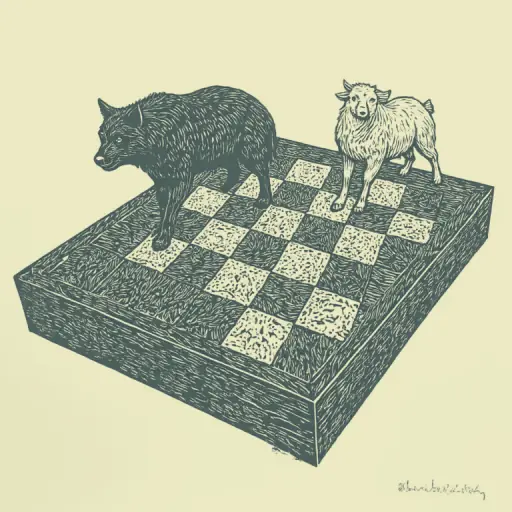
The classic version of "Wolves and Sheep" (also known as "Wolf and Four Sheep") is a fascinating asymmetrical logic game played on a standard checkerboard. Unlike traditional checkers, the opponents are in unequal positions here: one player controls a single, yet maneuverable, wolf, while the other controls four slow but numerically superior sheep. This ancient pastime excellently develops tactical thinking and spatial imagination in children and adults. To start a game, no complex equipment is needed—just a regular board and five standard pieces of contrasting colors. Let's examine the basic principles that will help you quickly master this deep dueling game.
Initial Piece Setup and Movement Rules
The game uses a standard 8x8 chessboard or checkerboard. Five pieces participate in the game: one wolf (usually a black checker) and four sheep (white checkers). The playing field is restricted only to the dark squares.
Initial Piece Setup:
- Sheep are lined up on four dark squares of the first row (e.g., B1, D1, F1, H1).
- The Wolf is placed on any dark square of the opposite, eighth row (traditionally, the corner square A8 is chosen).
Movement Rules:
- All movements are strictly diagonal to one adjacent empty square.
- Sheep can only move forward. They are forbidden from moving backward or jumping over other pieces.
- The Wolf has an advantage in maneuverability: it can move diagonally both forward and backward.
- There are no captures in this game (pieces do not "eat" each other). Players take turns, and the sheep always make the first move.
Winning Conditions for the Wolf and Sheep
To successfully complete the game, players must clearly understand their final objectives. In the classic "Wolves and Sheep" game on a checkerboard, the conditions for triumph for each side are fundamentally different:
- Wolf Victory. The single gray predator wins if it manages to break through the opponent's defensive redoubts. To do this, the wolf must physically move to the opposite edge of the board (the sheep's starting line) or simply bypass them so that they can no longer block its path. Since the sheep can only move forward, any breakthrough by the wolf past their line means its automatic victory.
- Sheep Victory. The four sheep win if they manage to completely surround and block the wolf. If the wolf has no possible diagonal moves left (it is trapped on the edge of the board or locked inside a dense chain of pieces), the sheep are declared the winners.
It has been mathematically proven that with flawless play, the wolf has no chance of success against the sheep. However, any tactical error on the part of the "flock" instantly opens a path to freedom for the wolf.
Winning Strategies and Tactics on the Board
The classic duel on the checkerboard seems simple. In reality, "Wolves and Sheep" is a deep logic game where the outcome of the game is determined by the precision of calculations. Although the wolf has virtually no chance of breaking the defense with flawless sheep play, in practice, the human factor and loss of concentration often change the course of the battle. To win consistently, both participants must master the basic geometric principles of the board. The sheep's success relies on collective discipline and synchronized movement, while the wolf must rely on cunning, provocation, and finding micro-cracks in the opponent's defensive redoubts. Let's look at the key tactical maneuvers for each side that will help you seize the initiative from the first moves.
Winning Tactics When Playing as the Sheep: Maintaining a Straight Line
The main task of the four sheep is to prevent the wolf from breaking through their defensive redoubts. Since the sheep can only move forward, any tactical error or allowing the predator to slip behind them means instant defeat. The only guaranteed winning strategy for the sheep is maintaining a "straight line" (or a dense diagonal wall).
Key rules of defensive tactics:
- Synchronized Movement. Never advance a single sheep too far. A lone piece instantly loses support, and the wolf can easily flank it. Move pieces in pairs or in a single line, maintaining minimal distance between them.
- Covering Diagonals. The wolf is constantly looking for breaches in your defense. Your goal is to create a continuous chain where every square accessible to the opponent is under control.
- Ignoring Provocations. The wolf will make sharp maneuvers backward and forward, trying to lure one of the sheep and break the formation. Do not fall for the tricks. Continue to methodically narrow the space, moving as a unified front.
With careful and unhurried play, the sheep will inevitably corner the wolf or press it against the edge of the board, completely depriving it of maneuvering space and the ability to move.
Aggressive Maneuvers and Tricks for the Wolf
When playing as the wolf, your main strength is high mobility. Unlike the sheep, the wolf can move diagonally both forward and backward. To break through the opponent's defensive wall, use the following tactical tricks:
- False Attacks and Rapid Flank Changes. Demonstratively attack one of the flanks, forcing the opponent to pull forces there. As soon as the sheep regroup, sharply retreat backward and move to the opposite edge of the board. Since the sheep cannot move backward, they will require many more moves to reorganize, which will open a path for your victory.
- Provoking a Line Break. Make a move that seems erroneous, luring one of the sheep forward. If the opponent succumbs to the temptation and breaks the straight formation, a breach will form in the defense, through which the wolf can instantly slip through.
- Waiting Maneuvers. Stay at a safe distance (one or two squares from the sheep's line), making moves backward and sideways. The sheep are obligated to move only forward, so sooner or later they will be forced to make a move that weakens their position.
The wolf's aggression lies not in blind assault, but in creating constant tension and searching for the slightest coordination errors of the opponent.
Active Outdoor Game "Wolves and Sheep"
By trading the silence of the checkerboard for open space and fresh air, we uncover a completely different facet of this ancient pastime. The outdoor active game "Wolves and Sheep" is a dynamic hybrid of hide-and-seek and tag that has been popular with children, youth leaders, and animators for over a century. Here, you cannot sit still at the table: players will need not only cunning and strategic thinking but also quick reflexes, agility, and the ability to move silently.
This active game is ideal for large groups at a dacha, in a park, or at a children's camp. It teaches children to coordinate their actions, develops spatial orientation, and provides a wealth of bright emotions. Let's break down how to properly organize this exciting process outdoors and what rules will help make the competition safe and thrilling.
Site Preparation, Wolf Selection, and Hide-and-Seek Rules
When conducting an active outdoor game, it is important to choose and prepare the location correctly. A forest edge, a spacious park, or a dacha plot with trees and bushes would be ideal. Natural hiding spots are necessary so that the predator can hide securely. Before starting a round, be sure to inspect the area and remove dry branches, large stones, and other obstacles that children might trip over while running actively.
The role of the wolf is assigned using a fun children's counting rhyme. Whoever is drawn becomes the "wolf," and the other participants become the "sheep." A safe zone—the sheep's "home" (for example, a specific meadow or bench)—is also designated on the site.
The rules for hiding and chasing are as follows:
- Wolf Camouflage: The sheep gather in the "home" and close their eyes, while the wolf goes to hide in the bushes or behind a tree. As soon as it finds a secure shelter, it shouts loudly: "Go!".
- Searching: Upon hearing the signal, the sheep cautiously go out to search for the wolf. Their task is to carefully examine the surroundings.
- Alert and Chase: The player who first spots the lurking predator must shout loudly: "Wolf!". After this, all the sheep run back to their "home."
- Hunt: The wolf bursts out of its hiding place and tries to catch and corner any sheep before it crosses the safe zone line. A caught player becomes the wolf in the next round.
Tips for the Wolf for Silent Hunting
The role of the wolf in an active outdoor game requires not only speed but also true hunting cunning. To make the process exciting and unexpected for the "sheep," the player in the role of the predator should use several proven tactical tricks:
- Acoustic Camouflage. When you shout the mandatory "Go!," cover your mouth with your palm on one side and direct the sound toward the side opposite your actual hiding spot. This will confuse the sheep and prevent them from immediately determining your location by sound.
- Position Change Maneuver. A great trick is to shout "Go!" from one spot (for example, from behind a thick bush) and then instantly and silently move to another nearby hiding spot. The sheep will begin to cautiously approach the first landmark, leaving their backs unprotected.
- Patience and Endurance. Do not jump out of your shelter at the first rustle. Let the sheep get closer. If one of them passes very close without noticing you, wait for the perfect moment for a swift lunge.
- Choosing an Easy Target. Direct your attack toward the most inattentive or careless "sheep." The element of surprise will work one hundred percent if you jump out in front of her at the moment she is looking in the opposite direction.
These simple tricks will make the forest or park hunt truly thrilling, and they will help the wolf quickly and cheerfully pass its role to the next participant.
Modern Board Game "Wolves and Sheep" (La Guerre des Moutons)
If active hide-and-seek outdoors and strict chess duels seem like a thing of the past, it is time to bring the confrontation between predators and herbivores to the game table. The modern board game "Wolves and Sheep" (originally La Guerre des Moutons), created by Philippe de Pallières, offers a completely different take on the classic plot. It is a vibrant, tactical, and incredibly exciting family strategy game that has gained recognition from players around the world due to its mechanism of secret role assignment and tile placement.
Unlike classic abstract games, here you are not just moving pieces; you are literally building safe pastures, protecting your flocks from raids by forest predators, and sending hunters to help in time. Let's examine in detail what is inside the game box and how to properly set up the playing area before your first shepherd's contest.
Overview of Game Elements and Setup for a Game
The board game "Wolves and Sheep" (originally La Guerre des Moutons) attracts attention with its colorful design and high-quality components. Before starting to build the safest and largest enclosure, it is necessary to understand the contents of the box and properly prepare the playing area.
Game Elements
The standard game set includes the following components:
- 77 double-sided square tiles (cards). They depict landscape elements: pastures with sheep of four colors (black, yellow, red, and blue), dense forests, village buildings, as well as wolf and hunter figures.
- Fabric bag. Used for shuffling the tiles and randomly selecting them while the game is in progress.
- Rulebook. A detailed booklet with illustrations and examples of card connections.
Game Setup
Setting up the game takes just a couple of minutes and consists of several simple steps:
- Placing the starting tile. Find the tile depicting a village fountain (it is the starting tile and has an image of four roads leading in different directions). Place it in the center of the table.
- Forming the reserve. Place all other 76 tiles into the fabric bag and shuffle them thoroughly.
- Dealing initial tiles. Each participant blindly draws 4 tiles from the bag. Players keep their tiles secret from their opponents.
- Choosing a secret color. Each player secretly chooses one of the four sheep colors they will protect and develop throughout the game. The card with the chosen color must be kept face down in front of you until the secret is revealed.
Now everything is ready for the confrontation between the shepherds and the gray predators!
On your turn, each participant performs the following actions:
- Tile Placement. Choose one tile from your hand and place it on the board. The main rule is that the sides of the new tile must perfectly match the already placed ones (meadow connects to meadow, forest connects to forest, fence connects to fence).
- Revealing Identity. At any point during your turn, you may reveal your secret shepherd card, showing your opponents your sheep color. This grants one instant extra turn.
- Wolf and Hunter Actions. If you place a tile with a wolf in a forest, you block the scoring for all adjacent pastures. Only a hunter tile played within the same forest area can neutralize the wolf.
- Tile Draw. At the end of your turn, draw a tile from the bag to bring your hand back up to four tiles.
Scoring and Determining the Winner
The game ends when all players have gotten rid of their tiles or when there are no more empty spaces on the board. The winner is determined by the following rules:
- Points are awarded only for enclosed pastures (completely surrounded by a fence or forest) where sheep of your color graze.
- Each sheep of your color in an enclosed pen earns 1 point.
- If a wolf roams near your enclosed pasture in the forest (and it has not been neutralized by a hunter), that pasture earns 0 points.
- The player who has accumulated the most points is declared the best shepherd and the winner of the game.
Conclusion
The game "Wolves and Sheep" is an amazing example of how one historical name unites completely different, yet equally engaging, leisure formats. Depending on your current goals, the age of the participants, and the location, you can always find the perfect option for your group:
- For developing strategic thinking and logic, the classic duel game on a checkerboard is excellent. It teaches concentration, calculating moves ahead, and visually demonstrates how geometric precision and the flock's teamwork can counter the high maneuverability of a lone wolf.
- For active outdoor recreation, a lively children's game is indispensable. This is a wonderful and time-tested way to occupy a group of children at a dacha, in a school camp, or at a picnic, developing their coordination, agility, attentiveness, and ability to move silently.
- For cozy family evenings and friendly gatherings, the modern board game "La Guerre des Moutons" is an ideal choice. Its colorful design, the element of chance when drawing tiles, and the hidden role mechanic will provide many fun minutes for players of any age.
No matter which version you choose—strict checkerboard classic, fun chase in the meadow, or tactical tile placement—the rules of "Wolves and Sheep" guarantee a dynamic process and lively emotions. Try different formats, experiment with tactics, and enjoy the game!