How to Roll Dice in Backgammon: Guide to Rolling Technique and Game Etiquette
- 8 min read
- 89
Backgammon is not just a strategic calculation, but also a respect for traditions. Many beginners believe it is sufficient to simply throw the dice onto the board as they please. However, in professional and amateur circles, the dice throws are subject to strict rules. An incorrect throw can lead to disputes, accusations of unfair play, or the invalidation of the move.
In this guide, we explain how to throw the dice correctly, why a special dice cup is needed, how to interpret a slanted throw, and what etiquette rules ensure a fair and enjoyable game for both opponents.
Preparation and Determining the First Move
Every Backgammon game begins long before the first piece is moved. The correct setup and respect for the opponent are evident in the preparation phase. To ensure the game proceeds smoothly and without dispute, it is important to prepare the necessary equipment in advance and clearly determine who has the right to the first move. Let's discuss what tools are needed for the throws and according to what protocol the starting player is determined.
Rule of the First Throw: Who Starts the Game?
Determining the first move in Backgammon is an important ritual that prevents disputes at the start of the game. For this purpose, both opponents simultaneously throw one die onto the board. The player whose die shows the higher number begins the game.
- In case of a tie: If the dice show the same number, the players throw again until a winner is determined.
- Special rule for the first move: In short-throw play, the winner of the toss makes their first move using the combination of the two numbers that just landed on both opponents' dice. In long-throw play, the first player simply throws both dice again.
Required Equipment: Dice (Zari) and Dice Cup
For a complete game, you need two standard game dice – in Backgammon, these are traditionally called Zari (or Zariki). These are six-sided dice with points from 1 to 6. In professional sets, each player has their own set of Zari in a specific color.
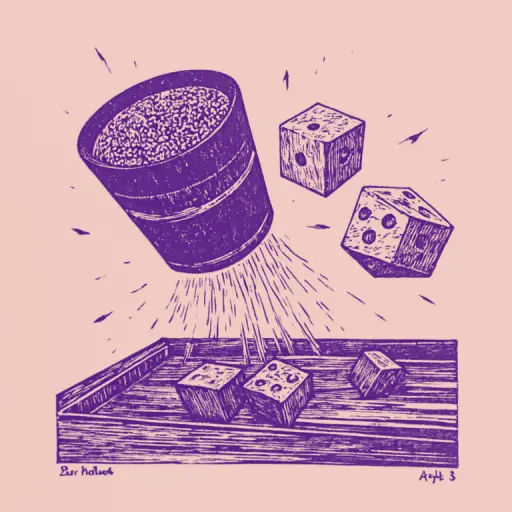
The most important element of a fair game is the dice cup. It is used to carefully mix the Zari before the throw. Using the cup completely excludes the controlled throwing of the dice (if an unscrupulous active player tries to throw a desired double or combination by hand) and guarantees the absolute randomness of the rolled values.
Technique of Correct Dice Rolling
A correct throw in Backgammon is not just a random throwing of the dice, but a strictly regulated action that influences the dynamics and fairness of the game. Learning the basic technique helps avoid points of contention on the board and ensures that every result is accepted by the opponent without unnecessary questions.
In this section, we examine the most important mechanical aspects of dice rolling: we determine the exact trajectory of the Zari and clarify why the classic hand throw is gradually being replaced by the use of a special cup.
Where and How to Correctly Throw the Zari onto the Board
According to the rules, the throw must be executed strictly onto the right half of the board from the throwing player's perspective. This is a fundamental requirement in Backgammon that helps avoid confusion and accidental displacement of the opponent's game pieces.
The main rules for a correct throw:
- Height and Trajectory: The Zari must be thrown so that they fly and roll freely, and not simply slide onto the field from the fingers.
- Impact on the Edge: Good manners and a rule in many tournaments is for the dice to hit the opposite board edge or the central dividing wall (Bar). This guarantees the randomness of the rolled value.
- Clean Landing: Both dice must come to a complete stop on the flat surface of your half of the board.
Hand Throw vs. Throw with a Cup
In amateur games, players often throw the Zari directly from their hand. However, this method allows room for manipulation: an experienced player can carefully "drop" the dice to control the trajectory.
This is why the use of the dice cup is mandatory in sporting Backgammon and in the rules of good manners. It guarantees the fairness of the game:
- Randomness: The Zari are carefully mixed in the cup, thus excluding the human factor.
- Protection against cheating: It is impossible to predict or manipulate the rolled number.
For a correct throw, place the dice in the cup, shake it at least three times, and gently throw the Zari onto your half of the board.
Resolving Disputes During Throwing
Even with perfect technique and the use of a special cup, the game dice do not always land perfectly. In the heat of an exciting game, the Zari may bounce off the board edge, get stuck between game pieces, or stand slanted. Such moments are often the cause of heated disputes between opponents.
To ensure the game is only a source of joy, there are clear rules in Backgammon for interpreting all ambiguous throws. Let's examine the most important disputes and find out in which cases the result is recognized as legitimate and when the dice must be thrown again.
What to Do If the Die is Slanted (Slanted Throw or Lands on a Game Piece)
In Backgammon, there is a strict rule: for a throw to be recognized as valid, both dice (Zari) must lie absolutely straight on the playing surface of the board.
The situation where a die is slanted is called a "slanted throw." This occurs if a Zari:
- Lies slanted and rests against the board edge;
- Falls onto a game piece from above (even if it is lying horizontally);
- Gets stuck between game pieces or at the boundary of the board halves.
In all these cases, the throw is considered invalid. The player is obliged to pick up both dice and throw them again. It is strictly forbidden to determine the value "from gut feeling" or to throw only one die again.
Cases Where the Throw is Invalid and a Re-throw is Required
In addition to the slanted throw, the game rules also stipulate other situations in which the dice throw is considered invalid and both dice must be re-rolled:
- Throwing off the board edge: If at least one game die leaves the playing surface (onto the table or the floor), the result is annulled.
- Premature throw: If the active player throws the dice before the opponent has finished their turn and removed their dice from the board.
- Interference with movement: If someone from the players or spectators accidentally touches the dice before they have come to a complete stop.
In all these situations, the player is obliged to pick up both dice and roll again.
Etiquette and Fair Play in Backgammon
The ability to correctly resolve technical disputes is only half the battle. In Backgammon, like a game with a deep history, respect for the opponent is valued as much as tactical skill.
Adhering to the unwritten rules and the etiquette of throwing the dice helps maintain a friendly atmosphere at the board and eliminates any suspicion of manipulation with the dice.
How to Avoid Accusations of Unfair Play and Dice Manipulation
To avoid accusations of manipulating the dice, follow simple rules of fair play:
- Use the dice cup. This completely excludes the controlled "hand throw," where a desired double throw could theoretically be thrown.
- Shake the dice carefully. Before throwing the dice, shake the cup in your hand at least three times.
- Ensure a free roll. The game dice must definitely bounce off the right board edge or the central dividing wall (Bar).
- Do not touch the dice before the end of the turn. The active player may only remove the dice from the field after they have completely finished moving the game pieces. Prematurely putting the dice into the cup is often interpreted as an attempt to cover up a mistake.
Behavior During the Opponent's Throw: What Not to Do
Respect for the opponent is the foundation of Backgammon etiquette. During the opponent's turn, it is important to remain calm and not to disturb the throw.
What is strictly forbidden:
- Touching the dice and game pieces. Do not touch the dice or move your pieces while the opponent has not finished their turn and removed their dice from the board.
- Obstructing the line of sight. Do not hold your hands over the playing surface or cover the throwing area.
- Distracting the opponent. Avoid sudden movements, do not shake your cup in advance, and do not comment on possible outcomes before the dice have come to rest.
Adhering to these simple rules preserves the friendly atmosphere and prevents any conflicts at the board.
Conclusion
Adhering to the dice throwing and game etiquette rules in Backgammon is not just a tribute to tradition, but the foundation for a fair and conflict-free game. Using the dice cup, carefully rolling the dice onto your half of the board, and respecting the opponent during their turn help avoid disputes and mutual accusations of manipulation.
By mastering these uncomplicated technical details, you can concentrate fully on tactics and strategy. May every one of your throws bring the desired doubles and bring only joy and fair sporting excitement to the game!