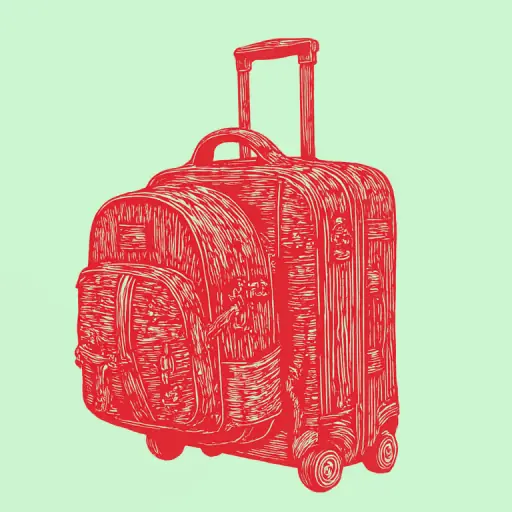
How to Secure a Backpack to a Suitcase Reliably: Detailed Travel Guide
- 14 min read
- 60
Modern travel pace demands maximum mobility from us. Often, we take two basic luggage items on a trip: a spacious wheeled suitcase and a backpack used as carry-on baggage. However, navigating a crowded airport, train station, or city streets while holding the suitcase with one hand and feeling the weight of the backpack on your shoulders is hardly a pleasant experience.
Properly securing a backpack to a suitcase solves several critically important tasks:
- Reducing physical strain: Transferring the backpack's weight to the suitcase's wheel base completely unloads the back and shoulders, preventing fatigue during the journey.
- Freedom of movement: Your hands remain free for documents, tickets, your phone, or a cup of coffee.
- Item security: A securely fastened backpack will not slip onto the dirty floor during a sharp turn and will not become easy prey for pickpockets.
- Maneuverability: The paired luggage transforms into a single, stable unit that is easy to control even in a dense crowd.
In this guide, we will thoroughly examine proven fastening methods that will help make your trip as comfortable and safe as possible.
Luggage Preparation and Weight Distribution Rules
Before securing the backpack to the suitcase's telescopic handle, both bags must be prepared correctly. The reliability of the entire structure in motion depends not only on the strength of the straps but also on simple laws of physics. If this stage is ignored, even the most reliable fastening will not save the suitcase from constant tipping, and the extension mechanism from deformation during a rush to board.
Smart luggage preparation is always a balance between dimensional compatibility and correct center of gravity distribution. Before setting off, it is important to assess the technical capabilities of your travel accessories and correctly distribute the internal weight to turn two different bags into a stable and obedient single system.
Assessing Suitcase and Backpack Compatibility Before Travel
For the luggage tandem of a suitcase and a backpack to work as a single unit, it is important to check their physical compatibility during the packing stage. Not every pair can form a stable and safe structure in motion.
When assessing compatibility before travel, pay attention to three key factors:
- Suitcase handle type. The ideal option is a sturdy P-shaped (double) telescopic handle. With single (mono) handles, the backpack will constantly spin and slip sideways.
- Top surface shape. The top of the suitcase must be as flat as possible. If the body has a significant curve or decorative protrusions, the backpack will lack a reliable point of support.
- Dimensional ratio. The backpack should not overhang the suitcase boundaries in width. Otherwise, the structure will lose balance, and you will constantly bump into corners and passersby in narrow passages.
- Backpack back panel construction. Check if it has a built-in luggage sleeve. If it doesn't, ensure that the straps can be adjusted and tightened to firmly secure the backpack to the handle.
By performing this simple test at home, you will immediately know whether you need additional straps for fastening or if the luggage is ready for a joint trip.
What Weight Distribution is Considered Safe for the Telescopic Handle
The suitcase's telescopic handle is the most vulnerable element of the entire structure. It is designed to guide and roll the suitcase, not to serve as a load-bearing support for heavy cargo.
To prevent bending or breaking the extension mechanism, observe the key rules for weight distribution:
- Load limit: The maximum safe weight of a backpack secured to the handle is 5–7 kg for high-quality branded suitcases and no more than 3–4 kg for budget models.
- Center of gravity shift: It must be located as low as possible and as close to the suitcase body as possible. Place the heaviest items in the backpack (laptop, chargers, books) against its back wall—the one that will press tightly against the telescopic tubes.
- Side balance: The backpack must not weigh more on one side or lean backward. Any tilt creates critical bending stress on the aluminum guides, which will eventually lead to them jamming.
If your backpack weighs more than 8–10 kg, refrain from securing it to the handle while moving over uneven surfaces (cobblestones, thresholds) to avoid immediate failure of the plastic fasteners.
Proper Packing: Heavy Down, Light Up
Correct weight distribution inside both bags is the key to ensuring your travel setup does not tip over at the first turn in the airport. The main principle here is simple: heavy down, light up.
When packing the suitcase, place the heaviest items (shoes, heavy equipment, dense organizers) at the very bottom—closest to the wheels. This shifts the center of gravity downward and makes the suitcase maximally stable.
In the backpack, which will be secured on top of the handle, distribute the weight according to a similar scheme:
- Heavy items (laptop, power banks, books) should be placed at the bottom of the backpack and strictly along its back panel, which will press tightly against the telescopic handle. This minimizes the lever effect and reduces the load on the extension mechanism.
- Light and bulky items (clothing, travel pillow) should be placed in the upper and outer sections.
- Quick access: Place items needed for quick retrieval during security checks (documents, small electronics) on the very top of the backpack.
This "Tetris" arrangement guarantees that the paired luggage maintains perfect balance, allowing you to roll it without unnecessary effort.
Step-by-Step Methods for Securing a Backpack to a Suitcase Handle
Once the luggage is packed correctly and the center of gravity is shifted downward, it is time to unite the suitcase and backpack into a single, easy-to-transport system. There are several proven fastening methods that will save you from constantly holding up a slipping bag while walking.
Depending on the construction of your backpack and the availability of extra accessories, you can use both professional solutions and simple travel hacks. Below, we will detail three main scenarios: from the simplest and most aesthetic use of a built-in attachment to the application of special straps and makeshift tools that will save you in an emergency.
Using the Built-in Luggage Sleeve (Smart Sleeve)
Using a built-in luggage sleeve (or Smart Sleeve) is the simplest, most aesthetic, and most reliable way to secure a backpack to a suitcase. A special fabric strip or through-pocket on the backpack's back panel is designed precisely for this purpose.
Step-by-step fastening algorithm:
- Extend the handle: Fully extend the suitcase's telescopic handle and lock it in the upper position.
- Place the backpack: Turn the backpack so its back panel faces the handle and carefully slide the luggage sleeve onto the metal guides.
- Lower it down: Slide the backpack down until it hits the stop, ensuring its bottom rests firmly on the top lid of the suitcase.
Advantages of this method:
- Stability: The backpack will not slip sideways during sharp turns or movement on uneven airport tiles.
- Quick Access: You can easily remove the backpack at security by simply pulling it up.
- Aesthetics: No extra straps or dangling cords—the design looks neat.
When buying a travel backpack, always pay attention to the presence of this feature. It turns baggage handling during a trip into a light stroll, completely freeing up your hands.
Securing with Special Straps and Elastic Ties
If your backpack does not have a built-in luggage sleeve, this is no reason to forgo comfort while traveling. Special accessories, available at any travel store, can help secure it reliably.
The two most popular solutions are:
- Elastic Bungee Strap (Bag Bungee): This is a double rubber cord with a leather or plastic divider. The bottom loop is placed over the suitcase's retractable handle, then you place the backpack, pull the cord over it, and secure the top loop to the handle. This creates constant tension that holds the backpack even during sharp turns.
- Adjustable Strap with Buckle Fastener: A sturdy nylon strap that literally "fastens" the backpack to the telescopic guides.
Step-by-Step Fastening Algorithm:
- Place the suitcase vertically and fully extend the telescopic handle.
- Set the backpack on the suitcase lid, back facing the handle.
- Thread the strap through the backpack's top carrying loop—this prevents it from sliding down.
- Wrap the strap around the suitcase's extended metal tubes and tighten the fastener fully.
This method guarantees that the paired luggage will not fall apart while moving, and the load on the retractable handle will be distributed evenly.
Life Hacks: How to Secure a Backpack with Household Items Without Special Fasteners
If you don't have a special luggage strap or a built-in sleeve handy, you can secure the backpack to the luggage using ordinary items that are always available during a trip. These travel hacks will help you quickly combine the two bags into one stable structure and free up your hands.
- Using Your Own Backpack Straps. Shorten the shoulder straps of your backpack as much as possible. Cross them over the suitcase's extended telescopic handle. If the backpack has a chest or waist stabilizer, fasten it around the handle—this prevents the backpack from tilting sideways during sharp turns.
- A Regular Belt. Thread a leather or textile belt through the backpack's top loop and tighten it firmly around the suitcase's extended metal guides. This securely presses the backpack against the body and prevents it from slipping.
- A Travel Carabiner. Clip the backpack's top loop to the base of the suitcase's extended handle. To prevent the bottom of the backpack from swinging while moving, tightly wrap its loose straps around the telescopic tubes.
These simple tricks will help you securely attach the backpack to the suitcase, ensuring comfortable baggage transport in any unforeseen situation.
Safety in Motion and Damage Protection
Securely fastening a backpack to a suitcase is only half the battle. When you step out into a crowded airport terminal or a busy street, the paired structure of your luggage begins to face serious tests of strength and safety. While moving, it is critically important not only to maintain balance but also to protect the fragile elements of travel accessories from premature wear.
Furthermore, combined luggage often becomes a target for pickpockets, as the traveler's attention is divided between the journey, documents, and smartphones. To prevent your trip from being marred by a broken telescopic handle or the loss of valuables, you must observe basic road safety rules and avoid typical mistakes when transporting such a "linkage."
How Not to Damage the Telescopic Handle Mechanism
The suitcase's telescopic handle is one of the most vulnerable elements of travel luggage. It is designed to guide and roll the suitcase, not to serve as a load-bearing support for a heavy backpack. To avoid breaking the mechanism in the middle of a trip, observe these key load distribution rules:
- Rest, Don't Hang. The main secret to safety is that the backpack must stand completely on its bottom on the suitcase's top panel. The extended handle only acts as a stabilizer against falling sideways; it should not bear vertical weight. If the backpack hangs from the handle "in the air," the metal tubes will deform at the first bump.
- Observe the Weight Limit. The safe limit for additional load on the extended tubes is 3–5 kg. If your backpack is heavier, you can only transport it in a paired configuration on a perfectly flat terminal floor.
- Do Not Lift the Structure by the Telescopic Handle. Before a curb, escalator, or stairs, always hold onto the main handle integrated into the suitcase body. Lifting the paired luggage by the extended tubes will guaranteed lead to their bending or the breaking of the fasteners.
- Choose Double Tubes. Suitcases with a single monopod handle are absolutely unsuitable for attaching backpacks—they instantly twist and break under load. Use only P-shaped extended handles.
Careful handling of the extended mechanism will save you from unnecessary expenses and maintain the luggage's maneuverability throughout the journey.
Pickpocket Protection: How to Position the Backpack to Safeguard Valuables
When the backpack is secured to the suitcase, it often ends up out of your direct line of sight—behind you or to the side while you are rolling the luggage. This makes it an easy target for pickpockets in crowded places: airports, train stations, and public transport. To protect your valuables, follow simple rules for their placement and fastening.
- Turn the Backpack "Face" to the Handle. When attaching the backpack to the telescopic handle, always turn it so that the main zippers and external pockets face you (into the structure), not outward. The backpack's back should face the outside. This makes it physically difficult for an intruder to discreetly unzip the bag.
- Use Hidden Pockets. Place documents, money, and gadgets only in the pockets on the backpack's back (which are tightly pressed against the suitcase when secured) or in the internal zippered compartments. Never leave valuables in external, easily accessible compartments.
- Lock the Zippers. Connect the zipper sliders to each other using small carabiners, TSA combination locks, or even ordinary paper clips. This prevents the bag from being quickly and silently opened while in transit.
- Protective Cover as a Barrier. In a dense crowd, put a dirt- and water-resistant cover over the backpack. It will not only protect the fabric but also create an additional obstacle for pickpockets by completely covering access to the zippers.
For maximum security, keep your most important documents and money with you—in a money belt or an inner pocket of your clothing—and use the paired luggage for less valuable items.
Common Mistakes When Transporting Paired Luggage at the Airport
Transporting paired luggage significantly eases transit through airport terminals, but haste and inattention often lead to annoying mishaps. To avoid damage and delays, pay attention to common traveler mistakes:
- Loose straps and belts. Before rolling the unit, be sure to tuck away all dangling backpack straps, tie-downs, and cords. They can easily snag on escalator railings, baggage belts, or suitcase wheels, leading to luggage falling or injury.
- Attempting to pass security as a "single unit." At the aviation security checkpoint, you will have to separate your items regardless. Trying to push the entire paired unit through the X-ray belt is a common mistake. Separate the backpack and suitcase in line beforehand to avoid creating a rush and to prevent damaging the telescopic handle during a sudden lift.
- Ignoring seams and floor coverings. Airport flooring often changes: from smooth tiles to dense carpet or metal seams at temperature joints. Suddenly hitting an obstacle at high speed creates a strong tipping moment. At this point, all the load falls onto the telescopic handle, which can bend or break.
- Leaving valuables in sight. When the backpack is attached to the suitcase, it is often out of your direct line of sight. The backpack's external pockets become an easy target for pickpockets in check-in or boarding lines. Move documents, money, and electronics to the inner compartments.
Conclusion: Checklist for Quick and Secure Travel Assembly
To attach the backpack to the suitcase quickly and without unnecessary fuss right before leaving home or in the airport terminal, use this practical step-by-step checklist. It will help ensure that your paired luggage is fully ready for any travel challenges, and your hands remain completely free for documents, tickets, or a cup of coffee.
Secure Luggage Attachment Checklist Before Leaving:
- Weight Balance: All the heaviest items (shoes, books, toiletry bag) are placed at the bottom of the suitcase. The backpack remains relatively light and weighs no more than 10–15% of the suitcase's total mass, which prevents the entire unit from accidentally tipping over.
- Telescopic Handle Check: The extension mechanism is fully extended and securely locked in place. The guides are dry, clean, and have no critical play.
- Secure Fastening: If an integrated luggage sleeve (Smart Sleeve) is available, the backpack is neatly placed onto the suitcase handle to the end. When using extra accessories, the fastening strap or elastic tie-down tightly wraps around the backpack body and is securely fastened around the metal handle guides.
- Theft Protection: All backpack zippers and external pockets are tightly closed. The backpack itself is oriented with its back facing out (or pockets flush against the suitcase handle) to prevent quick access by pickpockets to your belongings. Valuable gadgets and documents are stored in the inner compartments.
- Dimension Control: The backpack sits evenly in the center, does not hang off the sides, and does not block the free rotation of the suitcase wheels.
- Final Test Drive: Roll the suitcase a few meters in the room, make a sharp 360-degree turn, and tilt it slightly. If the unit maintains stability, does not wobble, and does not tip sideways—you are fully ready for a comfortable trip!
This simple check takes literally two minutes, but it guarantees you maximum comfort on the road, protects your luggage from accidental falls, and preserves the suitcase's extension mechanism from premature failure. Have a pleasant and safe journey!