How to Set a Table Beautifully and Correctly for Guests?
- 16 min read
- 82
A beautiful table setting is not just adherence to strict etiquette rules, but a true art of hospitality and a way to express care for loved ones. An aesthetically arranged dining area instantly transforms the atmosphere in a home, turning even the simplest dinner into a festive event.
Many believe that arranging dishes correctly and using exquisite decor requires huge expenses and professional skills. In reality, creating a harmonious composition is within everyone's reach. To do this, you just need to know the basic principles: how a tablecloth harmonizes with tableware, in what order to arrange cutlery, and how to use festive decor to create focal points.
In this practical guide, we will step-by-step break down all the subtleties of decoration: from choosing textiles to original life hacks for small spaces. You will learn how to make your table impeccable without unnecessary expense or fuss.
Preparing the Base: Choosing Tablecloths and Alternative Coverings
After realizing that table setting is not just about placing dishes, but a true art of hospitality, we must start with the foundation. The base upon which all the beauty will rest is the table covering. The choice of tablecloth, runner, or alternative covering sets the overall tone and style of the entire feast. This element determines how festive, cozy, or relaxed your celebration will feel. Therefore, this stage requires attention and an understanding of how to choose textiles that harmonize with the interior and the chosen decor.
Traditional Tablecloth or Runner: Textile Selection Rules
The choice of textile sets the tone for the entire table setting. A classic tablecloth is a foolproof option for formal occasions. According to etiquette rules, it should hang 20–30 cm down from all sides of the table. A cloth that is too short looks messy, and one that is too long will get in the way of guests.
For a formal dinner, white or cream linen is ideal, while practical blended fabrics are suitable for informal gatherings.
A table runner (or table scarf) is a modern alternative that allows you to highlight the beautiful texture of a wooden or stone tabletop. It can be laid down the center of the table to define a decorative line or across it, uniting the guests seated opposite each other.
To create a deep, festive look, use layering: lay a neutral tablecloth as a base, and then place a contrasting runner on top. This visually highlights the central composition and protects the main covering.
Alternatives to a Tablecloth: Using Placemats and Napkin Sets
If you want to highlight the beautiful texture of a wooden or stone tabletop, you can confidently replace a classic tablecloth with placemats or napkin sets. This is a modern and practical solution that works well for both everyday family dinners and casual friends' get-togethers.
When choosing alternative coverings, focus on the material and shape:
- Textile sets made of dense linen or cotton will add coziness. They require care but look very aesthetic.
- Woven placemats made of jute or rattan are ideal for creating a rustic, eco, or Scandinavian style.
- Leather and vinyl mats are the most practical option for a minimalist interior.
The main rule of setting the table: an individual placemat must fully accommodate the personal set of dishes and cutlery for one guest (optimal size is 30x40 cm). Place the sets 1–2 cm away from the edge of the table, directly opposite each seating position, to maintain visual symmetry.
Classic Dish and Cutlery Arrangement According to Etiquette Rules
Once the textile base of the table is ready, the most responsible stage begins—arranging the dishes and cutlery. Classic table etiquette often seems like a complex set of strict rules, but in practice, it follows simple logic and care for guest comfort. The correct placement of each element helps avoid fuss during course changes and sets the tone for the entire evening.
You will not have to memorize complex diagrams for royal receptions. It is enough to master the basic order of placing plates, forks, knives, and glasses, which can be easily adapted for both a formal dinner and a cozy family lunch. Let's break down step-by-step how to create an impeccable composition where every item has its strictly assigned place.
How to Properly Arrange Plates of Different Purposes
The foundation of a classic setting is always the charger plate (service plate). It serves as a base, protects the tablecloth, and designates the guest's personal space. It is placed directly in front of each chair, set back from the edge of the table by about 1.5–2 cm.
On the charger plate, you place the dishes for the current courses in the order they are served:
- Appetizer plate — used for cold and hot appetizers, salads.
- Deep plate or soup bowl — placed on top of the appetizer plate if the meal starts with a first course. For cream soups and broths, it is better to use special bowls with handles.
To the left of the main plate, slightly higher diagonally (at the 10 o'clock position), is a small bread plate for bread, croutons, and butter.
Golden rule of etiquette: never stack more than three plates simultaneously to keep the composition stable and neat.
Diagram for Arranging Cutlery and Glasses
The placement of cutlery and glasses follows the golden rule of etiquette: they are used in the direction "from the outer edge toward the plate" as courses change.
Cutlery:
- To the right of the plate: Knives and spoons are placed. Knives are always placed with the blade facing the plate. The outermost right item is the appetizer knife, followed by the soup spoon (if soup is on the menu), and closest to the plate is the dinner knife.
- To the left of the plate: This is the place for forks, which are placed tines up. The outermost fork is the appetizer fork, and closer to the dish is the dinner fork.
- Above the plate: Dessert cutlery is laid out horizontally. The tea or dessert spoon is placed handle to the right, and the dessert fork handle to the left.
Glasses and Goblets:
They are arranged in the upper right corner, oriented toward the tip of the dinner knife. Drinkware is placed diagonally or in an arc according to the order of service: the water glass is placed closest to the guest, followed by the red wine glass, then the white wine glass, and the line is completed by the champagne flute.
Decorative Arrangement and Centerpiece
After we have covered the ideal scheme for arranging plates, cutlery, and glasses, the final, yet equally important, stage remains—creating the atmosphere. A properly set table is not just about observing etiquette, but a true work of art. Decor and the centerpiece play a key role in creating the mood, transforming an ordinary meal into a memorable event. Here, the balance between classic elegance and a personal, cozy touch is important.
Even the most impeccably arranged cutlery will look perfect if surrounded by thoughtful decor. We will show you how to use textiles, candles, and floral arrangements to make the table look not just beautiful, but truly festive and soulful. This is the art of combining color, texture, and light.
How to fold fabric and paper napkins originally
Napkins are not just a decorative element, but a key accent that can set the tone for the entire festive table. They can be used as a functional element (to protect from splashes) or purely for decoration. The choice of material (linen, cotton, kraft paper) and color must harmonize with the overall serving style and the color palette of the dishes.
Ideas for fabric napkins (elegant and classic style):
- Simple "wave" fold: The most universal and sophisticated method. Simply fold the napkin into several casual yet neat "waves" and place it on the plate. This adds lightness and volume.
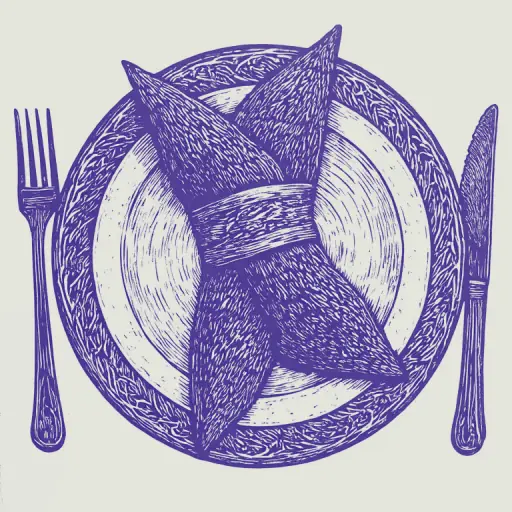
- Using a ring: If you have decorative napkin rings, use them. Wrap the napkin with the ring, and then you can add a small decorative element on top (such as an eucalyptus branch or a berry).
- "Flower" shape: For a more formal dinner, fold the napkin into a semi-circle or petal shape, imitating a flower. This looks very ceremonial.
Options for paper napkins (practical and creative):
Paper napkins are ideal for informal gatherings, picnics, or when you need to quickly decorate the table. They can be used to create "mini-bouquets" or to imitate textiles.
- Napkin "bouquet": Fold several identical square napkins into a "bud" shape and tie them with twine or a thin ribbon. This looks very striking and budget-friendly.
- Geometric folds: If the napkin is large enough, you can fold it into a cube or a triangle to give it a sharp, modern shape.
Combination tip: To make the look complete, always complement the napkin with natural elements: fresh greenery (rosemary, thyme), berries, or small branches. This adds texture and freshness, making the setting "alive" and memorable.
What to put in the center of the table to create a cozy atmosphere
The centerpiece is not just a vase of flowers; it is the decorative "anchor" that draws the eye and sets the overall mood for the table. The main principle: the decor should complement, not overpower, the food and conversation. To make the composition look expensive and thoughtful, follow several rules.
1. Balance and height:
- Do not overload: A few small but striking elements are better than one massive bouquet that might block views or impede movement. Use different levels (tall vases, low stands, candles) to create visual volume.
- Consider the scale: The composition must match the size of the table. For a long, narrow table, linear, elongated elements work best (such as candles or eucalyptus branches), while for a round table, more symmetrical, round accents are better.
- Light is your friend: Include candles in the decor. The warm, flickering light from candles instantly adds coziness and solemnity, making any gathering special.
2. Element selection:
- Color: Choose a color palette that harmonizes with the textiles (tablecloth, napkins) and the dishes. If the textiles are neutral (white, beige), feel free to use bright accents in flowers or berries.
- Nature and seasonality: The simplest and always successful option is to use seasonal elements. In autumn, this might be pumpkins, chestnuts, and dried flowers; in spring, budding branches and pastel flowers; in winter, pinecones and berries.
- Not just flowers: A centerpiece can be created from household items: for example, from beautiful candles in unusual holders, tinsel, decorative candles, or even a stack of books decorated with flowers.
Life hack: If you are unsure of your floristry skills, buy a ready-made arrangement, but be sure to add something of your own to it—such as a few candles or a small vase with branches—to make it look unique and "homemade."
Life hacks for beautiful serving in limited space
We have covered all stages of perfect serving: from choosing a tablecloth and arranging cutlery according to etiquette to creating an impressive centerpiece. But what if you don't have a huge banquet hall, but only a cozy, small kitchen? Don't think that limited space is a sentence for a beautiful table. In fact, even in the most compact dining area, you can create a festive atmosphere by using tricks and correct design techniques.
In this section, we have gathered practical life hacks that will help you use every centimeter of space as effectively as possible. We will show you how to visually expand the table, how to organize the serving of dishes so they look impressive, and how to give even a modest kitchen the look of an expensive restaurant.
Ideas for beautifully decorating a table in a small kitchen
Limited kitchen space is no reason to forgo aesthetics. To set a small table beautifully, use several simple tricks:
- Miniature textiles. Instead of a classic tablecloth, which visually weighs down a small room, choose a narrow runner along the table or concise placemats. They will neatly define the guests' personal zones.
- Optimizing dish size. Replace massive charger plates with neat, medium-sized alternatives. Use universal glasses suitable for both water and wine to avoid cluttering the table with glassware.
- Clearing the countertop. Utilize the windowsill or a mobile serving cart. Move pitchers of drinks, spices, and the bread basket there.
- Micro-decor. Instead of a lush bouquet, place one elegant candle or a thin vase with a single flower in the center of the table. This creates coziness without the feeling of confinement.
Vertical serving and using multi-level stands
When there isn't enough space on the table, don't sacrifice beauty. The solution is to use vertical space. This is not only a practical but also a very effective trick that instantly transforms the setting.
How it works?
Instead of arranging all dishes and decor in a single line, we use multi-level stands, trays, and candle holders of different heights. This creates an effect of "visual volume," making the table look richer and more abundant, even if it is small.
- Tiered Trays: Ideal for breakfasts, receptions, or dessert tables. You can place pastries on one level, fruits on the middle, and small snacks or sweets on the top. This looks very striking and saves space.
- Chafing Dishes: If you are serving several types of hot appetizers, use chafing dishes of different heights. This will not only maintain the temperature but also add dynamism to the composition.
- Decor Wall: If the table is very narrow, you can create a "wall" of decorative elements—vases, candles, small flower vases. Place them not strictly in the center, but along one side to visually expand the space.
Decor Tip: To prevent the composition from looking chaotic, always follow the "rule of three": use items that differ in height, size, and color. This will give the setting a professional and harmonious look.
Budget DIY Decor and Common Mistakes Analysis
We have covered all stages of creating the perfect atmosphere: from choosing textiles and arranging cutlery to creating a lush centerpiece and tips for small spaces. But what if you want the table to look festive, but your budget is very limited? Perfect table settings don't have to cost a fortune. The main thing is attention to detail and the ability to see beauty in ordinary things.
In this section, we will learn how to transform the dining area using household items and, just as importantly, we will analyze the most common mistakes that can spoil even the most beautiful arrangement. Remember: a perfect table is not just about expensive accessories, but about impeccable taste and order.
How to Decorate a Table Quickly and Inexpensively with Household Items
Beautiful table decoration does not require large expenses. Creating a festive atmosphere is easy with simple things found in every home:
- Natural Materials. Rosemary sprigs, seasonal flowers, pinecones, or bright autumn leaves will add a lively aesthetic to the table. They can be laid along the center of the table.
- Fruit Decor. Whole lemons, green apples, or mandarins in a clear vase instantly brighten the setting and fill the room with a delicate aroma.
- Glass Candles. Ordinary tea lights in sleek glasses with water and a sprig of greenery at the bottom will create a magical shimmer.
- Twine and Greenery. Tie fabric or paper napkins with simple jute twine, securing a sprig of fir, lavender, or eucalyptus underneath. This looks stylish and eco-friendly.
Main Mistakes When Preparing a Table for Guests
Ignorance of serving rules is the most common and easily correctable mistake. Don't think that it will turn out perfectly "by eye." Remember that every detail on the table must contribute to the overall picture, creating a sense of harmony and thoughtfulness.
Main mistakes to avoid:
- Clutter in Cutlery Placement: The most common mistake is mixing up utensils or placing them randomly. Always adhere to the principle of symmetry and logic: fork on the left, knife on the right, utensils as needed (e.g., for dessert or soup). If you are unsure what to do with a utensil, it is better not to place it.
- Mismatched Textiles and Dishes: Not all colors and textures go together. If you have chosen bright, thematic decor, the dishes should be neutral so as not to overload the look. Conversely, if the dishes are very bright, the decor should be minimalistic.
- Ignoring Cleanliness: Even the most beautiful decor cannot save the day if the dishes have stains or the tablecloth has creases. All items must be perfectly clean and polished. This is a basic rule of etiquette that cannot be broken.
- Overloading the Centerpiece: The table should not look like a display of decorative exhibits. The centerpiece should be an accent, not an obstacle. Leave enough space for placing dishes and for guests to comfortably rest their elbows.
- Lack of "Air": Too dense a arrangement of elements creates a feeling of tightness and disorder. Leave small but noticeable gaps between groups of cutlery and dishes. This will give the setting lightness and sophistication.
Conclusion
Table preparation is not just a duty; it is a true art of hospitality. Remember that your setting should tell a story: a story of your taste, care, and attention to detail. The main thing to take away from this entire process is the balance between impeccable adherence to etiquette rules and personal creative approach.
Key takeaways for perfect setting:
- Individuality over Perfection: Don't be afraid to deviate from strict rules if it matches the style of your home or the theme of the celebration. The main thing is that the table looks harmonious and cozy, not just "correct" according to a textbook.
- Focus on Atmosphere: Perfect cutlery and tablecloths alone will not create a mood. Use candles, fresh flowers, thematic decorative elements to create an emotional background. Decor should complement, not overshadow, the dishes.
- Simplicity is a Mark of Mastery: Sometimes the most elegant setting is one where the purity of lines, perfect order, and minimum excess details prevail. Do not overload the table so that it does not look chaotic.
- Caring for Guests: Remember that setting the table is primarily about comfort and pleasure for those who will be at the table. Ensure that all elements (from the convenience of cutlery placement to soft lighting) contribute to relaxation and pleasant conversation.
Next time you prepare a table, view it not as a set of rules, but as an opportunity to create a small, yet perfect event for yourself and your loved ones. May your table become a center of warmth and joy!