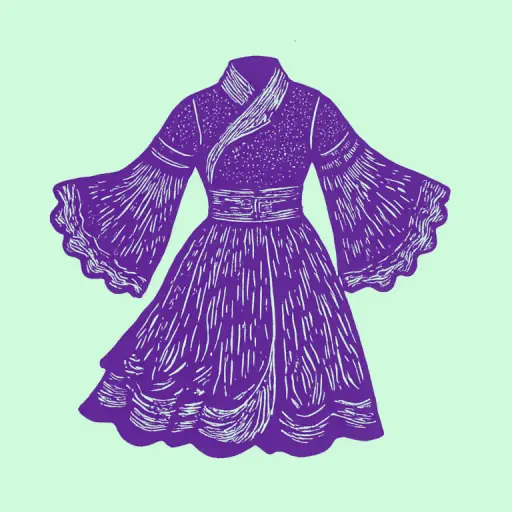
How to Sew a Traditional Chinese Hanfu Dress for a Doll: Detailed Instructions with Pattern
- 15 min read
- 63
The traditional Chinese Hanfu is the embodiment of elegance, layering, and deep cultural heritage. Today, Eastern aesthetics are experiencing an incredible peak in popularity, and creating a miniature replica of this historical attire is a true challenge and pleasure for any artisan. Sewing a doll Hanfu by hand not only allows you to add a unique piece to a doll's wardrobe but also lets you touch ancient tailoring art.
In this practical guide, we will thoroughly examine how to create an exquisite traditional Chinese dress for dolls of various sizes—from classic Barbie to articulated BJD and charismatic Blythe. A step-by-step master class on sewing, tips on choosing fabric for doll clothing, and a ready-made Hanfu pattern for a doll that can be easily adapted to any parameters await you. You will learn the secrets to creating the correct silhouette, constructing the traditional belt, and the subtleties of miniature decoration.
Preparation for Work: Choosing Materials and Tools for Doll Hanfu
Creating a miniature Hanfu is a captivating process that requires not only patience but also proper preparation. Unlike sewing clothing for people, the doll scale dictates its own strict rules. For the finished dress to drape gracefully, fit the doll's figure elegantly, and not look bulky, it is crucial to pay attention to selecting textiles and accessories.
Every detail of the traditional Chinese attire—from the flowing sleeves to the layered skirt—depends on the plasticity of the chosen material. Before starting the cutting, we will review which fabrics will help recreate historical authenticity in miniature, and we will prepare a special set of tools that will facilitate working with small details.
Which Fabric to Choose for Miniature Chinese-Style Clothing
Choosing the fabric for a doll Hanfu is a critically important stage. The main mistake of beginners is buying dense curtain silk or heavy brocade. On a miniature doll figure (especially 1/6 scale, such as Barbie or Monster High), such materials will stand stiffly, depriving the outfit of historical lightness and elegance.
To create a harmonious doll look, choose thin, pliable, and well-draping fabrics:
- Natural or artificial silk (habotai, crepe de chine, chiffon): perfectly conveys the flowing texture of traditional Chinese garments.
- Thin batiste or cotton muslin: is excellent for the underlayers of the Hanfu, as it does not create unnecessary volume around the doll's waist.
- Thin viscose: is a manageable material with a beautiful soft sheen and pliable folds.
- Microbrocade or silk with a fine jacquard pattern: use sparingly, only for trimming the collar, cuffs, or belt.
Master's Tip: Before cutting, be sure to check the fabric for fraying. For miniature details, it is better to choose materials whose edges can be neatly treated with a thin layer of textile glue or slightly melted over a candle (if synthetic fibers are present).
Necessary Tools and Accessories for Sewing
To work with thin, slippery fabrics and miniature details of a doll Hanfu, you will need a special set of tools. Ordinary sewing supplies can damage delicate silk or leave rough marks on micro-patterns.
Basic Tool Set:
- Fine Needles: For machine sewing, choose Microtex needles (No. 60–70), and for hand sewing, use long beading needles. They pass easily through dense thread weaves and do not leave pulls.
- Silk Pins: Ultra-thin pins that do not deform the delicate fabric when pinning pieces.
- Scissors: Sharp tailor's shears for cutting and small snips (or nippers) for neatly trimming threads and cutting seam allowances at corners.
- Erasable Marker: A fine marker for marking, whose lines are removed with water or disappear on their own. Regular chalk is too coarse for doll scale.
Necessary Accessories:
- Thread: Thin and strong (polyester or silk No. 80–120) exactly matching the fabric color.
- Micro-buttons and Hooks: Metal attachment buttons with a diameter of 3–5 mm or miniature hooks for discreetly fastening the dress wrap.
- Adhesive Netting and Interfacing: The thinnest interfacing for backing the collar and cuffs so they hold their shape.
Constructing and Adapting the Pattern for Different Doll Types
Constructing the correct pattern is the foundation upon which the traditional Chinese robe will sit on the miniature figure. Unlike human clothing, doll proportions are often exaggerated: some models have a slender waist and long legs, while others have a large head or articulated joints requiring freedom of movement. For the doll Hanfu to look elegant and historically accurate, we need a basic scheme that we will then learn to modify.
The main secret to successful modeling lies in understanding the geometry of traditional tailoring. Hanfu is based on free lines and whole-piece sleeves, which greatly simplifies fitting, but requires precise scaling for the specific toy format.
How to Construct a Basic Hanfu Pattern for a Barbie Doll
The traditional Hanfu cut is based on a flat T-shaped pattern without shoulder seams, which greatly simplifies the construction of miniature clothing. To sew a neat Chinese costume for Barbie (standard height 29 cm), we will construct a basic pattern for a loose robe with a cross-over overlap on the right side (jiaolin yuzhen).
To work, prepare millimeter paper and refer to the following basic measurements:
| Doll Parameter | Value for Barbie (cm) | Ease Allowance (cm) |
|---|---|---|
| Garment Length (shoulder to floor) | 22–24 | — |
| Sleeve Length (neck to wrist) | 10–11 | — |
| Bust Circumference | 12.5 | + 1.5–2 |
Step-by-Step Construction Algorithm:
- Pattern Grid: Fold the sheet of paper in half. The crease will serve as the center back. From the top point of the crease, measure down the length of the dress.
- Shoulder and Sleeve Line: From the top point, measure perpendicular to the crease for the sleeve length. The traditional sleeve should be wide, so allow about 4–5 cm for the cuff width.
- Designing the Overlap: The front panel (placket) is constructed similarly to the back, but with a deep V-neck cut. Extend the edge of the placket sideways by 3 cm from the center line to create a deep overlap.
- Side Seam: Draw a smooth curved line under the armpit and drop the side seam down, slightly widening the silhouette towards the hem.
When transferring the finished doll Hanfu pattern to fabric, be sure to add seam allowances of 0.5 cm on all sides.
Features of Pattern Modeling for BJD, Monster High, and Blythe Formats
Adapting the basic T-shaped pattern for dolls with non-standard proportions requires accounting for their unique anatomy:
- BJD (Ball-Jointed Dolls): They have realistic proportions but require freedom of movement in the joints. When modeling, allow for ease of movement (about 5–8 mm on the sides) so the doll can sit comfortably. Pay special attention to sleeve length, considering the joint receivers.
- Monster High: They are characterized by an extremely thin waist and long limbs. The basic pattern must be significantly tapered in the torso area while maintaining length. To prevent the dress from looking baggy, make the overlap deeper and the belt firmer.
- Blythe: Due to the large head and short neck, the standard Hanfu collar will not fit correctly. Expand the neckline on the pattern by 3–4 mm and make the front cut slightly deeper, while shortening the robe's length to suit the doll's body format.
Step-by-Step Process for Cutting and Sewing Dress Details
Once the pattern is adapted to your doll's size, the most critical stage begins—transferring the designs to the fabric and assembling the outfit. Creating a miniature Hanfu demands meticulous precision: the fine, flowing fabrics characteristic of the Chinese style behave capriciously in small details, and seam allowances are minimal here.
In this section, we will break down step-by-step how to properly prepare the elements of the layered dress to prevent fraying, and in what order to join the pieces. Careful cutting and sequential sewing will ensure that the finished Hanfu fits the doll perfectly, preserving the elegance and lightness of the traditional silhouette.
Cutting Details and Preparing the Pattern for Work
Cutting miniature Hanfu details requires jeweler-like precision, as the slightest skew will distort the doll's outfit silhouette. Before starting, be sure to steam-iron the fabric to prevent the finished dress from shrinking.
When cutting, observe these key rules:
- Grainline Direction: Place the pattern pieces strictly along the grainline. This is especially important for traditional wide sleeves so that the fabric drapes beautifully.
- Seam Allowances: For Barbie, Monster High, or BJD dolls, use minimal allowances—from 3 to 5 mm. Excess fabric inside the seams will create unnecessary bulk and ruin the fit.
- Edge Finishing: Thin silk, satin, and viscose fray heavily. Immediately after cutting, treat the edges of the pieces with a special fray-check agent or carefully melt the edges with a lighter if using synthetics.
Transfer the pattern contours onto the wrong side of the fabric using a disappearing marker. Cut the pieces only with sharp micro-scissors to avoid damaging the delicate fibers.
Step-by-Step Sewing of the Layered Chinese Dress
Assembling a layered Hanfu requires care, as the small details of doll clothing do not forgive inaccuracies. The sewing process consists of the following steps:
Sewing the Inner Dress (Yi):
- Fold the back and panel pieces with the right sides facing in and stitch the shoulder seams.
- Attach the sleeves to the open armholes.
- Sew the side seams and sleeve seams with a single stitch.
- Finish the edges of the overlap and neckline with a narrow facing.
Creating the Skirt (Qun):
- Fold uniform pleats of 3–5 mm depth (depending on the doll's format) onto the skirt panel, running from the center outward to the sides. Secure them with an iron.
- Attach the top edge of the skirt to the ribbon belt.
Sewing the Outer Open Robe:
- Repeat the assembly of the shoulder and side seams as for the inner dress.
- Pay special attention to the collar: fold the cut collar strip lengthwise, attach it to the neckline and overlap edges, forming the traditional V-cut.
Always press every seam through a damp pressing cloth—this will give the doll's outfit a factory-like neatness and a flat shape.
Creating the Traditional Doll Belt and Fastening Elements
A traditional Chinese costume cannot be imagined without a properly designed waistline. It is the wide belt that not only brings all the layers of the Hanfu together but also forms that recognizable silhouette that lends grandeur and refinement to the doll's appearance. In miniature format, this element serves another vital function—it securely holds the flowing silk fabrics, preventing the details from opening up.
To ensure the outfit fits perfectly, we need to recreate the classic belt and supplement it with hidden fastening elements. We will explore how to adapt traditional ties to suit the features of the doll's figure while preserving historical aesthetics and the neatness of the reverse side.
How to Make a Traditional Chinese Belt for a Doll's Dress Yourself
The traditional Chinese belt, yaodai, is a key element of the Hanfu, bringing the layered silhouette together and emphasizing the doll's graceful waist. For a miniature outfit, it is best to make a firm corset-style belt with long decorative ties.
Step-by-Step Process for Creating the Doll Belt:
- Cutting the Base. Cut a strip from thick silk, satin, or brocade, 4–5 cm wide (it will be 2–2.5 cm finished) and long enough to equal the doll's waist circumference plus 1 cm for allowances.
- Reinforcing the Piece. To ensure the belt holds its shape and does not gather in folds, be sure to double-layer the wrong side with thin fusible interfacing or interfacing.
- Sewing. Fold the piece lengthwise with the right sides facing in, and sew along the long side and one short side. Turn the piece right side out, carefully smooth the corners with a needle, and press. Fold the open edge inward and sew with a blind stitch.
- Adding Ties. Sew thin silk ribbons or decorative cord in a matching color to the short ends of the finished belt. Their length should allow them to wrap around the doll's waist and tie a beautiful traditional knot with hanging ends.
To add historical authenticity, the front of the belt can be decorated with a contrasting trim or a miniature pendant with a tassel and bead attached to the center.
Installing Closures and Drawstrings for Secure Outfit Fastening
For the layered Hanfu to fit the doll perfectly and not gape open, it is important to correctly place hidden closures and securing drawstrings. Traditional Chinese tailoring relies on the overlap, so the miniature outfit is secured in several stages:
- Inner Ties: Sew thin ribbons or twine from embroidery floss to the right side seam (inside) and to the edge of the left panel. These will hold the inner layer of the dress.
- Outer Drawstrings: Attach a second pair of ties to the left side seam and the edge of the right panel. For 1/6 scale dolls (Barbie), use waxed cord up to 1 mm thick.
- Micro-Buttons: Sew metal mini-buttons, 3–4 mm in diameter, at the junction of the collar stand and at the waist under the belt. These will prevent the pieces from shifting.
- Belt Attachment: Attach a thin Velcro strip or flat garment hooks to the ends of the decorative belt (yaodai). This will allow the belt to be fastened tightly around the doll's waist, avoiding excess bulk.
Decorating and Final Finishing of the Doll's Hanfu
When the foundation of the doll's Hanfu is completely ready and fits perfectly on the figure, the most captivating stage begins—artistic decoration. It is the details that transform a simple miniature dress into a true work of art, reflecting the spirit of ancient China. In traditional attire, every pattern, thread color, and hem direction held deep symbolic meaning, so one must approach the final finishing with special reverence.
Working with miniature details requires jeweler's precision. We must adapt complex historical techniques to the doll's scale so that the decoration does not weigh down the light silhouette of the garment. We will explore how to harmoniously place the finishing elements without overwhelming the look, and what techniques will give the doll's Hanfu an impeccable collector's appearance.
Secrets of Decoration: Miniature Embroidery, Trims, and Appliqué
Decorating a miniature Hanfu requires jeweler's precision, as large elements will instantly disrupt the doll's proportions. To make the garment look realistic, use proven techniques.
- Miniature Embroidery. For work, choose silk threads or single-strand embroidery floss. Traditional Chinese motifs—branches of blooming cherry blossoms, clouds, or bamboo—are best executed with simple stitches: stem stitch, satin stitch, or backstitch. To prevent the thin fabric from pulling, be sure to use water-soluble interfacing as a stabilizer.
- Fine Trims. A contrasting trim along the collar and wrap edges is the hallmark of Hanfu. For 1:6 scale dolls (Barbie), a standard bias tape is too coarse. Make the trim yourself: wrap a thin waxed cord (0.5–1 mm in diameter) with a strip of silk, pin it, and sew it into the facing seam.
- Appliqué. If hand embroidery seems too complicated, use fabric fragments with small patterns. Cut out the desired motif (flower or bird), treat the edges with textile glue to prevent fraying, secure it to the dress using adhesive netting, and carefully stitch around the contour with a hidden stitch.
Additional Traditional Accessories to Complete the Doll's Look
To make the doll's Hanfu look truly authentic and complete, supplement it with miniature traditional Chinese accessories:
- Yupei (Jade Pendant): A traditional jade amulet is easy to simulate. Take a flat bead made of green or white polymer plastic (to resemble jade), thread a thin cord through it, and attach a miniature silk tassel to the bottom. The pendant is attached to the doll's belt.
- Buyao (Hairpins): These elegant swaying hair ornaments are made from thin jewelry wire. Thread small beads, flower-shaped sequins, and metal pendants onto it. Secure the structure to a toothpick or an invisible metal base.
- Tuanshan (Round Fan): A round fan can be made from a wire frame covered with thin silk or nylon, painted with acrylic. A colored toothpick, decorated with a tiny tassel, can serve as the handle.
These small details instantly bring the doll's attire to life and lend it historical authenticity.
Conclusion
Creating a traditional Chinese outfit for a doll by hand is not just sewing; it is a true immersion into the history and culture of the East. Now that your doll's Hanfu is completely finished, decorated with miniature embroidery, and complemented by an elegant belt, it will become a true gem in your collection.
To ensure the miniature masterpiece remains beautiful for a long time, follow these simple rules for caring for the doll's wardrobe:
- Careful Storage: Keep the doll in the Hanfu away from direct sunlight so that the thin fabrics and bright embroidery threads do not fade.
- Dry Cleaning: Dust from delicate details should be removed with a soft cosmetic brush or a gentle stream of cool air from a hairdryer.
- Gentle Ironing: If the dress is wrinkled, steam it without contact or iron it from the reverse side through a thin cotton cloth on the lowest heat setting.
Do not be afraid to experiment with new patterns, textures, and color combinations. Every new Hanfu you sew will be even more perfect!