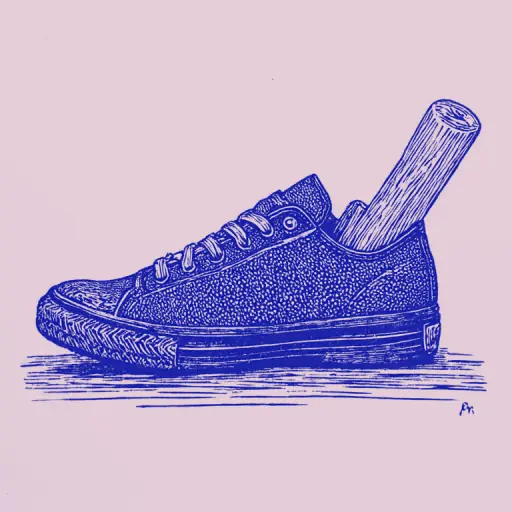
How to Stretch Textile Shoes at Home:
- 5 min read
- 60
Buying a new pair of sneakers or canvas shoes is always an exciting moment, especially when it comes to a favorite textile material. It often happens that the perfect model turns out to be slightly too small, and you don't want to throw away the shoes because of minor discomfort in your foot. Our goal as wardrobe experts is to give you a practical guide based on real methods to help you "negotiate" with your new pair of textile shoes and restore the perfect fit without damaging the structure or aesthetics of the material. Remember: the approach must be as gentle and gradual as possible.
Preparation and Material Assessment: Features of Textile Shoes
Before starting any manipulations, it is critically important to perform a diagnosis. Not all fabrics react the same way to thermal or mechanical stress. Ignoring this step can lead to irreversible deformation.
Which Fabrics Stretch (Cotton, Mesh, Knit) and Physical Limitations on Length and Width
- Cotton and heavy cotton: These materials are quite stable and react well to moderate mechanical stress. They best tolerate gradual stretching.
- Mesh: Mesh inserts require a delicate approach. They are prone to forming "puckering" or uneven stretching, so methods aimed at uniform width expansion, rather than strong elongation, are preferred for them.
- Knit: This is the most elastic but also the most sensitive. It responds best to temperature gradients (steam) and must be stretched very slowly.
Important Limitation: Remember that textiles have an elastic limit. A significant increase in size may be physically impossible without losing the material's shape or structure. Focus on improving the fit (comfort), not on radically changing the size.
Dangerous Methods: What Not to Stretch Textile to Avoid Deforming the Heel Counter and Destroying Glue
When working with textiles, you must observe the following "red flags":
- Direct contact with open flame or intense heat: This can cause fibers to char and lead to irreversible color change.
- Using aggressive chemicals without instructions: Not all stretching agents are suitable for the specific type of synthetic fiber used in the mesh. Always test on an inconspicuous area.
- Sudden and unilateral stress: For example, trying to significantly lengthen only the toe box while maintaining the width of the heel will result in an unnatural, "skewed" shoe shape.
- Ignoring the adhesive: If you use strong mechanical stretchers or high humidity, monitor the areas where the sole and heel counter are attached—they may weaken.
Effective Home Methods for Increasing the Volume of a Textile Pair
These methods are aimed at gradual and controlled action. Choose a method depending on what exactly needs correction: length or width.
Thermal Methods: Safe Steaming, Hot Water Application, and the Bag Freezing Method
- Safe Steaming (for knit): Hold the shoe over steam at arm's length. The steam softens the fibers, making them more pliable. After the procedure, be sure to wipe the inner surfaces with a damp cloth.
- Hot Water Application (Caution!): If the material allows, you can pour boiling water over and inside the shoe. This is effective for softening fibers, but strictly applies only to natural materials, not synthetics or mesh.
- Bag Freezing Method (for width): Fill sturdy bags with water and place them inside the shoe to fill problem areas (e.g., the sides of the toe box). Place the entire assembly in the freezer for 8–10 hours. This method helps evenly expand the volume.
Mechanical Stress: Stretching on a Thick Sock and Packing with Damp Paper
- Stretching on a Thick Sock: This is the gentlest method. Wear the shoes with a pair of thick, terrycloth, or wool socks for 15–30 minutes daily. This warms the material and stretches it gradually.
- Packing with Damp Paper (for width): Firmly stuff the sneakers with damp, slightly wrung-out newspapers, filling the side spaces as much as possible. Let the shoes dry at room temperature. The paper provides uniform resistance and volume expansion.
Special Agents and Securing the Result
To achieve a more pronounced effect or to fix the achieved volume, additional tools and care steps are necessary.
Using Professional Chemicals (Sprays, Foams) and Mechanical Screw Stretchers
- Specialized Sprays/Foams: Use agents designed to stretch your specific type of textile. Apply the agent to the problem areas (heel, toe box), and then be sure to walk around in thick socks. Always test the agent on an inconspicuous area.
- Screw Stretchers: This is the most powerful and controlled method for increasing length or width. Choose wooden models, as they distribute the load better and do not damage the material, unlike cheap plastic. The procedure requires several repetitions with a one-day interval.
Proper Care and Drying of Shoes After the Procedure for Reliable Shape Fixation
After any stretching, the fixation stage is critically important:
- Complete Drying: Let the shoes dry at room temperature, away from direct heat sources (radiators, heaters). Rapid drying can cause shrinkage or deformation.
- Wearing "for Stretching": For the next 1–3 days, wear the shoes in small amounts to allow the material to set the new shape during natural use.
- Inspection: If you used strong methods (steam, chemicals), check the seams and sole attachment areas for any weakening.
Conclusion
Remember that working with textiles is always a compromise between the desired size and maintaining the material's integrity. Approach the process methodically: diagnosis → gentle action (steam/socks) → reinforcement (stretchers/special agents) → fixation (proper drying). When choosing methods, always prioritize the safety of the fabric and its original appearance over the momentary desire to "increase the size." Good luck restoring the perfect fit to your favorite pair!