How to Understand the Difference Between the Ferz, Queen, and King for Beginners
- 8 min read
- 55
Chess is an amazing world of strategy, but for beginners, it often starts with confusion. The most common questions that arise for novice players and parents are: "Is the Ferz different from the Queen?", "How can I quickly tell the King from the Ferz on the board?" and "Why is the same piece called by different names?".
In this practical guide, we will eliminate terminological confusion once and for all. You will learn where these names come from, how to instantly distinguish the pieces by the crown's shape and height, and master the golden rules of their placement and moves.
Ferz and Queen: Understanding the Terminology
Starting their journey in chess, novices inevitably encounter confusion: there is one piece on the board, but it is called either the solid word "ferz" or the familiar "queen." Are these truly different pieces or just synonyms?
To feel confident at the board and understand the language of your opponents, it is important to understand the origin of these names and learn which term is used in professional circles.
Why One Piece Has Two Names: History from Vizier to Queen
The history of this piece is full of journeys and cultural transformations. The birthplace of chess is ancient India, from where the game traveled to Persia. There, the strongest piece was called the "vizier" (in Persian, farzin or ferz), which meant the advisor or chief minister of the ruler.
When chess entered Europe in the Middle Ages, the patriarchal image of the advisor did not take hold. Europeans reinterpreted the game and transformed the vizier into the queen (or lady) to pair with the king. In Russia, however, both variants became historically established: the official Eastern "ferz" and the colloquial European "queen."
How to Speak Correctly in the Chess Community: Ferz or Queen
In professional chess circles, only one variant is permitted—the ferz. If you call this piece a "queen" in a tournament or when speaking with an experienced grandmaster, you will immediately be identified as an amateur.
In official Russian-language notation for recording games, the letter "F" (from the word "ferz") is used, not "K" (which is reserved for the king). The word "queen" remains a colloquial, domestic term. It is often used when teaching children to simplify the perception of the game, but as skill grows, it is important to get used to the correct terminology.
Visual Differences: How Not to Confuse the King and Ferz on the Board
Beginner players often confuse the king and the ferz, especially when the pieces are made in a classic style. At first glance, they seem almost identical: both are majestic, large, and crowned. However, upon closer inspection, you can easily find the key markers that will help you instantly recognize the leader and his main defender.
Let's examine the main visual cues that chess players around the world use so they never confuse these pieces during a game.
Analyzing the Headwear: Cross Versus Ball and Crown Shape
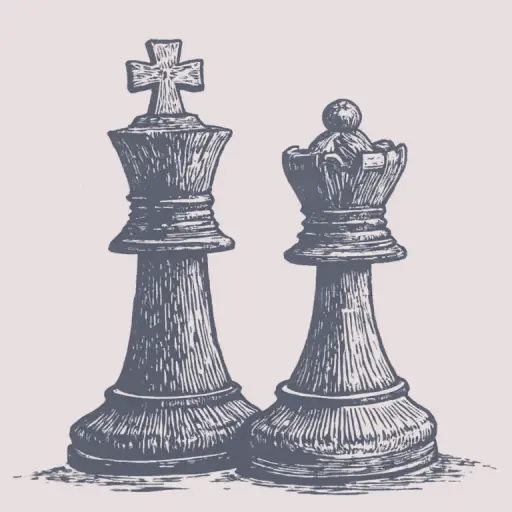
The simplest way to instantly distinguish these two pieces on the board is to look at their "headwear." In the classic Staunton design, which is used in most tournaments, they have fundamental differences:
- The King is always crowned with a cross. Its crown is wider, more massive, and flatter on top, symbolizing supreme authority.
- The Ferz (Queen) has a neat round ball (finial) on top. The ferz's crown itself is more elegant, with characteristic points resembling petals or a classic diadem.
This simple cue ("cross versus ball") will help you never confuse them during the game.
Height and Elegance: Which Piece is Taller
Besides the crown shape, the simplest way to instantly distinguish these two key pieces is their height and silhouette.
- The King is the tallest piece on the board. In the classic Staunton design, it always rises above the rest of the chess army. Its figure looks massive, solid, and majestic, emphasizing the status of the chief ruler.
- The Ferz (Queen) is slightly shorter than the king. Usually, the height difference is from a few millimeters to half a centimeter. Furthermore, the ferz's silhouette is more elegant, slender, and tapered at the "waist," which visually makes it resemble a female figure in a dress.
If you are in doubt about which piece you have, simply place the two pieces next to each other: the taller and more massive one is the king.
Initial Setup: The Golden Rule of Color
After understanding the appearance of the pieces, beginner chess players often face a new difficulty—how to correctly place them on the board before the game begins. It is very easy to mix up the king and the ferz, as they share the center of the first rank.
To eliminate this confusion once and for all, there is a simple and elegant mnemonic rule in chess. It instantly determines the position of the strongest pieces on the board and helps start any game without error.
The "Ferz Loves Its Color" Principle and Its Practical Application
The most popular and simple rule for remembering the placement of heavy pieces sounds like this: "The Ferz loves its color" (or "The Queen loves its color"). This golden rule eliminates confusion for beginners once and for all.
It is applied literally:
- The White Ferz is always placed on a central white square.
- The Black Ferz occupies the central black square.
The King, on the contrary, stands on a square of the opposite color (the white king on black, the black on white). By remembering this simple detail, you will never confuse the main pieces' positions at the start of the game.
Exact Starting Coordinates for the King and Ferz
To completely eliminate confusion during setup, it is enough to remember the exact coordinates of these key pieces on the chessboard. Chess notation strictly defines their positions on the first and eighth ranks:
- The White Ferz occupies square d1, and the white king stands on the adjacent square e1.
- The Black Ferz is located on square d8, and the black king occupies square e8.
Thanks to this scheme, the ferz are always directly opposite each other on the d file, and the kings are on the e file. This simple coordinate rule guarantees a correct start to any game.
Gameplay Differences: Strength, Importance, and Movement Rules
After the pieces take their rightful places on the starting squares, the most interesting part begins—their direct participation in the battle. Despite their external similarity and proximity on the board, the king and the ferz perform diametrically opposed tasks. One embodies crushing offensive power, while the other is the main objective of the entire game, requiring constant defense.
Understanding how these pieces move across the squares and what strategic value they represent is the key to mastering chess tactics. Let's look at their gameplay capabilities in more detail.
How the King and Ferz Move: A Comparison of Maneuverability
Chess rules grant these two pieces completely different movement dynamics on the chessboard:
- The Ferz (Queen) is the most maneuverable and long-range piece. It can move any number of free squares vertically, horizontally, and diagonally. Essentially, the ferz combines the power of the rook and the bishop.
- The King moves exactly like the ferz (in any direction—straight or diagonally), but only one square per move.
Because of this limitation, the king is slow and vulnerable, whereas the ferz can instantly cross the entire chessboard to attack or defend its forces.
Strategic Value: Why the Ferz is Strongest and the King is Most Important
In chess theory, the strength of pieces is measured in pawns. From this perspective, the ferz is the absolute leader. Its combat power is equivalent to about 9 pawns. It can single-handedly destroy the opponent's defense, so losing the ferz is a colossal blow to winning chances.
However, the king stands outside this value scale. Its strength as a combat unit is small (in the endgame, it is only valued at 3–4 pawns), but its strategic importance is absolute. The king is priceless. The rules of chess are strict: if the king is checkmated, the game ends immediately. You can capture all of your opponent's pieces, but if your own leader falls into a trap—you have lost.
Conclusion
Now you know exactly that the "ferz" and "queen" are the same entity on the chessboard, and the confusion in names is merely a tribute to history. To feel confident during a game, it is enough to remember three simple rules:
- Appearance: The King is always taller and crowned with a cross, while the ferz is slightly shorter and wears a round ball on its crown.
- Setup: The ferz always chooses a square of its own color (white on white, black on black).
- Role in the Game: The ferz is your main offensive force, and the king is the heart of the army that must be protected.
These basic pieces of knowledge will help you avoid frustrating mistakes at the start and make your first steps in chess easy and enjoyable. Have a good game!