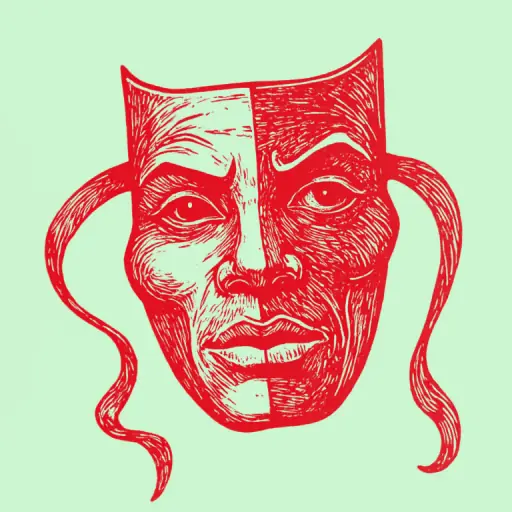
How to Understand the Dual Nature of Human and Why Opposites Constantly Struggle Within Us
- 24 min read
- 72
The philosophy of man and modern anthropology of man converge on one point: the duality of human nature is not a random evolutionary glitch, but a fundamental property of our existence. We belong simultaneously to two worlds: the material and the ideal, which gives rise to deep contradictions within the human being.
On one hand, man is a biological organism, guided by instincts for survival, dominance, and procreation. On the other hand, personality psychology points to our striving for higher meanings, altruism, and culture. This existential duality manifests on several levels:
- Soul and Body in Philosophy: The eternal debate on how to reconcile the physiological needs of the organism with the transcendent aspirations of the spirit. It is important, however, to distinguish duality (the division into flesh and reason) from the triad (body, soul, and spirit), which proposes a more complex structure.
- Social vs. Individual "Self": The conflict between egoistic motives ("I want for myself") and the demands of society ("I must for others").
- Reason vs. Feelings: The struggle between rational planning and spontaneous emotional impulses.
The main challenge of this duality is constant internal tension. Unlike animals, man lacks a rigid instinctive program and is condemned to free will. The inability to reconcile these polarities leads to existential crises. Understanding the nature of this split is the first step toward transforming internal conflict into a resource for development.
I. Philosophical Foundations of Duality: From Body to Spirit (Historical and Theoretical Review)
If in the previous section we established that duality is not merely a set of contradictions, but a fundamental driver of human existence, now it is necessary to delve into the historical and theoretical roots of this problem. Philosophy, throughout millennia, has attempted to provide a rational explanation for it, viewing it as a tension between opposing principles. We will trace how ancient thinkers, from Plato to Eastern sages, structured this duality, and how modern concepts strive to move beyond simple opposition. This is a journey from classical paradigms to the search for the integrity of being.
Studying these historical models will allow us not only to understand what is fighting within us, but also how these conflicts have been interpreted by civilization as a whole. We will separate the historical review from personal experience to create a solid theoretical foundation for further practical analysis.
1.1. Classical Dualism: Body and Soul (Overview of Paradigms)
Classical dualism is one of the most persistent and fundamental problems in the history of philosophy, attempting to explain what man is composed of. In the broadest sense, it is the concept of dividing being into two fundamentally different, yet interconnected, substances or principles. The most famous and influential example is the dualism of "Body and Soul."
The Essence of the "Body and Soul" Paradigm:
Within this concept (which was vividly developed by thinkers such as Plato and René Descartes), it is assumed that man consists of two separate, independent components: the material (body) and the immaterial (soul or mind). The body is viewed as a physical machine, subject to the laws of nature and biological necessity. The soul (or Mind), however, is an incorporeal, ideal substance that is the source of consciousness, thought, morality, and self-awareness. It is this immaterial part that gives man his uniqueness, elevating him beyond the purely animal world.
Philosophical Consequences:
The division into "body" and "soul" gives rise to a whole range of existential and metaphysical questions:
- The Problem of Interaction: How can the immaterial soul control the material body? This is the famous "problem of interaction" in the philosophy of mind.
- The Problem of Identity: What is the "Self"—the physical being or the immortal soul?
- Ethics and Freedom: If man is a soul, then his free will and moral choices belong to this immaterial part, separating him from biological determinism.
Thus, classical dualism does not merely state the existence of two principles, but creates tension between them: between our biological need (body) and our striving for ideals (soul). This tension is the source of all human contradiction.
1.2. Duality in World Systems: From Platonism to Eastern Philosophy
Unlike purely Western paradigms, which often focus on linear division (e.g., body-soul, matter-idea), world systems offer more complex, integrated models where duality is viewed not as a rupture, but as a dynamic tension. Eastern teachings, particularly Hinduism and Buddhism, often strive to transcend the very concept of duality (Maya), pointing to the ultimate unity of all phenomena. Here, duality is an illusion of perception, and true reality (Brahman, Nirvana) lies beyond opposites.
Within Platonism, although it is a classic example of dualism (the division of the world into sensible and intelligible), its legacy has been transformed in other cultures. For instance, in Chinese philosophy, the concept of Yin and Yang represents an ideal model of dynamic equilibrium. Yin and Yang are not two separate forces, but two sides of the same coin that constantly interact and generate each other. Neither can exist without the other, reflecting the principle of interdependence of opposites.
Russian religious philosophy, in turn, places a unique emphasis on the problem of "All-Unity" and "Sobornost" (spiritual community). Here, duality (for example, between the sinful and the divine, the base and the sublime) is not simply overcome, but must be integrated into the process of spiritual transformation. This is not merely a philosophical abstraction, but an ethical and existential imperative: man must accept his contradictory nature as the path to the fullness of being.
1.3. Modern Approaches to Overcoming Duality: Integrity of Being
The shift from contemplating duality to seeking practical integrity has become the main vector of 20th and 21st-century philosophy. Modern anthropology of man and philosophy of man resolutely reject the rigid Cartesian division into "thinking" and "extended" substances, striving to overcome existential duality through the concept of holism (integrity of being).
Today, overcoming dualism in science and philosophy is built upon three key directions:
- Phenomenology of Embodiment (Maurice Merleau-Ponty): The philosopher proved that the body is not merely a biological mechanism, but a “living, experiencing body” (Leib). In the philosophy of phenomenology, the soul and body are inseparable: we do not simply “possess” a body; we are our body, and through it, we construct meaning.
- Embodied Cognition: Modern cognitive science and personality psychology confirm that the mind is not isolated in the skull. Thinking is rooted in embodied experience and sensorimotor activity.
- Synergetics and Systems Theory: The human being is understood as an open, self-organizing system. The contradictory nature of human existence is not a fatal schism but a source of the internal dynamics necessary for personal evolution.
The modern approach proposes reconciling opposites by shifting them from the plane of ontological conflict to the plane of functional dialogue. The integrity of being is not a static absence of contradictions but a dynamic process of continuous self-creation, where the biological and the spiritual act as co-authors of a single human destiny.
II. Psychological Conflict: Internal Arenas of Struggle (Practical Analysis)
The transition from abstract philosophical categories to the living reality of the human psyche inevitably confronts us with the practical manifestations of duality. The inner world of a person is not a static unity but a dynamic arena where the metaphysical contradictions of spirit and matter take the form of tangible psychological conflicts. Every day, we experience this tension at the intersection of personal aspirations and external demands.
Psychological analysis allows us to see how fundamental duality transforms into the daily struggle of motives, giving rise to existential crises and emotional tension. Understanding the mechanisms of this internal struggle is the first step toward transforming destructive conflict into a constructive force for personal development.
2.1. The Dialectic of the Self: Conflict Between the Social and Individual “Self”
In psychology, the conflict between the “Social Self” and the “Individual Self” is one of the sharpest manifestations of the duality of human nature. This is not merely a theoretical abstraction but a daily internal struggle that determines our mental state and quality of life. Essentially, we are constantly trying to reconcile two “selves” that operate with different systems of motives and goals.
Social Self (Collective): This is the part of our personality formed under the influence of external demands, social roles, cultural norms, and societal expectations. It answers the question: “How should I behave to be accepted?” Its motives are belonging, approval, and conformity to the group. This “self” is necessary for survival in society, as it allows us to function within the collective. It teaches us conformity and adaptation.
Individual Self (Egoistic): This is the deep, internal core of the personality, formed from personal needs, unique desires, authentic emotions, and the striving for self-realization. It answers the question: “What do I truly want?” Its motives are self-actualization, uniqueness, and authenticity. This “self” often encounters resistance because its desires may contradict generally accepted norms.
Dialectics of Conflict:
Conflict arises when the motives of these two “selves” diverge. For example, the social self demands that we choose a prestigious but unloved profession, while the individual self yearns for creativity that does not bring a stable income. This divergence is the main source of existential tension. From a psychological perspective, the degree of this divergence directly correlates with the level of stress and the risk of depression. Our mental well-being requires not the suppression of one “self” by the other, but the search for a point of their dialectical unity—a place where social necessity coincides with personal truth.
2.2. Causes of Internal Tension: Mismatch of Motives and Existential Crises
Internal tension, which we call “internal conflict,” is not a sign of pathology but a fundamental characteristic of human existence. Philosophically and psychologically, the divergence of motives and goals between different “selves” (social, individual, moral) is a source of both suffering and creative potential. At the deepest level, a person is constantly in dialectical tension between who they should be (social role, societal expectations) and who they truly are (the authentic, egoistic self).
Key sources of this tension can be identified in several planes:
- Conflict of Self and Society: This is a classic problem where personal, authentic desires (individual self) clash with the norms established by the collective (social self). A person is forced to constantly balance the need for self-realization against the need to belong to a group. The attempt to suppress one self for the sake of the other leads to exhaustion and existential crisis.
- Morality vs. Instinct: This is the conflict between biological necessity (instincts, survival, sensual desires) and higher moral principles (duty, justice, altruism). Instincts are always egocentric, aimed at satisfying the “here and now,” whereas morality demands disinterestedness and a willingness to sacrifice for the abstract good. It is this tension that shapes human ethical responsibility.
- Being vs. Essence: From a philosophical point of view, this is the tension between what a person is (their biological givenness, their body, their past) and who they choose to become (their potential, their freedom). Existentialism emphasizes that a person is always in a process of becoming, and this uncertainty is the source of their internal drama.
Thus, internal tension is not a “breakdown” but a driver of development. It forces us to constantly ask questions about meaning, about the boundaries of our self, and about which of our conflicting motives is the true guide to life. Recognizing this tension is the first step toward understanding it.
2.3. From Depression to Harmony: How to Resolve Internal Conflicts (Practical Strategies)
The transition from destructive internal schism to dynamic harmony requires not the suppression of one side of our nature, but their conscious synthesis. When the divergence between individual (egoistic) and social (collective) motives reaches a critical limit, the personality sinks into apathy and depression. To prevent the disintegration of the self, it is necessary to apply a number of practical strategies that combine psychological tools and philosophical reflection.
Audit and Deconstruction of Motives.
Ask yourself: "To whom does this voice inside me belong?" Separate your aspirations into implicit (originating from the individual 'Self,' your authentic existential needs) and introjected (imposed by society, duty, or the expectations of others). Recognizing the source of the conflict is the first step toward resolving it.Controlled Dialogue Method (Dialectics of Polarities).
Instead of trying to suppress the 'selfish' or 'animalistic' impulse, allow it to speak. Imagine your social 'Self' (duty, reason) and your individual 'Self' (feelings, instincts) as two equal interlocutors. Record their dialogue. The goal is not the victory of one over the other, but the search for a compromise: how can an individual need be realized in a socially acceptable form?Search for Existential Overlap (Synthesis of Motives).
Harmony is achieved at the point where personal interest coincides with public good. Find an activity where your selfish drive for recognition or self-expression directly serves the good of the group. This transforms internal struggle into synergy.
| Strategy | Mechanism of Action | Result |
|---|---|---|
| Motive Audit | Separation of 'mine' and 'other' | Reduced anxiety, clarity of goals |
| Inner Dialogue | Legitimation of both sides of duality | Release of repression and neurosis |
| Existential Synthesis | Unification of the personal and the social | Exit from depression, surge of energy |
Conflict resolution is not the elimination of duality, but its translation from a state of civil war to a state of creative dialogue.
III. Battlefields of Consciousness: Contradictions and Their Origins (Comparative Analysis of Angles)
We have examined how internal conflicts between the 'Self' and society (the dialectics of the Self) and the strategies for resolving them. However, internal tension is not merely a psychological process; it has deep roots in the very structure of our being. Human duality is not just a conflict of motives; it is a fundamental contradiction embedded in our existence. To understand how to live with this, it is necessary to examine where these oppositions originate: in our biological programming, in cultural traditions, or in metaphysical concepts. In this section, we will conduct a comparative analysis of the key 'battlefields' of consciousness where instinct and morality clash, where West and East meet, and where the place of sin resides in our freedom.
3.1. Biological Determinism vs. Free Will (Man Between Instinct and Morality)
Viewing humanity through the prism of biology and evolution often reduces its essence to a survival mechanism. From this perspective, man is a highly developed biological apparatus whose motives and behavior are largely determined by instincts, hormonal background, and social patterns acquired during adaptation to the pack. This explanation, while scientifically sound, often leaves a 'gap' in understanding higher human manifestations: creativity, self-sacrifice, the search for absolute meaning.
However, it is precisely this 'gap' that constitutes the point of tension we must examine. If man were a pure product of biological determinism, his behavior would be predictable and reducible to resource optimization (food, safety, reproduction). But we see that man is capable of irrational heroism, of creating complex ethical systems, and of renouncing personal survival for an ideal.
Thus, duality arises at the intersection of these two principles: the biological 'Self' (instinct, need, survival) and the culturally-conscious 'Self' (freedom, morality, meaning). Philosophy and psychology view this contradiction as the fundamental source of human tragedy and greatness.
Key Aspects of the Conflict:
- Instinct vs. Morality: Instinct demands immediate gratification (e.g., aggression or fear), whereas morality requires the deferral of gratification for a higher goal (self-control, altruism). This is a constant struggle between the 'beastly' and the 'civilized' impulse.
- Necessity vs. Freedom: Biology dictates necessity (the need for food, a partner), but man possesses the consciousness of freedom, allowing him to choose how and when to satisfy that need. This freedom of choice is what elevates us beyond the purely animal world.
Understanding this conflict allows us not just to state that we are contradictory, but to understand that it is precisely this tension—between what ought to be (by the laws of nature) and what can be (by the laws of consciousness)—that shapes our unique, dual human nature.
3.2. East vs. West: Traditional Views on Human Duality (Sobornost, All-Unity)
Historically, the resolution of the contradiction between instinct and morality has followed two different paths: the Western and the Eastern (including Russian religious philosophy). These traditions respond differently to the question of how to overcome the internal conflict of man and reconcile his fractured nature.
Western Approach: Rational Separation and Autonomy
Western thought, starting from Plato and Descartes, tends toward rigid dichotomy. The duality of human nature here is understood as the opposition between the thinking substance (res cogitans) and extended matter (res extensa). In this paradigm:
- Man is viewed as an autonomous subject engaged in a constant struggle against his own physicality.
- Reason must subordinate feelings and instincts.
- The soul and body in Western philosophy are often in a state of hierarchical subordination, where the material is recognized as inferior.
Eastern and Russian Approach: All-Unity and Sobornost
In contrast to Western individualism, the Eastern tradition and Russian religious philosophy (V. Solovyov, N. Berdyaev) offer a path of integration, not separation.
- Principle of All-Unity: Human anthropology is built on the idea that the world and the individual are conceived as an organic whole. The contradictory nature of humanity is not a reason for an eternal war between spirit and flesh, but merely a temporary loss of the original unity that must be restored.
- Sobornost: Overcoming the internal fragmentation of the individual is possible only by stepping beyond one's own 'Self'—into unity with other people and the Divine principle. The individual achieves wholeness not in isolation, but in community.
- Eastern Non-dualism (Taoism, Zen): Opposites (Yin and Yang) do not fight to destroy each other but complement one another, forming the harmony of the whole.
Thus, while the West sees duality as a challenge to individual will and reason, the East and Russian thought seek salvation in overcoming egocentrism and returning to cosmic and social wholeness.
3.3. The Fall and Existential Choice: The Place of Morality in Dualism
In previous sections, we examined duality from the perspective of Western rationalism (Reason vs. Feelings) and Eastern tradition (All-Unity vs. Ego). However, neither of these paradigms provides a comprehensive answer to the question of moral choice. This is where the concept of the Fall comes into play; it does not merely state a conflict but imbues it with an ethical dimension. The Fall, from the perspective of many religious and philosophical schools, is a metaphor, yet it is also a real existential choice that determines the entire trajectory of human life.
Thus, the duality shifts from the plane of "Body/Soul" to the plane of "Animal Instinct/Divine Potential." As biological beings, humans inevitably inherit "animal" patterns: the need for hierarchy, survival, and dominance. These instincts, while natural, often place us before moral dilemmas where the "easy" path is the path of least resistance, aligning with the biological imperative.
However, because humans are endowed with consciousness, they receive the gift of free choice. This freedom is the source of our highest duality. We are capable not just of being instinctive, but of knowing that we ought to be better. Morality, therefore, becomes not an innate characteristic, but a constant act of overcoming one's own "baseness." This is the constant tension between what we are (the biological "Self") and what we ought to be (the moral ideal).
Philosophically, this can be formulated as the existential choice between necessity and possibility. Our task is not to eliminate the conflict, but to learn to live in the tension between these poles, accepting that our humanity lies precisely in this constant struggle and the choice in favor of the higher value, despite the temptation of instinct. This is where morality resides in duality: it is not an endpoint, but a continuous process of becoming, requiring constant ethical self-work.
IV. From Understanding to Acceptance: The Path to Wholeness (Self-Knowledge Guide)
We have traveled a long way, exploring human duality through the prism of classical metaphysical systems, psychological conflicts, and ethical choices. We have seen how the tension between body and spirit, between instinct and morality, forms the basis of our existence. However, if we view these contradictions merely as a "struggle," we risk getting stuck in a cycle of guilt and conflict. Philosophy, ultimately, offers not just a diagnosis, but a path to transforming the understanding of this duality.
This section is not just a collection of advice, but a kind of "integrative guide." Here, we move from analyzing conflict to accepting it. The goal is to stop perceiving opposites as warring forces that need to be "defeated" or "eliminated." Instead, we learn to see them as mutually complementary elements, recognizing that contradiction is not a defect, but a fundamental, dynamic characteristic of human existence itself. This is the key to true wholeness.
4.1. Accepting the "Dyad": From Conflict to Complementarity (Reinterpreting Opposites)
Accepting duality begins with a radical shift in perspective: we must stop seeing internal contradictions as an unfortunate error of nature or a consequence of the "Fall" that requires immediate correction. The philosophical concept of the "dyad" suggests viewing opposites not as warring camps, but as polarities of a single dynamic field. A person achieves true reality only when they agree with this incompatibility and stop wasting colossal resources on suppressing one of their parts. As philosophical existentialism noted, the attempt to ignore the dyad leads to a loss of contact with reality itself.
To shift internal conflict into a mode of complementarity, it is necessary to reinterpret the key oppositions of our existence through the lens of synergy:
- Social and Individual: Instead of being torn between societal demands and personal boundaries, it is important to understand that the individual "Self" provides our uniqueness and autonomy, while the social "Self" provides integration, communal spirit, and large-scale meaning. They do not exclude each other; they mutually condition one another.
- Corporeal and Spiritual: The body is not the "prison of the soul" nor merely a "herd animal" within us, but the material carrier and instrument of action. Spiritual aspirations require a solid biological foundation, and biological impulses require spiritual shaping.
- Centrifugal and Centripetal: Our activity is divided into external creation (creativity, expansion) and internal preservation (reflection, experience integration). The balance between them creates the rhythm of a healthy mental life.
Reinterpreting the dyad requires a practical step—abandoning rigid moralizing regarding one's own impulses. When we acknowledge the legitimacy of both sides, internal tension subsides. We move from an exhausting internal war to the wise co-creation of polar forces, where each side fulfills its evolutionary and existential task, turning conflict into a source of vital dynamism.
4.2. Developing Awareness: How to Balance Centrifugal and Centripetal Actions
The transition from the theoretical recognition of duality to everyday harmony requires understanding the dynamics of two fundamental forces: centrifugal and centripetal. In the context of philosophical anthropology and personality psychology, these forces determine the direction of our life energy, reflecting the eternal debate between soul and body in philosophy.
- Centrifugal action is directed outward. It is the vector of expansion, creativity, social achievement, and transcendence. When we write books, build careers, fight for status, or transform society, we act centrifugally, moving beyond our "Self."
- Centripetal action is directed inward. It is the vector of integration, self-reflection, energy conservation, and rooting in being. It brings us back to our own selfhood, ensuring psychological safety, peace, and deep contact with the inner world.
The existential duality of a person lies in the fact that we cannot abandon either of these vectors. Imbalance is destructive. Excessive centrifugal force leads to existential emptiness, burnout, and loss of identity in service of social masks. Excessive centripetal force threatens isolation, stagnation, and depression. Awareness acts here as a dynamic regulator, allowing us to maintain equilibrium.
To practically balance these vectors, use the following methods:
- Existential Energy Audit. Regularly analyze your actions over the week. Divide them into "expanding" (external projects, social contacts) and "gathering" (reflection, solitude, self-care). Assess whether there is a critical imbalance.
- "Mindful Pause" Practice. Before transitioning from solitary reflection to active social engagement, take a three-minute pause. This helps switch the internal register without losing integrity.
- Breath Rhythm of Being. Use breathing as a physiological anchor: inhalation symbolizes centripetal filling and self-care; exhalation symbolizes centrifugal creative action and giving energy to the world.
Balancing these forces means recognizing that contradictions within a person do not require the destruction of one side. The duality of human nature is fully revealed when we allow ourselves to be simultaneously agents changing the world and contemplators guarding our inner temple.
4.3. Integrating Duality into Life: Practical Steps for Living with Contradiction
Integrating duality is not merely acknowledging that we have two sides, but an active process of learning the coexistence of these opposites. It is a transition from the paradoxical "I must be two things" to understanding "I am two things, and that is my strength." Philosophically, this means abandoning the search for the "true Self" and accepting one's "dyad" as a whole being.
1. Reconceptualizing Conflict as a Resource:
Instead of viewing internal contradictions (e.g., the need for freedom vs. the need for security, or instinct vs. morality) as a "struggle," they must be reclassified as a dialectical resource. Conflict is not a defect, but a driver of development. For example, the tension between the desire to be social (to belong, to be accepted) and the desire to be individual (autonomous, unique) constantly compels us to perfect our personality, making us more complex and adaptive beings.
2. "Complementary Action" Practice:
Wholeness is achieved not by eliminating one side, but by teaching them to interact. This requires a conscious approach to one's actions:
- Example (Centrifugal vs. Centripetal): If you feel yourself "flying away" into abstract ideas (centrifugal action), do not ignore it. Instead, ask yourself: "How can this great idea be realized in my immediate environment right now?" (Centripetal action). Conversely: if you are too "stuck" in routine (centripetal), consciously plan an "exit"—meeting a new person, studying a new field of knowledge unrelated to work.
- Example (Ego vs. Altruism): Recognize that self-care (ego) is a necessary condition for the ability to care for others (altruism). This is not a choice between "I" and "We," but an understanding that the "I" must be strong enough to nourish the "We." This is the principle of self-sustainment.
3. Integration through the "Third Space":
The most important step is moving beyond the binary opposition. One does not have to choose: "either body or spirit." Wholeness resides in the "Third Space"—the point of synthesis where opposites do not merely coexist, but transform each other. This is your unique, inimitable human reality. Accepting this Third Space is the highest form of self-knowledge and practical wisdom in life.
Conclusion: Man as a Continuous Process of Becoming
Understanding the dual nature of humanity leads us to a fundamental philosophical conclusion: human existence is not a static given, not a frozen mold of flesh and spirit, but a continuous, dynamic process of becoming. The attempt to permanently resolve the internal conflict between the biological and the spiritual, the individual and the social, is an illusion that would mean the cessation of life's movement. Our contradiction is not an evolutionary defect or a curse, but the primary source of development, the existential engine that compels us to seek new meanings and surpass ourselves.
In philosophical tradition, the idea of becoming connects the ancient dialectics of Heraclitus, the German classical idealism of Hegel, and the existential anthropology of the 20th century. Man is defined not by who he is at a given moment, but by who he is becoming in the process of overcoming his internal divisions. As Nikolai Berdyaev noted, man is the intersection point of two worlds, a being capable of transcending his natural boundaries through creativity and free choice.
Viewing human nature's duality through the prism of becoming, we can identify three key orientations for self-knowledge:
- Dynamic Equilibrium: Instead of seeking static peace, we learn to maintain balance at the junction of opposites, transforming internal tension into stability in motion.
- Creative Sublimation: The conflict between instinctive impulses and spiritual aspirations becomes fuel for creation—art, science, ethics, and self-perfection.
- Existential Self-Projection: True freedom is born in the gap between the polar forces of our psyche. We are not rigidly determined by biology or society; we rewrite ourselves with every decision.
| Aspect of Being | Static Perception (Illusion) | Dynamic Becoming (Reality) |
|---|---|---|
| Internal Conflict | An obstacle to be destroyed | A source of energy and vector of development |
| Identity | A rigid, unchanging set of qualities | An open project created by choice |
| Wholeness | Absence of contradictions | Harmonious synthesis of opposites |
Ultimately, reconciling with one's own duality is not capitulation to chaos, but the attainment of true maturity. By understanding and accepting our duality, we cease to be hostages of internal struggle and become the authors of our unique life trajectory. Man is not a finished product, but an open question to which we answer every day of our existence.