How to Understand How Ordinary People Live in Modern India?
- 14 min read
- 59
India is a country that leaves no one indifferent. For some, it is a fairy-tale land from Bollywood films, with bright saris, songs, and ancient wisdom. For others, it is chaos, where the incredible wealth of megacities coexists with the poverty of Indian slums. But what is the daily life of Indians really like?
To understand the reality of life in India, one must look beyond tourist reservations and into the homes of ordinary citizens. Here, India's age-old traditions and the caste system still determine people's fates, while the modern middle class tries to balance globalization with strict religious rituals.
In this practical guide, we will explore what constitutes daily life on the Indian subcontinent. We will honestly discuss the standard of living in India, local etiquette, attitudes towards foreigners, and what you need to prepare for if you are considering permanent residency in this amazing and contrasting country.
Step 1: Debunking Stereotypes and Preparing for Cultural Differences
The first encounter with India often results in cognitive dissonance. Our minds, fueled by scenes from Bollywood films and frightening blogger accounts, paint either a fairy-tale land of maharajas or a zone of ecological disaster. To truly understand how the daily life of the locals is structured, it is necessary to completely reset one's expectations and abandon ingrained templates.
Preparation for immersing oneself in Indian reality begins with mental hygiene. We must separate popular tourist scares from the actual state of affairs, and also understand the nuances of terminology and religious diversity that define the identity of every resident of this amazing country.
Myths of Poor Sanitation and Bollywood Fairy Tales vs. Reality
The first thing everyone planning a trip or permanent residency in India encounters are two polar stereotypes. On one hand, Bollywood depicts a fairy-tale land of bright saris, songs, and eternal celebration. On the other, online reviews warn of total filth and poor sanitation. The reality of life in India is much more complex and interesting than these extremes.
Yes, there is a lot of garbage on the streets of Indian cities, and the chaotic daily life of Indians can shock a European at first. However, behind the external chaos lie strict internal rules. The daily lives of ordinary Indians are governed by strict rituals of cleanliness:
- Personal Hygiene: Indians bathe at least twice a day, and the concept of ritual purity strictly regulates daily life.
- Culinary Cleanliness: Food is prepared from fresh ingredients, and dishes are washed with great care.
- Home Cleanliness: External disorder on the streets often does not correspond to the perfect cleanliness inside apartments and temples.
India is not a film set, nor is it a collection of slums. It is a living, contrasting world where high technology coexists with ancient traditions.
Hindus and Indians: Religious Diversity and Terminology
Let's start with an important terminological subtlety that often confuses novice travelers. In Russian, two concepts are often mixed up, but the difference between them is fundamental:
- Indians — are citizens of the Republic of India, regardless of their origin, language, or faith.
- Hindus — are exclusively followers of Hinduism, the country's main religion.
Calling every resident of the Indian subcontinent a "Hindu" is a gross mistake. Although about 80% of the population practices Hinduism, India is a secular and multi-religious state. Millions of Muslims (the second largest community), Christians, Sikhs, Buddhists, and Jains live side by side here.
Religious affiliation directly determines the daily life of Indians: from culinary taboos (such as the strict vegetarianism of Jains) to family law and street rituals. Understanding this diversity will protect you from awkward situations and help you show respect for local traditions.
Step 2: Understanding the Social Structure and Caste Division
Understanding Indian society is impossible without delving into its unique social hierarchy. Despite rapid modernization, the launch of space missions, and the IT boom, the daily lives of Indians are still permeated by invisible but strong threads of age-old traditions. It is here, at the intersection of ancient caste division and modern economic realities, that the most striking contrasts that surprise travelers are born.
To truly understand how ordinary people live in India, one must look beyond the facade of glossy skyscrapers and understand what social mechanisms govern their choices—from future profession to life partner—and how representatives of the most polar social strata coexist.
How the Caste System Determines Profession and Marriage in Modern India
Although official discrimination based on caste is prohibited by the Constitution of India since the mid-20th century, in practice, the caste system (division into varnas and jatis) continues to invisibly govern the lives of millions. This is especially evident in two key areas: career and family.
Career Choice: Tradition vs. Globalization
In large metropolises like Mumbai or Bangalore, caste boundaries are blurring due to the development of the IT sector—skills are valued here, not origin. However, in the provinces, the jati (sub-caste) still predetermines one's line of work. For example, leatherworking or street cleaning often remain the domain of Dalits ("untouchables"), while administrative positions and intellectual labor are concentrated in the hands of higher castes.
Marriage as a Union of Two Clans
In matters of marriage, the caste system is practically unshakeable. More than 80% of marriages in India remain arranged, where the parents make the choice. The main criterion for finding a partner is belonging to the same caste. Even on modern Indian dating sites, caste filters are a basic function. Inter-caste unions are gradually taking hold among the urban middle class, but in rural areas, they can still be met with severe social condemnation.
Contrasts of Megacities: Life in Mumbai Slums vs. Middle-Class Life
In Indian megacities, especially Mumbai, social stratification takes on tangible physical outlines. Here, ultra-modern glass and concrete skyscrapers literally border endless quarters of self-built housing.
Life in the Slums (using the famous Dharavi as an example):
- Daily Life and Hygiene: Families of 5–8 people often live in tiny rooms of about 10 square meters. Slate or plastic roofs, lack of individual sewage systems, and one public toilet for hundreds of residents—this is the harsh reality shaping the standard of living in India for millions.
- Survival Economy: Contrary to stereotypes, Indian slums are not just depressed areas, but giant economic hives. Small businesses thrive here: plastic recycling, leather production, and pottery workshops. Slum residents actively work for the city as taxi drivers, couriers, and domestic help.
Middle Class Life:
- Comfort and Security: Members of the middle class (engineers, IT specialists, doctors) live in a completely different world. Their daily life is centered in gated communities with swimming pools, fitness centers, and green areas.
- Consumption: They use modern household appliances, order delivery through apps, and invariably hire domestic help for cleaning and cooking, which is considered normal even for middle-income families.
This stark contrast shows how diverse the daily life of Indians is in modern megacities.
Step 3: Exploring Indian Household Life and Daily Habits
Having understood the external social contrasts of Indian cities, it is time to step across the threshold of an ordinary home. It is here, hidden from the hustle of the street, that the true daily life of Indians unfolds, woven from age-old traditions and habits that might be surprising to a European. Household life in India is a unique microcosm where religious prescriptions are closely intertwined with everyday practicality.
To truly understand the reality of life in India, one must look into Indian cuisine and living rooms. Here, you will not find the familiar cult of soft furniture or an abundance of porcelain; instead, you will encounter a particular attitude toward cleanliness, metal, and water. Let's examine how the daily life of an Indian family is structured from the inside: from unfamiliar domestic details to strict rituals of hospitality and dining etiquette.
Features of the Indian Home: Hygiene, Steel Utensils, and Lack of Familiar Amenities
Stepping into an Indian home, you immediately notice strict rules that define the daily life of Indians. Shoes are always left outside the door: street dust must not defile the living space.
Life here is organized differently than in the West:
- Lack of Familiar Amenities: Central heating is absent, and hot water is rare. Local geyser boilers are used for washing, or water is heated in buckets. Instead of toilet paper, a hygienic shower or a special pitcher called a lota is used everywhere.
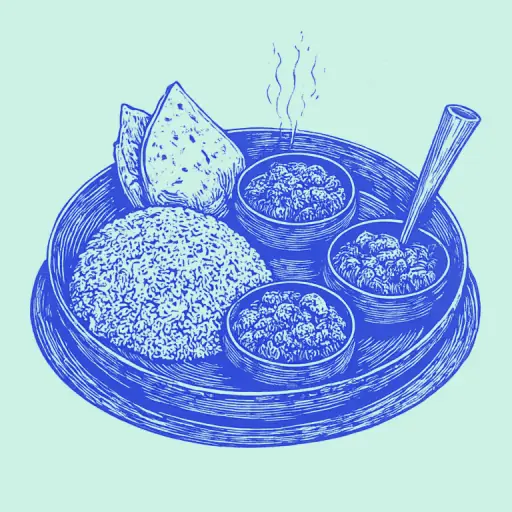
- Cult of Steel Utensils: You will hardly see ceramics in Indian kitchens. Shiny stainless steel utensils (thalis, glasses, bowls) are practical, durable, and, most importantly, considered ritually pure. Metal does not absorb odors and is easy to clean, which is critically important for observing religious hygiene norms.
Even in middle-class homes, furniture is often minimal, and floors are washed several times a day.
Culinary Traditions and Etiquette Rules: Why Eat with the Right Hand and Wash Hands Before a Meal
Moving from steel utensils to the dining process itself, it is important to understand: food in India is a sacred ritual and a gift from the gods. The main rule of local etiquette that often surprises travelers is to eat exclusively with the right hand.
In Indian culture, the left hand is traditionally considered "unclean" because it is associated with personal hygiene. The right hand, however, is "clean," intended for eating, greeting, and passing objects. Even left-handers are retrained from childhood to perform all important actions with their right hand.
Before and immediately after a meal, everyone washes their hands. This is not just a hygienic measure, but a ritual of purification. Eating with the hands (or more precisely, with the fingertips) is also a way to show respect for the food. Indians believe that tactile contact with food initiates the digestive process and allows one to feel the taste of the dish more deeply. At the table, idle chatter is usually avoided, and leaving food on the plate is considered bad manners.
Step 4: Observing Social Behavior and Attitudes Towards Foreigners
Stepping out of the Indian home, you instantly enter a whirlwind of street life, where personal boundaries blur, and public space transforms into a single living organism. On the streets of Indian cities, daily life is closely intertwined with age-old rituals, creating a unique social theater. To truly understand how people live in India, one must learn to read the non-verbal signals of this society, observe its rhythm, and the dynamics of interaction.
Here, every gesture, piece of clothing, and even the direction of a gaze matters. The social behavior of Indians may seem chaotic, but it is governed by strict internal rules. Let's examine how India's age-old traditions manifest in the daily street bustle and how local residents communicate with those who have come to their country from other corners of the globe.
Traditional Lifestyle: Clothing, Street Rituals, and Religious Festivals
Daily life in India is unimaginable without the vibrant colors of traditional clothing and street rituals. On city streets, even among modern skyscrapers, women of all ages prefer elegant saris and practical salwar-kameezes, while men wear light kurtas or dhotis. This is not a tribute to the past, but a living reality.
Every morning, rangolis—patterns made from colored rice powder—are created at the thresholds of homes and shops to attract prosperity. Walking through the streets, you will inevitably see small altars where morning puja (prayer) is performed with offerings of flowers and incense.
Religious festivals, such as Diwali (the festival of lights) or Holi (the festival of colors), unite millions of people regardless of their social status. On these days, the streets transform into a single festive space where every passerby becomes part of a grand spectacle. Observing these traditions helps to understand the soul of the Indian people more deeply.
How Indians Treat Russian Expats and Tourists
The attitude of Indians towards guests from Russia is traditionally warm, rooted in the Soviet past with its famous slogan, "Indians and Russians are brothers." For the average resident of India, a white foreigner is an object of sincere curiosity and respect. Be prepared for frequent requests for selfies: for locals, this is a way to show friendliness and acknowledge meeting a European.
However, the attitude differs depending on your status:
- Tourists are treated friendly, but pragmatically. In tourist centers like Goa or the state of Rajasthan, foreigners are often seen as a source of income, so it is important to know how to bargain gently but firmly and remain vigilant.
- Expats receive a deeper and more respectful treatment. Indians sincerely value it when visitors try to understand their culture, learn basic Hindi phrases, and observe rules of propriety—for example, dressing modestly outside of beach areas.
Overall, the Russian-speaking community feels safe and comfortable in India. Locals are always ready to help on the street, give directions, or offer tea if they see reciprocal respect for their country.
Step 5: Assessing the Prospect of Permanent Residency and Financial Reality
Moving to India for permanent residency is a step that completely changes one's familiar worldview. It is one thing to admire the color of ancient temples as a tourist, and quite another to daily confront local bureaucracy, rental peculiarities, and budget planning. Life in India attracts expats with its affordability, but low prices often hide non-obvious expenses and daily challenges.
To prevent your dream of living under palm trees from crashing against harsh reality, you must realistically assess your financial capabilities and prepare for organizational difficulties. Let's examine what a comfortable life in this contrasting country truly costs and how to set up your daily life without unnecessary upheaval.
The Real Cost of Living in India and Saving Opportunities
India attracts expats with its affordability: it is genuinely difficult to go hungry here, and basic needs are met for minimal money. However, the real cost of living heavily depends on your demands and your ability to assimilate.
Main Monthly Expenses:
- Housing Rent: From 12,000–15,000 rupees ($150–180) for a modest apartment (1 BHK) in the suburbs of Mumbai or Delhi, and from 18,000 rupees in Goa.
- Food: Around 8,000–10,000 rupees per person when buying groceries at local markets (sabzi mandi) and making rare trips to local eateries (dhaba), where a traditional lunch thali costs only 100 rupees.
- Transport and Communication: Around 3,000 rupees when using rickshaws via apps (Uber, Ola) and a local SIM card.
How to Save Significantly:
- Look for MRP labeling: All factory-made goods in India display the Maximum Retail Price. Sellers are not allowed to sell the item for more than this amount.
- Buy local: Imported cheeses, chocolate, and alcohol are expensive due to duties. Switching to a local diet will reduce food expenses threefold.
- Bargain in markets: For foreigners, the starting price in markets and shops is always inflated by 2–3 times.
Finding Accommodation, Renting, and Overcoming Initial Culture Shock
Finding housing in India has its own peculiarities. It is best to search for apartments through local Facebook groups, specialized websites (NoBroker, MagicBricks), or directly through local brokers (whose commission is usually the cost of one month's rent). When signing a lease (usually for 11 months), be prepared to pay a deposit—in Mumbai or Bangalore, this can range from 3 to 10 months' rent, whereas the conditions in Goa are much more lenient. Always check the functionality of the water heater, air conditioner, and the availability of a backup power generator (power backup), as power outages are common.
Initial culture shock is inevitable: chaotic traffic, intrusive attention from locals, and a specific attitude toward cleanliness can throw you off balance. To adapt, embrace the local pace of life ("shanti-shanti"), do not try to control everything around you, and create an oasis of comfort at home. Gradually, the chaos will transform into a comprehensible and friendly ecosystem.
Conclusion
It is impossible to understand how ordinary people live in modern India through the lens of stereotypes about eternal celebration or, conversely, absolute poverty. The reality of this country is woven from deep contrasts: the ancient caste system coexists with high technology, and the modest life in the slums of Mumbai exists alongside genuine hospitality and the spiritual calm of the middle class.
India opens up to those willing to abandon familiar templates of comfort and accept its rules of the game. For travelers and future expats, this is not just a geographical point, but a school of flexibility and tolerance. If you are looking for perfect European order, India may disappoint. But if you strive to understand the amazing philosophy of life, where joy does not depend on material wealth, and every day brings new discoveries—India will become your second home.