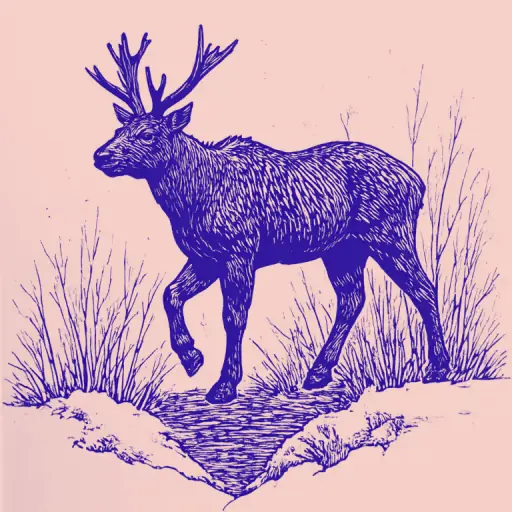
How to Understand Why Moose Walk in Deep Snow
- 8 min read
- 63
The winter taiga imposes severe limitations on the movement of forest inhabitants. However, the moose is a true triumph of evolution. How does this giant, weighing up to 600 kilograms, manage not only to survive but also to move quickly over deep snow when the snow layer exceeds critical limits?
The secret lies in its unique physiology and behavior. In this article, we will analyze how the special structure of the moose's hooves reduces the load, why its long-limbed nature saves it when the ground is loose snow, and why the ice layer forces the animal to seek a safe winter refuge.
Anatomical Secrets: How Body Structure Helps the Moose Move in Snowdrifts
The moose's survival in harsh winter conditions depends directly on its unique anatomy. While other large ungulates literally sink into the snowdrifts, evolution has endowed the moose with amazing physiological tools. The secret to its safe movement over deep snow lies in the particular structure of its locomotor apparatus, which transforms the heavy forest giant into an efficient natural all-terrain vehicle.
Hoof Structure and Weight Distribution
The secret to the stability of a moose weighing up to 600 kg lies in the unique structure of its hooves. Unlike many other deer, the moose's hooves are capable of spreading widely when stepping on a loose surface, significantly increasing the surface area of support. Between the horn-like halves is a tough cutaneous membrane that functions like a natural snowshoe.
When walking on deep snow, the lateral toes (secondary toes) also come into play. They are located quite low, and when the foot submerges, they create an additional point of support. Thanks to this, the weight is distributed uniformly, reducing it to approximately 320–400 grams per square centimeter, which allows the forest giant to move successfully through deep snowdrifts.
Role of Long Limbs in Traversing Loose Snow
The remarkable length of the moose's limbs is its greatest advantage when moving through snowdrifts. The height of an adult moose's limbs allows it to step easily over obstacles that would be an insurmountable barrier for other ungulates.
When loose snow covers the ground with a layer of 50 to 60 centimeters, the animal barely reduces its speed. Thanks to the high elevation of the legs and the special angle of joint flexion, the moose lifts its limbs high with each step. This prevents the 'plowing' effect, which is dragging the legs through the mass of the snowdrift—a process that consumes a lot of energy. Only when the snow layer height exceeds 80 to 90 cm and begins to reach the belly does free running give way to an arduous obstacle traversal.
Dependence on Snow Layer Type and Height
Although its unique anatomy gives the moose a colossal advantage, the state of the winter terrain changes constantly. The physical properties of the snow itself—its density, moisture, and height—directly dictate the moose's movement tactics. Depending on the structure of the snowdrifts, the forest giant's usual gait can become either an easy traversal of the distance or an exhausting struggle for survival, where every step requires a huge expenditure of energy.
Overcoming Critical Loose Snow Depth
Loose snow up to 50 cm does not represent a major barrier for an adult moose thanks to its limb length. However, when the layer height is 85 to 90 cm, the situation changes drastically: the animal begins to hit the snow with its belly, which greatly increases energy expenditure.
The critical threshold is considered a depth of 90 to 100 cm. Under such conditions, running becomes practically impossible. The moose switches to walking, lifting its legs high, or moves strictly along previously cleared trails. If the snowdrifts exceed 130 cm, the animals cease active movement and adopt a sedentary lifestyle to conserve vital energy.
Influence of Ice Layer on Movement Speed and Safety
The ice layer is one of the most dangerous winter factors for the moose. Unlike loose snow, the dense ice layer cannot support the giant's weight (up to 600 kg). The moose sinks with every step, which leads to serious consequences:
- Limb Injuries: The sharp edges of the frozen ice layer cut the skin and tendons of the legs above the hooves, leaving deep wounds.
- Loss of Speed: Running in such conditions is practically impossible. In an attempt to protect its legs, the animal slows to a crawl, lifting its limbs high.
- Vulnerability: The ice layer strips the moose of its main advantage: speed, turning it into easy prey for wolves, which, due to their lower weight, can run freely over the ice layer.
Therefore, when ice appears, moose try to minimize crossings and take refuge in the dense undergrowth, where the tree canopies prevent the formation of a solid ice layer.
How to Read Moose Tracks in the Snow: Practical Techniques
Understanding how the moose overcomes snowdrifts and ice allows the naturalist to read the forest's "white book" without error. Every step of the heavy animal leaves a unique signature in the snow, reflecting its speed, direction, and even alertness level.
To decipher these secrets of the forest, it is important to pay attention to the shape of the prints, the snow displacement, and the distance between the tracks. Practical tracking techniques will help reconstruct recent events in the giant's life with precision.
Determining Running Direction by Snow Displacement
When the moose moves over deep snow, the key indicator for determining direction is the entry and exit lines of the foot in the snowdrift: the entry ramp and the exit ramp (displacement).
- Entry Ramp: Forms when the moose lowers its foot into the snow. It is a smooth, long line extending toward the print itself.
- Exit Ramp (Displacement): Appears when lifting the limb. It is steeper, shorter, and accompanied by the expulsion of small pieces of snow.
When running fast, this shedding becomes especially pronounced: in front of the track in the direction of the animal's movement, a mound or fan of snow expelled forms. Where this expulsion and the detached piles are directed, that is where the moose ran.
Differences Between Tracks from Calm Walking, Fast Running, and Jumping
In a calm walk, the moose's tracks form an orderly and relatively uniform chain. The animal's hind legs generally land exactly in the tracks of the front legs (what is called a covered stride), and the distance between them is about 70 to 90 cm. The secondary lateral toes practically leave no tracks in the snow.
When switching to fast running (gallop or trot) and jumping, the character of the track changes drastically:
- Stride Lengthening: The distance between tracks increases to 1.5–2 meters, and in jumps, it can exceed 3 meters.
- Hoof Separation: Under the action of dynamic load, the moose's hooves separate widely, and the lateral toes are clearly imprinted on the rear.
- Track Grouping: In jumps, the tracks group into sets of four, and around them, deep pits are seen with chaotic shedding of loose snow.
Moose Behavior in Deep Snow: Minimizing Dangerous Runs
Understanding how the moose walks in deep snow only reveals part of its winter survival strategy. In practice, the moose seeks to completely eliminate dangerous and energy-consuming runs. When the snow layer height approaches the critical limit, the animal switches to an energy-saving mode. Instead of running exhaustingly through snowdrifts and dangerously over ice, the forest giant radically changes its behavior, minimizing activity to conserve heat and strength.
Creating Winter Shelters (Herds) in the Undergrowth
When the snow layer height exceeds critical limits, moose adopt a sedentary lifestyle, creating what is known as winter shelters (herds). To do this, they choose dense undergrowth, riverbanks, or areas with abundant leaf litter, where the depth of the snowdrifts is less and the food base (young shoots of willow, alder, and pine) is within reach.
Within the shelter, the moose mark a network of permanent trails. Moving over compacted snow minimizes the load on the moose's hooves and protects its limbs from ice cuts. In this small area, the group of animals can spend weeks, almost completely foregoing wide crossings and conserving precious energy.
Protection Against Predator Pursuit in Deep Snow Conditions
Deep snow often becomes a natural ally for the moose. While wolves tire quickly and get stuck in snowdrifts over 50–60 cm high, the long-limbed moose continues to move safely.
If pursuit cannot be avoided, the giant uses effective tactics:
- Defense on the Trail: The moose lures pursuers onto the trampled trails of its shelter, where predators lose the advantage of numerical encirclement.
- Fighting with Back to the Shelter: The animal positions itself with its back to a dense bush or a fallen tree, protecting its rear, and defends itself against wolves with deadly strikes from its front hooves.
- Use of Debris: The moose intentionally retreats into dense undergrowth and tree debris, where it is more difficult for wolves to maneuver due to the loose and deep snow.
Conclusion
Understanding how the moose overcomes deep snow opens up an amazing world of winter adaptation. The unique structure of the hooves, the length of the limbs, and the intelligent behavior—from creating winter shelters to avoiding dangerous ice—allow the moose not only to survive but to move effectively in the harsh conditions of the taiga. Observing these majestic animals helps us better appreciate the fragile balance of winter nature.