How to correctly use left and right turn signals in a car
- 9 min read
- 63
Road safety starts with predictability. Knowing how to use turn signals correctly and on time is a basic skill that protects you from accidents and guarantees a successful exam with the traffic police (ГИБДД). For novice drivers, using the turn signal lever often causes stress: when should you press it, exactly where should you move the stalk, and how to avoid confusion when maneuvering at intersections or roundabouts?
In this practical guide, we will cover the physics of controlling maneuver light signals, the traffic rules (ПДД), and even unspoken driving etiquette.
Physical Control: Where the Turn Signal Lever Is and How to Operate It
For confident driving, it is important to automate the control of light signals. The first step toward this is understanding how the turn signal activation system is physically arranged inside the car. You will not have to take your eyes off the road or search for the correct button by touch—automakers have long standardized this unit for maximum driver convenience. Below, we will examine exactly where this control element is located and what basic finger movements are necessary for its correct operation.
Location of the Stalk and Basic Movements (Up and Down)
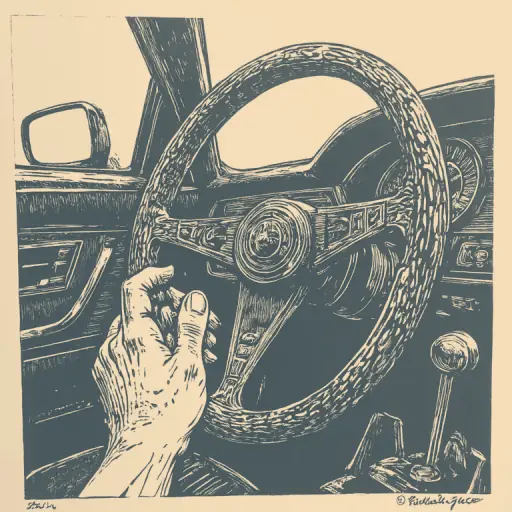
The main tool for controlling light signals is the stalk (turn signal lever). In most left-hand drive cars, it is located to the left of the steering column. It is easily reachable with the fingers of the left hand without removing the palm from the steering wheel.
The lever has three main positions:
- Neutral (Middle) — signals are off.
- Upward Movement — activates the right turn signal.
- Downward Movement — activates the left turn signal.
Modern cars also have a "quick flash" mode (partial press without locking) for rapid three-blink signaling when changing lanes.
Simple Mnemonic Rule: "Where You Turn the Wheel, There the Lever Goes"
To eliminate doubt on the road forever, use this simple mnemonic rule: the direction of the lever's movement always matches the direction of the steering wheel's rotation.
Imagine you are holding the steering wheel in the standard position:
- Turning Right: you will turn the wheel clockwise. The left hand moves up. Consequently, you push the stalk up with your fingers.
- Turning Left: the wheel rotates counter-clockwise, the left hand goes down. You also lower the lever down.
This simple rule also applies when reversing: move the lever in the direction you plan to steer the rear of the car.
Traffic Rules for Using Turn Signals: When and How Far to Activate
Knowing how to physically press the lever is only half the battle. To avoid dangerous situations and pass the traffic police exam successfully, you must clearly understand the requirements of the Traffic Rules (ПДД). The ПДД strictly regulate not only the act of signaling but also the timeliness of that action.
Maneuver light signals serve as the primary language of communication between drivers. Let's examine in which specific road situations the law requires us to use turn signals and at what distance from the start of the maneuver this must be done so as not to mislead other road users.
Key Maneuvers: Starting, Changing Lanes, Overtaking, and Reversing
According to the ПДД, the driver must signal before any maneuver. Let's look at key situations:
- Starting and Stopping: Before pulling away from the curb, always turn on the left signal (or right, if starting to move right). When stopping at the edge of the road—the right signal.
- Changing Lanes and Overtaking: Activate the signal well in advance of changing lanes. When overtaking, the turn signal is activated twice: first the left (to move into the oncoming lane), and after passing—the right (to return to your lane).
- Reversing: The ПДД require signaling when maneuvering while reversing. Turn on the signal corresponding to the direction you plan to steer the rear of the vehicle.
Timing and Distance: How Many Seconds or Meters Before Signaling and Rules for Entering a Roundabout
According to the ПДД, the signal must be given in advance of the maneuver. In real road conditions, rely on the following intervals:
- In the city: 50–100 meters (approximately 4–5 seconds before starting a turn or lane change).
- On the highway: 150–300 meters, as the speed outside the city is significantly higher.
The main rule is that your signal must not mislead other road users. If there is another exit before your intended turn, only turn on the signal after you have passed it.
Entering a Roundabout (Traffic Circle):
When entering an intersection with a roundabout, the driver makes a right turn. According to the ПДД, at this moment, the right turn signal must be activated. The left turn signal is used only on the roundabout itself if you need to change to the left lane. Exiting the roundabout is always done with the right turn signal.
Hand Signals When Optics Fail: How to Properly Indicate a Maneuver
The failure of lighting equipment while driving is a dangerous situation that does not relieve the driver of the duty to inform other road users of their maneuvers. According to clause 8.1 of the ПДД, if the turn signals are faulty or absent, you are obliged to signal with your hands. This allows you to safely continue driving to a repair or parking spot without creating dangerous situations on the road.
How to Indicate a Left and Right Turn with Hand Gestures Using the Left or Right Hand
If the turn signals are not working, the driver must signal with their hands through an open window (according to clause 8.1 of the ПДД):
- Turning Left: extend the left arm horizontally toward the window. If signaling with the right hand, bend it at the elbow at a right angle upwards.
- Turning Right: extend the left arm to the side and bend it at the elbow at a right angle upwards. If using the right hand, simply extend it horizontally to the right.
These gestures replace the maneuver light signals and are mandatory for all drivers to understand.
Stop (Braking) Gesture and Safety Precautions When Signals Are Faulty
To warn of braking or stopping, a simple gesture is used—a hand raised vertically upwards (left or right). This signal is extremely important so that drivers behind you have time to react and reduce speed.
Safety Rules When Optics Are Faulty:
- Advance Warning: Signal with your hand in advance, before starting to brake or maneuver.
- Hand Freedom: Immediately before the turn, return your hand to the steering wheel to maintain full control of the vehicle.
- Movement Restriction: With non-functional turn signals, you are only allowed to drive to a parking or repair location (clause 2.3.1 of the ПДД), exercising extreme caution.
Common Mistakes of Novices in the Traffic Police Exam and Informal Driving Etiquette
Knowing the theory and being able to mimic signals with your hands is a great foundation, but novice drivers often face difficulties during the practical exam at the Traffic Police (ГИБДД) and in real traffic flow. Inspectors strictly evaluate the timeliness of signal activation, and any oversight can cost the coveted driver's license.
At the same time, the real road dictates its own rules. In addition to strictly following the Traffic Rules (ПДД), there is an unwritten driving etiquette that helps motorists understand each other without words and avoid dangerous situations.
Main Mistakes with Turn Signals During the Exam and How to Avoid Them
Passing the Traffic Police exam is often ruined by frustrating penalty points for turn signals. Inspectors strictly record the following typical oversights:
- Ignoring the signal when starting off: Pulling away from the curb or the edge of the roadway without a left turn signal is a guaranteed loss of points.
- Violating timeliness: Activating the signal immediately at the moment of maneuvering or, conversely, too early, which misinforms other drivers.
- Forgotten signal: If the stalk switch does not return to its original position automatically after changing lanes, be sure to switch it off manually.
- Confusion at the roundabout: When entering a roundabout, the Traffic Rules require you to use the right turn signal, not the left.
To avoid these mistakes, automate the operation of the lever during practical sessions with an instructor.
Unwritten Rules of Road Communication: Using Turn Signals and Hazard Lights
In addition to the official Traffic Rules (ПДД), there is an unwritten driving etiquette on the road:
- Thanks and apologies: One or two flashes of the hazard lights are a universal "thank you" (for example, if someone lets you pass) or "sorry."
- Assistance on the highway: Truck drivers often help when overtaking. A left turn signal illuminated on a truck means "do not overtake, danger ahead," while a right signal means "the road is clear, you can go."
Conclusion
Remember that knowing the rules and being able to physically activate the turn signal is only half the battle. True driving skill is the ability to signal in time and correctly to ensure the safety and predictability of your actions for other road users.
Key takeaway to remember: The turn signal is not just a Traffic Rule requirement; it is your primary communication tool on the road. It tells those around you: "I see that I am about to maneuver, and I know what I am doing."
- Practice over theory: It is not enough to know that you must use a turn signal when changing lanes. This action must become automatic, like breathing. The more you practice in safe conditions, the more confident and natural your behavior on the road will be.
- Responsibility for attention: Always keep in mind that your signal must not only be legally correct but also as understandable as possible to those around you. Unwritten etiquette rules are often more important than the letter of the law when it comes to preventing an accident.
- Continuous improvement: Driving is a process of continuous learning. Regularly repeat maneuvers, refine your signaling, and always be prepared for unexpected changes on the road. Only this approach guarantees your safety and the safety of others.