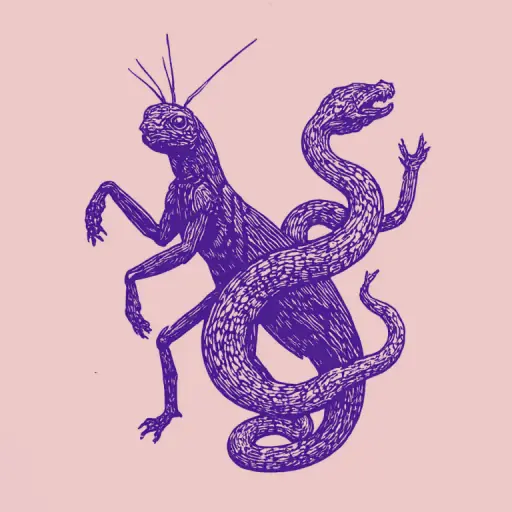
How Praying Mantis Can Defeat and Kill Snakes
- 9 min read
- 76
Nature is filled with amazing and terrifying contrasts. One of the most surprising sights in the wild is the life-or-death battle where a fearless praying mantis confronts a reptile. Traditionally, we are accustomed to viewing reptiles as dangerous predators at a higher evolutionary level. However, this large insect predator easily breaks this stereotype.
Young snakes and small reptiles are often prey to these ruthless ambush experts. Thanks to perfect camouflage, the praying mantis remains undetected until the last moment. But how can this seemingly fragile creature manage to defeat a strong and slippery opponent? The secret lies in its unique natural weaponry, which transforms this hunter into a perfect killing machine.
Praying Mantis Anatomy: Dissecting the Combat Arsenal
To understand how this seemingly fragile insect can defeat scaled reptiles, we need to look at its evolutionary weaponry. The praying mantis is not just a waiting predator; it is a high-tech combat machine in the micro-world. Every part of its body is designed by nature to capture, hold, and kill prey quickly, even if the prey is larger than it. Success in a fight against a snake is determined by its unique body structure, which turns this hunter into a deadly gladiator.
Spiked Raptorial Leg Structure
The praying mantis's primary weapon in a fight against reptiles is its front raptorial limbs. Built like folding knives, these legs consist of a femur and tibia that press together with colossal force. The inner edges of these segments are lined with rows of sharp, strong spines of various sizes.
When the praying mantis attacks, these sharp spines act like spears: they immediately pierce the scales and skin of the small reptile, locking the prey tightly. Because of the inward-pointing angle of the teeth, any attempt by the snake to escape only pushes it deeper into the body, completely eliminating the prey's chance of survival in this deadly battle.
Strong Jaws and Circular Vision Features
Once the spines lock the prey tightly, another evolutionary advantage comes into play. The praying mantis is the only predatory insect capable of rotating its head up to 180 degrees. Its unique vision from five eyes provides an almost circular view, allowing it to control every movement of the small reptile and react instantly to counterattacks.
When the target is locked, the strong mandibles are used. This sturdy chitinous tool easily bites through scales. The praying mantis does not wait for the prey to die; its jaws are designed to methodically bite the flesh, beginning to feed while the prey is still alive from the head or neck, which quickly incapacitates the snake.
Combat Tactics: From Camouflage to Attack
Superior weaponry is useless without a solid strategy. In a confrontation with a fast and flexible reptile, the praying mantis relies not on brute strength, but on perfect calculation. This cold-blooded predator turns its surroundings into its main advantage, combining absolute invisibility with phenomenal reaction speed.
Success in a life-or-death battle is determined by the ability to strike at the single moment when the prey is least prepared. Below, we will discuss how tactical advantages allow this insect to outwit and attack snakes.
The Art of Camouflage and Ambush Waiting
The praying mantis is an unparalleled ambush expert. Thanks to its cryptic coloration (ranging from bright green to dry brown) that mimics leaves or twigs, this insect predator blends perfectly into the foliage. The praying mantis can remain motionless for hours, waiting for an unsuspecting small reptile or young snake to come within range.
Its unique vision and ability to rotate its head 180 degrees allow it to control its surroundings without revealing its presence with unnecessary movements. For a snake slithering past, the lurking praying mantis appears merely as part of the dead landscape, determining the outcome of the future life-or-death battle.
Strike and Instant Capture Mechanics
When a young snake is within range, the praying mantis immediately switches from a state of total stillness to action. Its strike mechanics are truly astonishing: the attack lasts only a few tens of milliseconds, far faster than a human blink.
At that moment, this insect predator launches its specialized raptorial limbs forward. The speed of the attack is guaranteed by a sharp release of energy accumulated in the extensor muscles. Once the leg reaches the target, it folds up like a pocket knife. The sharp spines embed deep into the small reptile's body, locking it tightly and eliminating any possibility of escape.
Battle Scenarios: How the Praying Mantis Restrains and Neutralizes Snakes
When the lightning strike reaches the target, the most dangerous phase of the confrontation begins. The snake is not just large prey, but a strong, muscular, and highly agile opponent. Restraining the slippery, writhing body of a reptile is a task at the limit of an insect's physical capability. At this critical moment, the praying mantis must use unique biomechanical tricks to turn its grip into a trap with no escape, while neutralizing any counterattack.
Immobilizing the Slippery Reptile Body
Restraining the slippery, writhing body of a reptile is a very difficult task, but the praying mantis succeeds due to the unique construction of its raptorial limbs. When the predator launches its lightning strike, the tibia and femur fold like pocket knives.
The sharp spines located on the inner side of the leg function like spears:
- they immediately pierce the scales and skin of the young snake;
- they securely lock the prey's body, preventing it from escaping due to muscle contraction;
- they block the reptile's main bending points, eliminating its ability to counterattack.
The praying mantis distributes the gripping force in such a way that the snake's head or upper body is pressed against the substrate. This rigid mechanical blockade neutralizes the reptile's main advantage—its flexibility.
Overcoming Resistance and Avoiding Bites
Restraining a writhing reptile is not an easy task, as the young snake desperately tries to bite its captor. In this life-or-death battle, the praying mantis relies on the length of its raptorial limbs. It instinctively locks the prey in such a way that its head is at a safe distance from its body and its vulnerable eyes.
Thanks to its phenomenal reaction speed, this predator insect is able to evade sudden snake attacks, intercepting its neck closer to the base of the skull. The sharp spines on its femur embed tightly into the reptile's skin, eliminating its ability to bite and maneuver. Once the snake's head is securely locked, the mantis deploys its powerful mandibles, delivering the first devastating wound.
Battle Resolution and Real Prey Scale
When the prey's resistance is completely broken, the most astonishing phase of this incredible fight begins. Unlike most vertebrate predators, the mantis does not waste time killing the prey first and immediately starts feeding. Below, we will detail the frightening aspects of this process, and explore what types and sizes of young snakes most often fall victim to this voracious insect in the wild.
The Uniqueness of Preying on Live Snakes
The mantis is a true predatory insect that only consumes live, moving prey. Once the snake is firmly secured by the spines of its raptorial limbs, the mantis does not waste time killing it first. It begins eating it while it is still alive.
Using its strong mandibles, the predator literally bites the prey's body, easily piercing the scales. Typically, the meal starts from the back of the head or the neck to more quickly damage the nervous system and paralyze the young snake's resistance. The sharp mandibles work like surgical scissors, methodically peeling off pieces of the writhing reptile. This deadly fight ends with a slow death for the prey, as the mantis can feast for several hours while the prey still shows signs of life.
What Size Reptiles Can Be Prey
The real prey for large mantis species (such as the Chinese mantis or giant Asian mantis, which reach 10–12 cm in length) are small reptiles. In a deadly fight with this insect, it usually involves young snakes no longer than 15–20 centimeters, and as thick as a pencil.
The most common prey includes:
- Baby snakes and constrictors;
- Blind snakes and small burrowing types;
- Small lizards and geckos.
If the reptile weighs more than two to three times the weight of the mantis, its spined raptorial limbs and strong mandibles will not be able to hold it—the snake will slip away easily.
Conclusion: Survival Lessons from the Super Micro Predator
The encounter between the mantis and the snake is not merely a chance fight, but a demonstration of a perfect biological survival machine. The lessons we can take from this fight relate not only to predation but also to general principles of survival in the wild.
First, adaptability. The mantis is a master of camouflage and patient waiting. It does not waste energy searching aimlessly, but rather waits for prey (be it a snake, mouse, or bird) to enter its attack zone. This is a lesson in energy conservation and strategic thinking.
Second, weapon specialization. Its spined raptorial limbs and strong mandibles are not mere ornaments, but highly specialized weaponry that allows it to neutralize prey even when there is resistance. This is an example of how evolution refines tools for specific tasks.
Third, determination. The mantis, like other super predators, knows no word of 'surrender.' Its hunting instinct demands the total elimination of a threat or food source. This is a reminder that in the natural world, there is no room for weakness.
Thus, the mantis is a real example of how a relatively small creature can possess extraordinary fighting power and tactical intelligence, making it a true 'super micro predator.' Its story is a hymn to survival, where anatomy, tactics, and instinct meet in a perfect mechanism of victory.