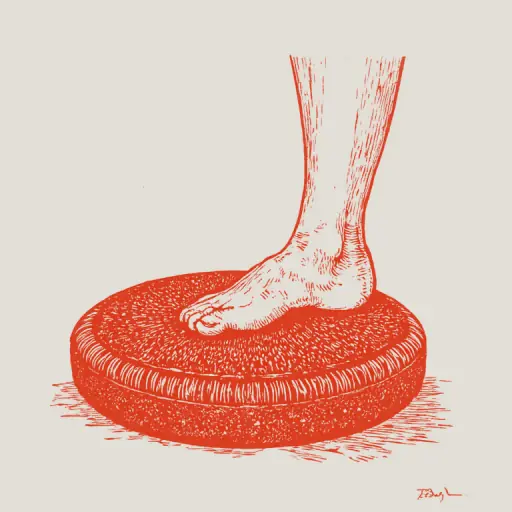
How to choose a balance cushion for workouts and posture?
- 14 min read
- 75
The modern pace of life often forces us to choose between hours of sedentary work and intense workouts. But what if you could combine back health care and physical activity right in the office or at home? A balance cushion (or balance disk) is a compact and accessible piece of equipment that creates an unstable surface.
The main secret of this equipment is that even when sitting normally or performing simple exercises, your body constantly has to maintain balance. Deep stabilizer muscles are actively engaged in this process, muscles that are rarely used during regular loads. As a result, posture improves, coordination develops, and blood circulation is activated.
The sensorimotor cushion is versatile. It is used for:
- Dynamic sitting at the computer (preventing lower back pain);
- Balance training and complicating classic fitness routines;
- Rehabilitation after joint injuries;
- Preventing flat feet in children.
In this guide, we will thoroughly examine how to choose the ideal balance disk for your needs, what characteristics (cushion diameter, maximum load, stiffness, and texture) to pay attention to, and how to avoid common mistakes when purchasing.
Step 1: Determining the Purpose of the Balance Disk
Before delving into technical specifications and stiffness, you must answer the main question: what exactly are you buying the balance disk for? This compact trainer is unique because the same model can serve as both a passive posture corrector and a tool for intensive functional training. However, the requirements for shape, density, and surface texture will differ drastically in these cases.
A clear understanding of your goals will prevent you from buying unsuitable equipment that ends up gathering dust in the corner. Let's examine two main scenarios for using the sensorimotor cushion so you can accurately define your choice vector.
For Computer Work: Dynamic Sitting and Posture Strengthening
For office workers whose day is spent in a chair, the balance cushion becomes not just an accessory, but a tool for "active sitting" (dynamic sitting). The main goal here is to break the monotony and passivity associated with a sedentary lifestyle and make the muscles work, even when you are just sitting. This is not a replacement for full-fledged physical exercise, but rather a form of prevention and tone maintenance.
How it works?
When you sit on an unstable surface, your body automatically activates deep stabilizer muscles (core muscles, pelvic floor muscles, foot muscles). These muscles constantly make micro-adjustments to maintain balance. It is this "invisible" work that is key to improving posture and reducing the load on the lumbar spine.
Practical recommendations for the office:
- Integration into the workflow: You don't need to set aside separate time for this. Use the cushion during meetings, reading, or even while watching videos. The goal is to make sitting "work" for the muscles.
- Initial stage (Adaptation): Start with short sessions (10–15 minutes) and use the cushion in its most inflated state. This will reduce the load and allow the muscles to get used to the instability.
- Focus on the hip joints: While sitting, try not to slouch backward. Actively engage your abdominal muscles, keeping your back straight. This mimics the body's natural position and strengthens the muscle corset.
Important selection nuances:
- Stiffness: For beginners and for prolonged sitting, medium stiffness is optimal. A cushion that is too soft might give a false sense of support, while one that is too stiff can cause excessive tension. Look for models that allow you to feel constant, yet manageable, instability.
- Diameter: Choose a diameter that allows you to sit comfortably without spreading your legs too wide to mimic a natural posture.
Remember: regular dynamic sitting is prevention that helps strengthen the muscles that "forget" when working at a desk and improves overall coordination.
For Functional Fitness, Balance Training, and Rehabilitation
When the topic is sports, fitness, or rehabilitation, the balance cushion ceases to be just an office accessory—it becomes a full-fledged, multifunctional trainer. In this context, your main goal is not just to sit, but to actively load the deep stabilizer muscles and improve overall coordination. This requires a more serious approach to selection.
For balance training and functional fitness:
- Increasing the load: Unlike dynamic sitting, here you must engage the whole body. The cushion is used to perform dynamic exercises: squats, lunges, plank supported by the disk. This forces the stabilizer muscles to work in a state of constant tension, mimicking an unstable surface.
- Focus on the core: The main benefit for athletes is strengthening the core muscles (abdomen, lower back) and improving the vestibular system. This is critically important for preventing injuries and enhancing athletic performance.
- Rehabilitation: For people recovering from injuries (such as ankle or lower back sprains), the disk is indispensable. It allows joints and muscles to be safely loaded in a controlled environment, improving proprioception (the sense of the body's position in space).
How to choose for sports purposes:
- Stiffness: Choose cushions that allow stiffness adjustment (if this feature is available), or those that inherently have a medium/high degree of instability. Beginners are better off starting with a softer one to master basic movements, and then gradually moving to stiffer models.
- Diameter: The optimal diameter should be large enough to provide a stable base for performing exercises, but not so large that it offers insufficient challenge.
- Material: If you plan to use the cushion for massage as part of your workout, look for models with massage spikes. Otherwise, a smooth but unstable surface will provide better loading for the stabilizers.
Step 2: Choosing the Product's Technical Specifications
We have already determined the specific purpose for which you need the balance disk: for office dynamic sitting or for intensive training and rehabilitation. However, for this trainer to be a maximally effective tool, you need to understand its physical characteristics. Choosing a cushion is not just about buying a "pretty" item; it is about selecting a tool that matches your physical parameters and goals. The safety and effectiveness of your workouts depend on these characteristics.
First and foremost, pay attention to the dimensions and material. Diameter and surface texture are key parameters that determine the type of load and safety of use. Furthermore, it is critically important to understand how to select the optimal stiffness so that the training is effective but not injurious. By studying these technical details, you can move on to choosing the ideal balance cushion for yourself.
Cushion Diameter and Selection Based on Physical Parameters (Maximum Load)
When choosing a balance disc, its geometric dimensions and strength characteristics play a key role. An improperly sized cushion will make training uncomfortable, and ignoring the weight limit can lead to quick breakage or injury.
Cushion Diameter
- 33–35 cm — The universal standard. This size is ideal for dynamic sitting on most office chairs, as well as for standing balance training (both feet comfortably fit on the unstable surface).
- 30 cm or less — Compact models, which are often chosen for children, single-leg training, or for targeted rehabilitation.
- 36–40 cm — Enlarged platforms required for people with large builds or for performing complex functional exercises (e.g., wide-stance squats).
Maximum Load
A quality balance disc is made of durable polyvinyl chloride (PVC) and can withstand a load of 100 to 150 kg (some professional models — up to 200–300 kg). For dynamic training using body weight or weights, always choose equipment with a safety margin of at least 20–30% of your actual weight. This guarantees the safety of the joints and the longevity of the trainer.
Surface Texture: Smooth Models vs. Massage Spikes
The choice of surface texture directly depends on how you plan to use the balance disc. Manufacturers offer three main options: completely smooth, massaging (with spikes), and combined (double-sided) models.
- Smooth models are optimal for dynamic sitting on an office chair. They do not cause discomfort during prolonged contact with clothing and do not leave marks on the skin. If your goal is gentle posture support while working at a computer, choose a smooth texture.
- Models with massage spikes are indispensable for barefoot training and rehabilitation. The elastic massage spikes actively stimulate reflex zones of the feet, improve blood circulation, and enhance proprioception (muscle sense). This unstable surface forces the stabilizing muscles to work even more intensely, which is critical for developing coordination and preventing flat feet.
For maximum versatility, experts recommend purchasing a double-sided balance disc: one side is smooth, and the other is covered with soft acupuncture spikes. This allows you to easily alternate between active balance training and comfortable office work.
Step 3: Adjusting Stiffness and Adapting the Choice to the User
Having decided on the shape and surface texture, it is important to move on to the individual tuning of the equipment. The effectiveness of training and the safety of dynamic sitting directly depend on how resilient your balance disc will be. Stiffness is not just a fixed factory characteristic but a flexibly adjustable parameter that must be adapted to the user's fitness level, weight, and age.
An improperly inflated sensorimotor cushion can either negate the entire health benefit or make exercises excessively difficult and even dangerous. Let's explore how to find the ideal level of resilience for a safe start and what nuances to consider if the equipment is being purchased for the youngest family members.
Optimal Stiffness for Beginners and Secrets of Proper Inflation
For beginners who are just starting to develop coordination and strengthen stabilizing muscles, high stiffness is the optimal choice. Contrary to intuition, a tightly inflated balance disc provides more stable support, making it easier to maintain balance. The softer the cushion (the less air inside), the more the unstable surface flexes, and the harder it is to control body position.
Secrets of Proper Inflation:
- Use the right tool: A standard sports pump with a ball needle will suffice.
- Protect the valve: Before inserting the needle, be sure to wet it with water or silicone lubricant. Insert the needle carefully, slightly angled, so as not to accidentally puncture the opposite wall of the item.
- Control the shape: Inflate the equipment so that it remains a flat disc, not turning into a ball. When pressing down on the center of the cushion with your palm, it should depress slightly by 1–2 cm.
As your posture and balance improve, you can gradually deflate the air, increasing the amplitude of oscillations and complicating the training.
Features of Choosing a Sensorimotor Cushion for Children and Flat Feet Prevention
When choosing a sensorimotor cushion for a child, the physiological characteristics of a growing body play a key role. The main goal of using such equipment in childhood is the prevention of flat feet, the development of coordination, and the strengthening of the foot's ligamentous apparatus.
When purchasing a children's balance disc, pay attention to the following parameters:
- Item Diameter. Compact models with a diameter of 30–33 cm are ideal for children. On a disc that is too wide, it will be difficult for a child to maintain the correct anatomical foot placement.
- Surface Relief. Be sure to choose models where one side is covered with pronounced massage spikes. They actively stimulate receptors on the soles of the feet, improve blood circulation, and promote the correct formation of the foot arch.
- Pressure Level. Do not inflate the cushion too much. A slightly deflated, soft unstable surface makes the stabilizing muscles work more effectively and gently develops the ankle joint without the risk of injury.
Using the sensorimotor cushion in a playful manner—for example, balancing on one leg or walking on 'bumps'—will turn beneficial prevention into an exciting activity.
Step 4: Analyzing Common Mistakes Before Purchase
We have thoroughly covered how to choose a balance cushion depending on the goal—whether it is improving posture while working at a computer or intensive balance training. We have also studied the technical details: from optimal diameter to choosing between a smooth and a massage surface. However, as in any field with a lot of useful information, there are pitfalls. Before making a purchase, it is crucial to know about common mistakes so that your choice is as effective and safe as possible. In this section, we will discuss what to pay attention to in order to avoid typical errors related to materials, load, and usage mode.
Common Mistakes When Choosing Materials and Ignoring Weight Limits
When purchasing a balance cushion, it is easy to make critical errors that will not only shorten the product's lifespan but also make workouts ineffective or even dangerous.
- Ignoring the maximum load. Every sensor-motor cushion has a strength limit. Cheap models are often rated for weights up to 80–90 kg. If your weight is close to or exceeds this mark, the apparatus under load will simply "spread out" on the floor. As a result, the necessary unstable surface will disappear, and the stabilizing muscles will not receive adequate load. For active workouts and dynamic sitting, choose models with a safety margin—a quality balance cushion should withstand a maximum load of 150–200 kg.
- Buying items made of cheap plastic. A quality cushion is made from dense, hypoallergenic polyvinyl chloride (PVC) with an "Anti-Burst" technology. Budget alternatives made of thin rubber quickly stretch, lose shape, and can burst during sudden movement. Furthermore, low-quality material has a strong chemical odor, slides on the floor, which impairs coordination and increases the risk of injury.
Always check the product labeling before buying: a reliable manufacturer will definitely indicate the material composition and the maximum operating weight.
Can I Sit on a Balance Cushion All Day: Safety Rules
Many people buy a balance cushion with the noble goal of replacing their regular office chair and training their back while working. However, using this trainer continuously for the entire 8-hour workday is a grave mistake that will bring harm instead of benefit.
The unstable surface forces our stabilizing muscles to remain in constant micro-tension to maintain balance. This is excellent training, but all muscles have a limit to endurance. With continuous sitting, deep back muscles become fatigued after only 30–40 minutes. As soon as they "shut down," the entire load is transferred to the intervertebral discs and ligaments, leading to slouching, muscle spasms, and lower back pain. Posture and overall coordination of movement are disrupted.
To ensure dynamic sitting is only beneficial, observe these key safety rules:
- Pace yourself. Start with 10–15 minutes, 2–3 times a day. Gradually increase the session time, but do not exceed a limit of 30–45 minutes at one time.
- Listen to your body. As soon as you feel fatigue in your lower back or catch yourself slouching heavily, immediately remove the balance cushion.
- Maintain proper geometry. Your feet must be flat on the floor, and the angle at your knee and hip joints should be about 90 degrees. Adjust the chair height according to the cushion's height.
- Alternate sides. If one side has massage spikes, use them for short sessions to stimulate blood circulation, and flip the cushion to the smooth side for longer sitting periods.
The balance cushion is a wonderful tool for active breaks, but it must remain a trainer, not a permanent replacement for an ergonomic chair.
Conclusion
Choosing a balance cushion is a simple yet important step toward healthy posture, strong stabilizing muscles, and excellent coordination. This compact trainer proves that effective body care does not require bulky equipment. The main thing is to clearly match the product's characteristics with your goals and physical parameters.
To summarize, let's recall the key selection algorithm:
- Define your goal: For dynamic sitting in the office, choose flatter and smoother models; for balance training, fitness, and rehabilitation—use contoured discs that have massage spikes.
- Consider physical parameters: Be sure to check that the maximum load matches your weight with a margin, and that the cushion diameter suits the size of your chair seat or the width of your foot.
- Adjust stiffness: Remember that beginners find it easier to start on a more resilient, well-inflated unstable surface, gradually reducing the air pressure to increase the difficulty of the training.
Remember that the health of the musculoskeletal system is built in daily small habits. A properly chosen balance cushion will become your reliable helper at home, in the office, or in the gym. Make a conscious choice based on material quality, and may every movement bring you only benefit and pleasure!