How to Choose Clothes for a Short Neck and Visually Lengthen Your Silhouette
- 6 min read
- 68
As a wardrobe expert, I understand that the perception of proportions is not an innate gift, but a skill that can be honed through a conscious approach to style. The goal of this guide is to give you a practical toolkit so that your wardrobe works for you, visually lengthening your neck and creating overall vertical silhouette harmony.
Understanding the Problem: Why Clothing Can Change Neck Length Perception
The perception of neck length heavily depends on how clothing elements interact with the décolletage area. The stylist's main task in this case is not to 'correct' anatomy, but to create an optical illusion through lines and volumes. Clothing can either draw attention to the area, making it look more compact (due to horizontal lines or volume), or, conversely, guide the eye up and down vertically, creating the illusion of elongation.
Key Principle: We are working with the vertical line. Any element that breaks this line or forces it to curve horizontally can shorten the silhouette.
Section 1. Styling Basics: Secrets of Necklines and Cuts for Lengthening the Neck
The neckline area is your main canvas. The correct choice of cut radically changes the perception of proportions.
1.1. Kings of Verticality: Ideal Necklines That Work for Your Look (Focus on V-Neck and U-Line Cuts)
These cuts are your best allies in creating visual height:
- V-Neck: This is the standard. It mimics the natural fall of a line, directing the gaze from the center of the chest toward the collarbones and down. The deeper (within reasonable limits) and cleaner the V line, the stronger the lengthening effect.
- U-Neck: Works excellently in the waistline of a dress or the décolletage of a top. It gently opens up the collarbone area without creating a sharp accent like a deep V, while still maintaining vertical direction.
- Open Collar (Unbuttoned Blouse): If you are choosing a classic shirt or blouse, never button it all the way up. Leave the top 2-3 buttons undone. This creates a natural, layered V-effect and gives the look a sense of lightness.
1.2. Styling Taboos: Which Collars and Elements Categorically Shorten the Silhouette (Turtlenecks, Stiff Collars, High Necklines)
These elements create a 'ring' around the neck, visually reducing its length:
- Turtlenecks ("High Neck"): If you need to wear a turtleneck (for example, due to the weather), do not panic. It is not a sentence. See Section 2 for ways to 'save' this element.
- High Stiff Collars and Stand-up Collars: They completely block the visual line of the neck. Avoid them as a main accent if your goal is elongation.
- 'Harness' Collars or Voluminous Jabots: Any element that creates excessive horizontal volume right at the base of the neck will 'consume' precious inches of length.
Section 2. Comprehensive Approach: Working with Accessories and Outerwear
Here we move from basic items to image correction tools.
2.1. Accessory Artillery: How to Choose the Perfect Scarf, Necklace, or Shawl (Principles of Vertical Line in Jewelry)
Accessories must work on the principle of 'vertical fall':
- Necklaces and Pendants: Choose long pendants on thin chains. Cascading or multi-strand necklaces that mimic a flowing waterfall work perfectly. Avoid massive chokers—they visually 'lock' the neck.
- Earrings: Prefer long drop earrings or chains. They continue the vertical line started by the décolletage.
- Scarves and Shawls: If you must use a scarf (especially in winter), it should not be wrapped tightly around the neck in a dense circle. It is best to:
- Create a low, loose knot that barely touches the base of the neck.
- Use a shawl that drapes freely over the shoulders as a decorative element of the outerwear, rather than as a 'wrap' around the neck.
2.2. Outerwear and Details: Cardigans, Blazers, and Scarves – How to Unbutton/Tie Them Correctly for Maximum Effect
Outerwear is your second chance for correction:
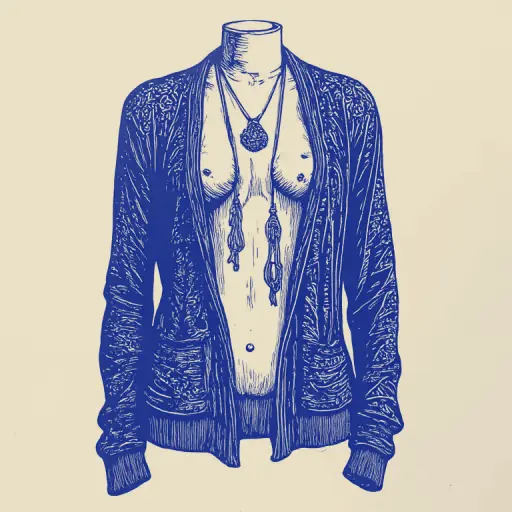
- Cardigans: If you are wearing a turtleneck or a high-necked blouse, use a cardigan. It is critical: unbutton it completely and allow it to hang freely down the sides of the body. The vertical lines of the coat/cardigan will create the necessary 'illusion' of length.
- Blazers: Choose jackets that have an open collar or lapels that can be unbuttoned and allowed to hang freely. This creates the effect of vertical lines along the torso.
- Layering Principle: If you are forced to wear something closed (like a turtleneck), use an element with a deep V-neck over it—such as a vest or a jacket with thin straps. This will 'hack' the monotony and add the necessary vertical play.
Section 3. Finishing Touches: Harmonizing the Look (Clothing + Makeup + Hairstyle)
The perfect look is not just clothing, but a cohesive composition.
3.1. Manifesting Verticality in the Look: The Role of Prints, Lines, and Color Accents in Clothing
- Prints: Prefer prints with a distinct vertical direction. These can be thin stripes (pinstripes), teardrop patterns, or vertical elements in the ornament. Avoid horizontally placed, large-format prints.
- Color: Monochromatic looks (one shade from head to toe) are your best friend. Gradual color transitions also enhance the effect of a continuous vertical line.
3.2. The Ideal Combination: Pairing Hairstyle with Wardrobe to Create an Elongated Silhouette (Hair Styling Tips)
Hairstyling should 'support' the neck line:
- Open Hair: Loose hair, styled with soft waves or sleekly, looks best. It does not create sharp horizontal barriers.
- Updos: If you are putting your hair up, avoid styles that 'cling' to the base of the neck (such as a low bun that looks like a cushion). It is better to consider higher or textured styles that visually draw attention upward.
- Makeup: To enhance the lengthening effect, use light, glowing tones on the collarbones and the upper part of the décolletage. This optically 'highlights' the area, making it more noticeable and longer.
Quick Checklist: 5 Rules to Never Make a Mistake When Choosing Clothes Again
Before leaving the house, ask yourself these five questions:
- Neckline: Did I choose a V-, U-, or open collar? (Yes = OK).
- Collars/Necklines: Does my outfit have any elements that 'hug' the neck (stiff collars, turtlenecks)? (No = OK).
- Verticality in Layers: If I am using a cardigan or blazer, is it unbuttoned and hanging freely? (Yes = OK).
- Accessories: Do my jewelry pieces create a long, descending line (chains, drops)? (Yes = OK).
- Overall Silhouette: Does my look combine vertical lines in the print or color from the shoulders down? (Yes = OK)