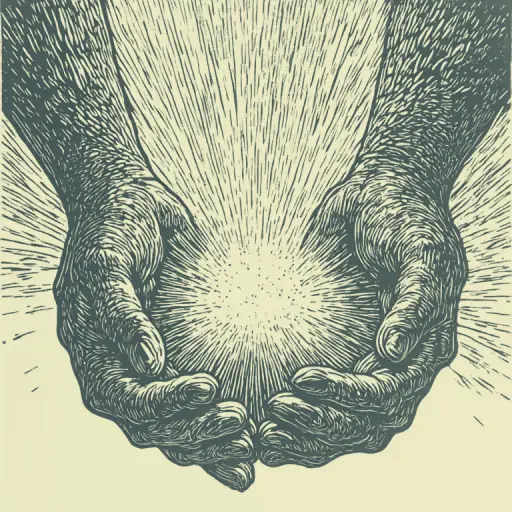
How to Feel Qi in the Body with Simple Exercises
- 14 min read
- 69
Attempting to "feel Qi" is not just a fashionable trend, but a deep return to the awareness of one's own physical and energetic potential. At the core of this practice lies the understanding that our body is not merely a collection of bones and muscles, but a complex, interconnected system of channels through which vital energy constantly circulates. Qi, or life energy, is the fundamental basis of our existence, and its free flow directly determines our physical and emotional state.
Many of us live in "autopilot" mode, ignoring internal signals. We perceive fatigue, tension, or discomfort as inevitable "problems," without realizing that this is often a sign of energy stagnation or blockage. Therefore, our goal is not just to "learn to feel," but to restore the natural connection with our inner flow, to learn to listen to and consciously manage the body.
This practical guide is designed to simplify this process as much as possible. We will not delve into complex philosophical treatises, but will focus on concrete, actionable steps. Starting with basic relaxation and breathing, we will gradually move toward exercises that will allow you not just to theoretically understand what Qi is, but to physically feel its movement in your palms, abdomen, and limbs. Remember: regularity and attention are key. The more you practice mindful attention to your body, the sharper your sensitivity to these subtle energetic processes will become.
What is Qi Energy and How Our Body Perceives It
Understanding the nature of Qi begins at the intersection of ancient philosophy and direct bodily experience. In the Eastern tradition, this vital force is not an abstract idea; it flows through the body's meridians, like water, nourishing every organ and cell. To awaken sensitivity to this flow, we must shift our focus from external noise to internal processes.
Our body is a finely tuned receiver. The perception of Qi is closely linked both to the energy centers studied by Qigong masters for centuries and to entirely explainable physiological responses of our body. Recognizing this dual nature helps us more quickly catch the first, barely perceptible signals of inner energy.
Where Vital Force Accumulates: The Lower Dantian and the Qihai Point
In Traditional Chinese Medicine and Qigong practice, the human body is viewed as a complex system of reservoirs and channels. The main storage area where primal vital force accumulates is the Lower Dantian (which translates to "elixir field"). It is located deep in the lower abdomen, about three fingers below the navel and one-third of the distance inward toward the spine. This is the center of gravity of our body, the cradle of physical strength and endurance.
The key "gate" to this reservoir is the acupuncture point Qihai, whose name translates to "Sea of Energy." It is located on the anterior midline meridian, approximately 3–4 centimeters below the navel.
- The Lower Dantian acts as an accumulator where energy is transformed and stored.
- The Qihai Point serves as the main entrance through which we can consciously direct breath and attention to awaken inner strength.
Concentrating attention on this area during practice allows one to quickly feel warmth and density—the first signs that your vital force is beginning to coalesce.
Physiological and Scientific View: Nervous System, Vessels, and Microvibrations
If we view Qi energy from the perspective of modern physiology, we find a surprising correlation: what traditional medicine calls "vital force" has direct correlations with the function of our physical systems. Qigong and meditation are essentially training for our nervous system and vascular tone.
The Nervous System as a Conductor: The meridians described in TCM can be interpreted as pathways along which the autonomic nervous system is activated. When we practice breathing and conscious movement, we are not just "moving energy," but stimulating the parasympathetic response, which is responsible for relaxation and recovery. This is the physiological basis for the sensation of flow.
Vessels and Microvibrations: The feeling of warmth, tingling, or vibration described by practitioners is often related to improved microcirculation of blood and lymph. Exercises aimed at "awakening" Qi actually improve the tone of the vascular wall and increase sensitivity to natural physiological processes. These microvibrations are not only a sign of "Qi" but also a sign of high body awareness.
Thus, the scientific view does not deny Qi, but offers a more detailed model: Qi is a metaphor for the optimal, harmonious, and conscious functioning of all bodily systems, including the nervous, cardiovascular, and lymphatic systems.
Body Preparation: Relaxation and Breathing Practices
Understanding the physiological nature of Qi is only the first step toward practically experiencing it. To transform theoretical knowledge into lived experience, the body must be prepared, becoming a sensitive receiver and a free conduit for vital force. In daily life, our bodies are constrained by habitual muscle armor, and breathing remains shallow, which literally obstructs the channels of perception and blocks natural microvibrations.
Preparation for Qigong practice always begins with two fundamental pillars: deep relaxation and setting the correct breathing pattern. Without this, any attempt to feel the movement of energy will remain mere mental visualization. We must learn to consciously remove internal barriers and use breath as the primary tool to initiate the circulation of Qi through the meridians.
Psychosomatics of Blocks: How Body Tightness Hinders Energy Circulation
In Traditional Chinese Medicine and Qigong practice, the body is viewed as a single energy system. The free flow of vital force is often hindered by physical constrictions—so-called "blocks." From a psychosomatic perspective, any unexpressed stress, fear, or suppressed emotion settles in the body as chronic muscle tension.
When a muscle is constantly contracted, microcirculation in it is disrupted, and the energetic meridians are literally squeezed. Qi cannot flow through a rigid physical barrier. Blocks are most often localized in key areas:
- Neck and Shoulder Area — blocks the ascent of energy to the head, causing mental strain.
- Diaphragm — "locks up" emotions, hindering the connection between upper and lower centers.
- Pelvis and Lower Back — obstructs access to the main reservoir of strength—the Lower Dantian.
Conscious relaxation (Fan Sun) is the active dissolution of these barriers. Without releasing physical constrictions, any attempt to feel energy will be ineffective.
Qigong Breathing as the Main Tool for Awakening and Directing Flow
Qigong Breathing is the bridge between consciousness and body, initiating the movement of vital energy. To awaken Qi energy, we use natural diaphragmatic (abdominal) breathing. It relieves residual tension and gently massages the internal organs.
Dantian Breathing Practice:
- Starting Position: Sit with a straight back or stand upright. Place your palms on the lower abdomen (two to three fingers below the navel).
- Inhale: Slowly inhale through the nose, directing the air to the very bottom of the abdomen. Feel the abdominal wall round out, and your palms lift. The chest remains still during this process.
- Exhale: Gently exhale, allowing the abdomen to naturally draw in. Imagine that with each exhale, the accumulated energy concentrates into a warm, glowing sphere in the Lower Dantian.
This Qigong breathing instantly activates the parasympathetic nervous system, preparing the body's channels for the free flow of energy.
Step-by-Step Exercises for Quickly Sensing Qi
The transition from theory and deep relaxation to direct action is a key moment in Qigong practice. When your body has released its tensions and your breathing has become steady and deep, you are ready to direct your attention toward awakening dormant sensors. The vital energy of Qi is always present within us, but in the hustle and bustle of daily life, we lose sensitivity to it.
To restore this connection, we will turn to simple yet powerful techniques that masters have used for centuries to quickly activate energy centers. These exercises do not require special physical training. They are based on concentration and gentle movement, allowing you to literally 'touch' the invisible flow and connect your own biofield with the forces of nature.
'Energy Ball' Practice and Activating Laogong Points in the Palms
Begin by activating the Laogong ('Palace of Labor') points located in the center of your palms.
- Vigorously rub your palms against each other for 10–15 seconds until you feel intense heat.
- Take a deep breath, and on the exhale, gently press the thumb of one hand onto the center of the opposite palm, then switch hands. This stimulates blood flow and nerve endings.
- Spread your palms about 20–30 centimeters apart, bending your elbows and relaxing your shoulders. Hold your hands as if you are embracing the trunk of a tree.
- Slowly bring and spread your palms (the amplitude of movement is only a few centimeters). Imagine that there is a taut, warm air ball between them.
- Concentrate all your attention on the space between your hands.
Soon, you will feel slight resistance, tingling, warmth, or a sensation of magnetic attraction. This is your first tactile encounter with Qi energy.
Connecting Heaven and Earth: Breathing Through the Feet and Crown
After your palms have awakened, it is time to connect the entire body to the practice, linking the two main sources of vital energy—Earth (Yin) and Heaven (Yang). This exercise establishes the central energy conduit and helps you feel like part of a single cosmic flow.
- Assume the correct stance: Stand upright, feet parallel and shoulder-width apart, knees slightly bent, as if you are sitting on a high chair. Relax your shoulders and open your chest.
- Inhale through the feet: Take a slow, deep breath. Imagine the dense, supporting energy of the Earth rising through the centers of your feet (Yunjuan points), flowing up through your legs, and accumulating in the Lower Dantian.
- Inhale through the crown: In the next breathing cycle, visualize pure, light energy from Heaven entering through the crown (Baihui point), descending down the body, and connecting with the earthly force in the abdominal area.
Practice this breathing for 5 minutes. You will feel your body gaining extraordinary stability, and inside, you will feel a pleasant expansion and light pulsation.
How to Recognize Qi: Physical Sensations and Basics of Control
When the ascending and descending flows become rooted in the body, and the palms are filled with dense warmth, a natural question arises: how exactly do we recognize that what we are experiencing is not just imagination, but the real movement of vital energy? Our body is the most delicate tuning fork. It responds to the slightest changes in Qi circulation with very specific physiological responses, which may initially seem unfamiliar.
Recognizing these signals is the first step toward conscious energy control. By learning to register subtle changes in the body, we can not only passively observe them but also direct this flow along the main energy highways of our body, transforming chaotic sensations into a harmonious system of self-regulation.
What Physical Sensations Arise: Tingling, Warmth, and Vibration
When vital energy begins to circulate freely through the body's meridians, our brain interprets this process through specific physical markers. These sensations are not self-suggestion, but a real response of the nervous and vascular systems to focused attention and relaxation.
Practitioners most often encounter the following manifestations:
- Pleasant warmth or heat. This usually originates in the palms (at the Laogong points) or in the Lower Dantian, and then spreads outward in a soft wave to the limbs. Physiologically, this is related to capillary dilation and improved microcirculation of blood.
- Light tingling. It resembles weak static electricity discharges or the movement of tiny bubbles under the skin. This is how nerve endings react to the harmonization of the biofield.
- Vibration and humming. A feeling of internal pulsation, 'buzzing,' or slight magnetic attraction between the palms, indicating a high concentration of energy.
By recognizing these signals, you can move from passive observation to conscious direction of the flow.
Basics of Energy Movement: The Microcosmic Orbit
Having mastered the basic sensations, you are ready to direct the flow along the body's main energy circuit—the Microcosmic Orbit (Small Heavenly Orbit). This path unites two crucial meridians: the Du Mai (Back-Centrum), which runs from the coccyx up the spine to the crown, and the Ren Mai (Front-Centrum), which descends from the face along the front line of the body back to the groin.
To complete this circuit, perform the key steps:
- Build the 'Tongue Bridge': Gently press the tip of your tongue against the upper palate just behind your front teeth. This physically connects the two channels.
- Direct attention on inhalation: Mentally guide the warmth and tingling from the Lower Dantian down to the groin, and then up the spine to the crown.
- Release the flow on exhalation: Allow the energy to smoothly drain from the crown, through the palate, throat, and chest, back into the Dantian.
Do not force the movement with muscle strength. Use gentle intention, allowing the energy to naturally follow your attention, like warm water.
Overcoming Difficulties and Developing Sensitivity
The path to sensing vital energy is rarely linear. Even after thoroughly studying meridian trajectories and mastering basic exercises, many practitioners encounter the issue that their sensations remain barely perceptible or disappear temporarily. In Eastern philosophy, this is considered a natural stage: our perception gradually reconfigures, overcoming the physical stiffness and mental noise accumulated over years.
If you do not feel warmth or tingling in the beginning, it does not mean there is no progress. Often, the reason lies in excessive effort or subtle errors in technique. Let's examine what internal barriers prevent the free flow of Qi and how simple adjustments can make practice a regular source of strength.
What to do if you cannot feel the energy: common mistakes
If you are unable to feel the movement of vital energy in the beginning, do not get discouraged. Most often, the barrier is typical errors that are easy to correct:
- Excessive muscle tension. When trying to "feel" the energy, beginners often unconsciously clench their shoulders, jaw, or hold their breath. In Daoist tradition, there is the principle of Sun (active relaxation). Qi energy flows freely only when the body is completely relaxed and the joints are "open."
- Too much mental concentration. Expecting dramatic special effects—like an electric shock or a powerful vortex—prevents you from noticing subtle signals. Start small: a light tingling in the palms, a barely noticeable feeling of warmth, or the density of air between your hands—these are the first manifestations of qi.
- Stiff spine. If the back is curved, the body's meridians are compressed, blocking circulation. Ensure that your tailbone is slightly tucked and your crown is reaching upward.
Try to reduce the importance of the result. Shift the focus from the question "Am I feeling it?" to simply observing the qigong breathing and the physical sensations in the body.
Recommendations for regular training and deepening practice
To turn the initial glimpses of Qi sensation into a stable skill, a systematic approach is necessary. Energy channels adapt to new loads gradually, much like blood vessels.
Here are key recommendations for deepening your practice:
- Principle of consistency: Practice daily for 10–15 minutes, instead of grueling two-hour sessions once a week. Regularity forms new neural connections and prepares the nervous system for the conduction of subtle signals.
- Keeping a sensation journal: Immediately after practice, record any physical manifestations: warmth in the palms, tingling, pulsation in the lower Dantian, or a light breeze along the spine. This strengthens the mental connection with the body.
- Gradual complication: Start with simple relaxation exercises and activating the Laogong points. Only after the sensations in your hands become stable should you move on to static standing in the "Pillar" posture (Zhang-Zhuang) and practicing the Microcosmic Orbit.
- Daily mindfulness: Transfer your focus to qigong breathing during daily activities—while walking, washing dishes, or waiting in line.
Remember the Daoist principle of Wu Wei (action through non-action): do not try to evoke sensations through willpower. Simply create the conditions, relax, and allow the vital energy to flow naturally.
Conclusion
The feeling of Qi energy in the body is not a mystical gift available only to the chosen few, but a natural result of synchronizing your attention, breathing, and physical relaxation. By taking the first steps through simple exercises, such as the "Energy Ball" or foot breathing, you have opened the door to a deeper understanding of your body.
Regular qigong practice will gradually transform faint tingling and warmth into a stable flow of vital energy, capable of strengthening health, relieving stress, and harmonizing the psychosomatic state. Remember that the path to mastering Qi requires patience and the absence of excessive expectations. Allow the energy to flow naturally, listen to your body's signals, and make these simple exercises a part of your daily life. Your journey toward inner harmony and unlocking the potential of vital energy is just beginning.