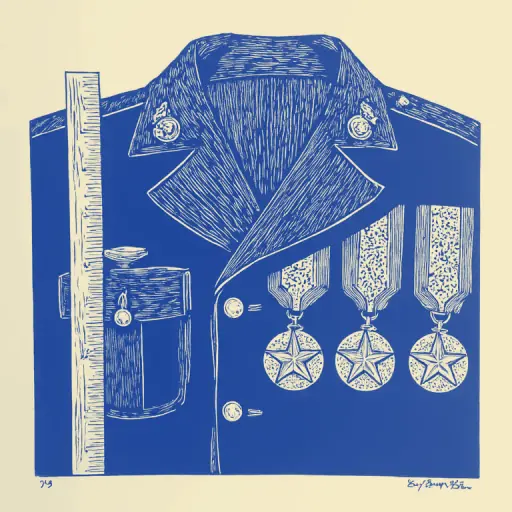
How to position medals on a jacket according to official instructions with photos
- 16 min read
- 84
The correct positioning of insignia on a military uniform is not merely a matter of aesthetics, but a rigorous requirement of military discipline and respect for national symbols. Every order, medal, or breast insignia has a location strictly regulated by the regulations. Errors in their placement on the dress coat are inadmissible: they are immediately noticeable at solemn events, parades, and inspections.
In this practical guide, we will analyze in detail the current rules for the use of decorations, based on the current order of the Ministry of Defense of the Russian Federation and the regulations of other security agencies (Ministry of Internal Affairs, Federal Service for Disaster Management). You will learn how to determine the distance from the lapel without error, how the insignia are distributed on the left and right sides of the chest, how to assemble the general pentagonal ribbon, and how to correctly fasten the order ribbons.
Basic Rules for Positioning Decorations on the Uniform
The impeccable appearance of the dress coat begins with understanding the fundamental principles of military heraldic etiquette. The positioning of insignia on the coat is strictly regulated by state standards and departmental orders, leaving no room for chance. Every element—from a state medal to a discreet service badge—has a strictly defined coordinate, linked to anatomical references and the details of the uniform cut.
Before proceeding with precise measurements using a ruler, it is necessary to assimilate the basic logic of the composition. It is based on the rigid division of decorations by the sides of the chest, depending on their status, and also on considering the specificity of each agency, whether it is the Ministry of Defense, the Ministry of Internal Affairs, or the Federal Service for Disaster Management. Understanding these fundamentals will prevent gross errors when preparing the uniform for solemn events.
Left and Right Chest: Distribution of Orders, Medals, and Insignia
The distribution of decorations on the coat is strictly regulated by the rules for the use of decorations and follows a unified logic: the left side is designated for special state recognition insignia, and the right side is designated for personal professional achievements, distinction badges, and wounds.
Left Chest (closer to the heart) is traditionally reserved for the most significant state and departmental decorations:
- Orders and medals that have a pentagonal ribbon (they are mounted on a general ribbon);
- "Impeccable Service" distinction badge;
- Order ribbons (used on the service coat instead of the original decorations).
The positioning of decorations on the left side strictly follows from right to left (from the center of the chest to the left shoulder) in order of seniority.
Right Chest is used for the positioning of the following elements:
- Orders without ribbons (pinned on);
- "For Distinction in Military Service" medal;
- Breast insignia (for completion of educational institutions, classification, honorary titles);
- Wound number insignia (pinned 10 mm above other decorations and insignia).
This division helps to correctly read the military's service biography.
Specifics of Attaching Decorations on Coats of Different Agencies (MD, MI, SGD)
Each security agency is governed by its own heraldic rules, which define the details of the decoration positioning on dress coats:
- Ministry of Defense (MoD of the RF): According to the current order of the MoD of the RF, on the dress coat of one side (sea green or blue), there is a strict limit—it is permitted to position a maximum of 10 state and departmental medals on the left side of the chest. They are composed in two rows (maximum of 5 in each) on a single ribbon. The use of public and unofficial insignia is strictly prohibited.
- Ministry of Internal Affairs of Russia (MIA of the RF): Regulated by a specific departmental order. On the steel or dark blue coat, the top edge of the first row of ribbons is strictly leveled with the level of the lapel notch (or 70 mm below its angle). Special attention is paid to symmetry relative to the seams.
- Federal Service for Disaster Management of Russia (FSDM of the RF): The rules largely replicate military rules but have their own specifics. On the dress coat, departmental medals (e.g., "For Distinction in Service" in three grades) and rescue operation insignia are arranged in a general line strictly after the state decorations of the RF.
Positioning Scheme and Exact Measurements in Millimeters
The violation of regulatory distances, even by a few millimeters, transforms the dress uniform into a poorly arranged garment and can lead to reprimands from inspectors. The impeccable appearance of the military personnel or security officer depends directly on the strict adherence to geometric precision when fastening decorations. In this section, we move from theory to exact calculations. We will analyze the official marking schemes approved by the current orders and define the basic reference points that will help you prepare the coat without errors for any solemn event using a standard ruler.
The 70 mm Rule: Defining the Lapel Distance
According to the current order of the MoD of the RF, the key reference point for positioning the first row of decorations on the left side of the chest is the so-called "70 mm rule." This measurement defines the exact distance from the lapel where the medals must be hung for the dress coat to appear impeccable and strictly compliant with regulations.
Step-by-step measurement algorithm:
- Find the lapel notch point (for a one-sided coat) or the lapel angle (for a two-sided coat and service coat).
- Apply a rigid ruler vertically from this point, parallel to the button line.
- Measure exactly 70 mm and make a careful mark with chalk or soap. The top edge of the pentagonal ribbon of the first row of medals or orders (or the top edge of the order ribbon) must be located at this level.
| Uniform Type | Lapel Reference Point | Distance to Top Edge of Ribbon/Ribbon |
|---|---|---|
| One-sided coat (MoD, MIA, FSDM) | Lapel notch | 70 mm |
| Two-sided coat, service coat | Lapel angle | 70 mm |
This positioning scheme ensures that the decorations are not covered by the collar and maintain the correct position during movement.
When positioning decorations in multiple rows, it is crucial to observe symmetry and the rules for overlapping ribbons. According to the current regulations of the agencies (including the MD Order of the Russian Federation), the marking is performed following these rules:
- Spacing Between Rows: The general ribbon of the second and subsequent rows must partially overlap the medals of the preceding row. The top edge of the ribbons in the lower row is positioned so that the depth of the overlap under the upper row is exactly 10–15 mm. This ensures compactness and excludes empty spaces in the fabric.
- Reference by Pockets: On coats with breast pockets (characteristic of the Ministry of Internal Affairs and the Federal Service for Disaster Management), the bottom edge of the ribbons in the lower row is strictly leveled with the top of the left pocket closure.
- Centering: The entire assembled block of decorations is centered along the vertical line passing through the middle of the visible torso of the coat or through the center of the left pocket.
After marking the coat and defining the exact limits of the rows, it is necessary to proceed to the most responsible stage—determining the precedence of the decorations and their immediate assembly. In military heraldry, this process is rigorously regulated: chaotic positioning is inadmissible and considered a serious violation of uniform usage rules.
Each medal has a unique status that determines its exact position on the chest relative to other insignia.
The correct arrangement of the medal bar requires not only knowledge of the hierarchy—from the highest state symbols to departmental and commemorative medals—but also an understanding of the mechanics of their union in multi-row structures. Below, we detail how to arrange this sequence without errors, from left to right and from top to bottom, so that its gala appearance is in full compliance with the current decrees of the departments.
Medal Hierarchy: From State to Departmental Decorations
The basis of the correct positioning of decorations on the gala coat is the strict adherence to their precedence. According to Presidential Decree of the Russian Federation No. 1099 and the current order of the Ministry of Defense of the Russian Federation, all insignia are arranged from left to right in a strictly defined sequence:
- State Decorations of the Russian Federation and the USSR. This is the highest priority. This includes orders and medals of the Russian Federation (for example, the "For Courage" medal or the medal of the "For Service to the Fatherland" order). They always lead the general bar on the left side of the chest.
- Departmental Decorations. These are arranged strictly after the state decorations. Priority is given to medals from the department where the military personnel is currently serving (Ministry of Defense, Ministry of Internal Affairs, Federal Service for Disaster Management, FSB).
- Service Time Medals. The "For Distinction in Service" or "For Impeccable Service" insignia are placed at the end of the departmental decoration block. They are hung by grade—from Grade I (for 20 years) to Grade III.
- Social and Commemorative Insignia. These are arranged last and only if there is official authorization for use.
Important statutory rule: if you have decorations with the same name from different grades, only the insignia of the highest grade is affixed to the coat (with the exception of the George Cross and insignia).
How to Correctly Arrange Multiple Medals in Multiple Rows
If the number of decorations exceeds five, it is physically impossible to accommodate them elegantly in a single line. In this case, according to the current order of the Ministry of Defense of the Russian Federation, the medals are composed in multiple rows, using common bars.
Main rules for multi-row arrangement:
- Limit Per Row: In a row on the left side of the chest, no more than 5 decorations are arranged on pentagonal bars.
- Overlap Effect: The bars are connected in a line so that each bar to the right partially overlaps the bar to the left. The upper faces must form a continuous and uniform line.
- Cascade Arrangement: The second and subsequent rows are positioned below. In this arrangement, the top part of the bars in the lower row must pass underneath the medals hanging from the upper row.
- Distance Maintenance: On the gala coat, the top edge of the bars in the first row is invariably positioned 70 mm below the level of the lapel corner.
This arrangement scheme ensures that even an impressive set of decorations appears tidy, without deforming the coat fabric.
Practical Guide to Assembling the General Bar
After determining the exact order of decoration precedence and calculating their quantity in rows, comes the most crucial stage—joining the individual pentagonal bars into a monolithic structure. The impeccable appearance of the gala coat depends directly on the precision of the assembly: any misalignment or gap between the elements will instantly break the rigorous geometry of the military uniform.
Assembling the general bar yourself requires not only patience but also knowledge of small technical details. In this practical guide, we will detail how to manually connect the medals into a rigid, straight line and affix the finished structure to the coat fabric, completely eliminating the risk of the decorations falling off or damaging the expensive wool fabric.
Step-by-Step Manual Assembly of Decorations on a Single Bar
Assembling a single bar for multiple medals requires care so that the decorations are level and not twisted. To work, you will need pentagonal bars, a general metal or plastic base bar (which can be purchased in military supply stores), and fine tweezers.
Step-by-step assembly algorithm:
- Preparation and Arrangement. Place the medals on the table strictly according to precedence, from right to left (according to the rules for using decorations from the Ministry of Defense of the Russian Federation order). The most honorable decoration must be on the right end of the general bar—as it will be closest to the lapel when worn on the left side of the chest.
- Alignment by Top Line. The upper faces of all pentagonal bars must form a continuous straight line.
- Bar Overlap. Each bar to the right must partially overlap the bar to the left. The ideal width of the visible overlapping part of the bars is adjusted according to the total number of bars in the row.
- Fixing to the Base Bar. Pass the fixing pins or hooks of the bars into the grooves of the general base bar. From the back, carefully secure them with tweezers or fix them with special clips.
Ensure that the ribbons are stretched firmly, without twists or folds, and that the medals are hanging freely and without tangling.
Secure Attachment Methods to the Jacket Fabric Without Damaging the Material
Fixing the assembled bar to the jacket so that it remains perfectly straight, without pulling the fabric or leaving marks, is a task that requires precision. There are several tested attachment methods that will protect the dress uniform from damage:
- Classic Pin with Buffer. If the bar is fastened with a standard long pin, you must use a backing on the inside of the jacket. A small piece of dense felt, wool, or leather, placed internally at the puncture site, will distribute the weight of heavy decorations and protect the wool fabric from deformation and tearing.
- Screw Fastening (with nuts). The safest and gentlest method for multi-row bars. For this, the jacket fabric fibers are carefully separated with a scalpel (without cutting them), and small metal grommets are installed. The bar screws pass through them and are secured from the inside with nuts through a plastic or metal reinforcement plate.
- Clip Fastening (Butterfly Clips). A modern and quick method. Fine clip needles minimally traumatize the fabric fibers, and the flat clips hold the bar firmly from the back.
Expert Tip: Never puncture the jacket fabric "in the air." Place the uniform on a flat, firm surface, pre-marking the entry points for the needles or screws with soap or tailor's chalk.
Rules for Using Order Bars and Breast Insignia
The transition from dress uniform to casual wear requires replacing full-sized decorations with more concise elements—order bars and breast insignia. According to statutory regulations and departmental orders (including the Armed Forces, Internal Police, and Rescue Service), the casual jacket should not be overloaded with heavy medals. Instead, a rigorous system of fabric bars and metal insignia is used that clearly reflects the military's merits, training, and functional status.
The correct positioning of these elements is regulated with no less rigor than the assembly of medals. Every millimeter matters: the distance from the lapel, the centering relative to the pockets, and the strict hierarchy of arrangement. Let's analyze how to fasten the bars and insignia on the casual jacket without errors, complying with current regulations.
Positioning of Order Bars on the Casual Uniform
On the casual uniform, instead of full-sized orders and medals, order bars are used. According to the current order of the Armed Forces of the Russian Federation, they are placed exclusively on the left side of the chest.
Main rules for positioning bars on the casual jacket:
- Bar Height: The standard height of a ribbon bar is strictly 8 mm.
- Reference Point: The top edge of the first (upper) row of bars must be exactly 70 mm below the notch level of the jacket lapel.
- Arrangement Order: The ribbons are fastened on a common base from right to left (from the center of the chest to the left shoulder), in strict conformity with the hierarchy of decorations.
If there are many decorations, the bars are composed in several rows. In this case, no more than 4 ribbons are arranged in a single row. The lower rows are positioned directly below the upper rows, with no spacing. On casual uniform jackets (the so-called "office" uniform), the bars are fastened directly above the closure of the left front pocket.
How to Correctly Fasten Academic, Honor, and Functional Insignia
Breast insignia (academic, honor, and functional) are traditionally placed on the right side of the chest. Their positioning is strictly regulated by current departmental orders (in particular, the Order of the Armed Forces of the Russian Federation No. 300):
- Academic Insignia (for university graduation): Only one higher education institution insignia is permitted. If there are insignia from two or more civilian or military universities, only one must be used—the one of higher level (e.g., from a military academy).
- Honor Title Insignia: Honor title insignia ("Honored Military Specialist," etc.) are placed above the academic ones.
- Functional Insignia: Qualification class insignia ("class") and "Guard" or service excellence insignia are fastened below the academic insignia or to its right.
Positioning Rule:
The insignia are arranged horizontally in a single row, from left to right (from the center of the chest to the edge). The total number of breast insignia in a row must not exceed three (four for some departments). The distance between the outer points of the insignia is exactly 10 mm.
Conclusion
The correct positioning of decorations on the jacket is not just compliance with statutory and departmental order requirements, but also a demonstration of deep respect for military traditions, the country's history, and one's own merits. The impeccable appearance of the dress uniform visibly demonstrates the discipline and high status of the military or security service official.
Before every solemn event, parade, or formation inspection, always perform a final check of your uniform:
- Control Measurement: Ensure that the key distance of 70 mm from the lapel notch or corner to the top edge of the first row of decorations is strictly maintained.
- Fastening Security: Verify that the overall bar or individual pentagonal decorations are firm, not dangling, and not deforming the jacket fabric.
- Element Care: Carefully clean the metallic parts of the decorations with a soft, dry microfiber cloth to remove fingerprints and dust. Keep the moiré silk ribbons clean.
Store decorations separately from casual clothing in special cases or panels. This will protect the ribbons from fading and the metal from accidental scratches. Remember that attention to detail is the foundation of the impeccable appearance of the Defender of the Fatherland.