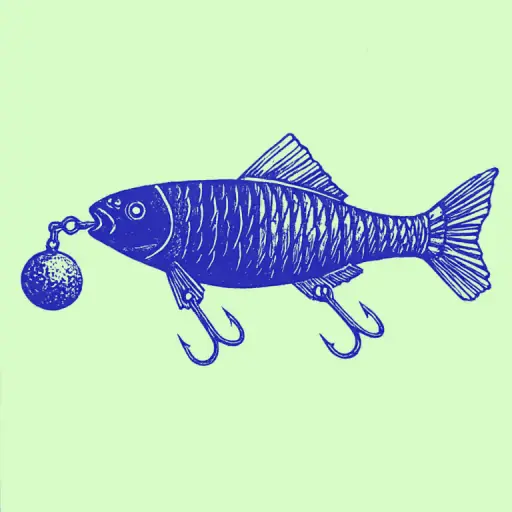
How to rig a silicone lure with a double hook using simple instructions?
- 15 min read
- 77
Jig fishing for predatory fish—zander, pike, and large perch—demands maximum reliability from the tackle. Every spinning angler has encountered frustrating dry strikes when the fish only lightly bites the tail of a vibrotail or twister. The correct mounting of silicone onto a double hook helps solve this problem.
Unlike a classic jig head or an offset hook, a double hook ensures excellent fish hooking due to its two open points. Combined with a detachable 'cheburashka' weight, this hinged mounting gives the lure freedom of movement and increases casting distance. However, many anglers, especially beginners, find the rigging process difficult: how to thread the double hook onto the rubber evenly and without damaging the delicate material?
In this practical guide, we will break down the step-by-step mounting algorithm, teach you how to correctly select the double hook size for different lure types, and reveal the secrets to safely opening the hook eye.
Preparation: How to Choose the Lure and Double Hook
The effectiveness of jig fishing largely depends on how harmoniously the tackle components match. Before starting the mounting, it is necessary to correctly select the 'pair': the silicone lure and the double hook. A mistake at this stage can ruin the action of even the most effective vibrotail or lead to frequent dry strikes and the fish washing off.
The correct choice is based on understanding the geometry of the lure's body and the physical parameters of the hook. We need to figure out which silicone shapes are ideally suited for mounting on a double hook, as well as how to correctly correlate the shank length, wire thickness, and hook size with your lure's dimensions to achieve maximum hooking rate.
Which Silicone Shapes Best Combine with a Double Hook
Not every silicone lure is equally suitable for mounting on a double hook. To ensure the mounting is neat and the lure's action remains attractive, it is important to consider the geometry of its body.
The following shapes work best with a double hook:
- Vibrotails (shad and slim models). Lures with a moderately flat or streamlined body are an ideal choice. The double hook is securely fixed in the dense silicone, and the hook points exit along the sides of the back, not interfering with the active movement of the tail fin. Overly "fat" models are harder to mount as they can deform significantly.
- Twisters. The classic streamlined body of a twister handles double hook mounting perfectly. Since the twister only has a sickle-shaped tail that moves, the rigid hook frame in the body does not affect its catchability.
- Elongated Slugs and Creatures. Models with a dense worm-like body are also suitable for this mounting, especially when fishing active zander in currents.
Avoid using double hooks on overly thin, delicate worms or lures with many small, movable legs on the sides—the hook may damage their structure even during assembly.
How to Correctly Select Hook Size and Wire Thickness
Choosing the right double hook is key to ensuring the lure retains its natural action and the predator hooks securely. The main rule for determining hook length is: its shank must occupy 1/3 to 1/2 of the silicone body's length (without capturing the tail section). A double hook that is too long restricts the vibrotail's movement, while one that is excessively short increases the number of dry strikes.
Use the following ratio for quick selection:
| Lure Length (inches / cm) | Recommended Double Hook Size |
|---|---|
| 2.5" – 3" (6–7.5 cm) | #2 – #1 |
| 3.5" – 4" (9–10 cm) | #1/0 – #2/0 |
| 4.5" – 5" (11–12.5 cm) | #3/0 – #4/0 |
Hook wire thickness directly affects the lure's presentation and the reliability of the fight:
- Thin wire is optimal for delicate "edible" silicone. It minimally traumatizes the material during mounting and penetrates the fish's mouth more easily when setting the hook with light tackle.
- Thick wire is indispensable when fishing large pike and zander on heavy jigs. Such a hook will not bend under extreme load and will reliably hold a trophy.
What You Need for Mounting and How to Prepare the Double Hook
Choosing the right lure and hook is only half the battle. To ensure the mounting process goes smoothly and the silicone doesn't break on the first attempt, you must prepare your workspace and the double hook beforehand. Quality assembly of a jig rig requires not only neatness but also a minimal set of auxiliary tools that will protect your fingers from accidental punctures and the lure from unnecessary damage.
Before threading the metal eye through the soft body of a vibrotail or twister, the hook needs to be prepared correctly. A small preliminary manipulation of the shank will significantly ease the mounting and preserve the integrity of the silicone without reducing the strength of the entire structure when fighting a large predator.
Tools and Tackle Components for Jig Fishing
For quality mounting of silicone onto a double hook, you will need a minimal but specialized set of tools and tackle components. Prepare your workspace and lay out the following components before you:
- Silicone lures—vibrotails or twisters of the required size.
- Double hooks—choose specialized models with a long shank that minimize body damage during rigging.
- Detachable 'cheburashka' weights—the optimal choice for hinged mounting, ensuring free lure action and quick weight changes.
- Pliers for spreading—small pliers, round-nose pliers, or specialized hook spreading tools. This will protect your fingers from punctures and help neatly spread the shank.
- Marker or waterproof marker—for accurately marking the exit points of the hooks on the silicone body.
Having this simple arsenal guarantees that the jig rig will be neat, and the lure will maintain its integrity and attractive action.
How to Safely Spread a Double Hook Without Losing Strength
Spreading the hooks is a delicate procedure that requires care. Most quality double hooks are made of resilient, hardened steel capable of springing back without residual deformation. Our goal is to temporarily increase the distance between the points to thread the lure body without causing excessive silicone damage.
For safe spreading, follow these simple rules:
- Use a lever. Insert a flat object (such as a coin, a knife butt, or a slotted screwdriver) between the shanks closer to the eye and gently twist it.
- Control the force. Spread the points slowly with your fingers, without sudden jerks. It is enough to spread them by 10–15 mm so that the body of the vibrotail or twister can pass freely between the points.
- Check the elasticity. A quality hook should return almost completely to its original position after the load is removed. If the wire bends easily and "remembers" the deformed shape, such a double hook will quickly break or bend during the fight with a large predator.
Step-by-Step Guide to Attaching Silicone to a Double Hook
After preparing the double hook, we move on to the most critical stage—the direct mounting of the lure. Properly attaching the silicone to the double hook is a true art that demands extreme precision. The slightest mistake at this stage can cause a vibrotail or twister to swim crookedly in the water, roll onto its side, or quickly become unusable due to critical tears in the soft material.
To avoid frustrating failures and to maximally preserve the silicone's structure, the entire mounting process is divided into two sequential steps. First, we will precisely determine the mounting geometry, and then we will carefully pass the hook eye through the body of the lure. Let's break down these actions in detail so that your mount is perfect from the first attempt.
Hook Fitting and Marking the Lure Piercing Point
Proper fitting is the key to ensuring that the lure does not deform, bulge, or swim unnaturally in the water. Mistakes at this stage lead to the silicone tearing quickly or slipping off during casts.
Perform the marking according to the following algorithm:
- Place the double hook against the side of the lure. Align the hook eye with the 'nose' (front end) of the vibrotail or twister. The eye should slightly protrude beyond the head section—just enough so that it can later be freely inserted into the split shot.
- Determine the piercing point. Look at where the straight shank of the hook ends and the bend (point) begins. This is where the double hook must exit the lure's body.
- Make a mark. Carefully mark this point on the back or side of the silicone. You can do this by lightly pressing with a fingernail, making a tiny puncture with the hook point, or using a waterproof marker.
Expert Tip: If you are mounting a lure with a narrow body, mark the point strictly along the central axis. This guarantees perfect coaxial alignment and stable action in the current.
Step-by-Step Process of Inserting the Eye and Exiting the Hooks
For correct mounting, perform the following steps:
- Side Pierce. Hold the lure in one hand and the prepared double hook in the other. Pierce the silicone body with one of the points exactly at the side point you marked during fitting. The puncture must pass completely across the lure's body.
- Insert the Eye. Thread the hook through the resulting hole so that its mounting eye is completely inside the silicone body.
- Advance Towards the Head. Gently push the double hook eye forward inside the lure body toward its 'nose.' Try to guide it strictly along the longitudinal axis to avoid tearing the delicate side walls.
- Exit Outward. When the eye hits the head end, gently push it out through the center of the 'nose.'
- Final Seating. Pull the silicone forward until it stops. The hook points must fit snugly and symmetrically against the lure body on both sides, without deforming its shape.
Assembling the Hinged Rig with a Weight
A silicone lure properly mounted on a double hook is only half the battle. For the lure to come alive in the water and attract the predator with its natural action, it must be correctly combined with a weight. In modern jigging, the de facto standard is a hinged rig using a split-shot weight. Such a flexible connection not only ensures maximum freedom of movement for the vibrotail or twister during retrieves and pauses but also significantly increases casting distance.
Assembling this rig requires care: the slightest misalignment or incorrectly chosen weight eye can deprive the lure of its attractive action or lead to constant tangling of the rig. Let's examine how to quickly and securely fasten the weight, and also ensure that our tackle is perfectly balanced.
How to Connect the Double Hook Eye to the Split-Shot Weight
The hinged rig with a split-shot weight is valued by spin anglers for the lure's maximum mobility and quick assembly. To correctly connect the already equipped double hook to the weight, perform these simple steps:
- Remove the Clip: Take the wire clip (armature) out of the split-shot weight's slot.
- Attach the Hook: Thread the double hook eye onto one of the wire clip's eyes. Pay attention to the orientation: the hook points must face strictly upwards.
- Orient the Weight: Flip the clip so that its mounting eye (to which the leader is attached) is directed upwards and slightly forward relative to the lure body.
- Secure the Rig: Insert the clip with the hook back into the lead or tungsten body of the split-shot weight until it stops.
| Rig Component | Correct Position | Effect |
|---|---|---|
| Double Hook Points | Directed strictly upwards | Reduces bottom snagging, secure fish hookset |
| Split-Shot Eye | Oriented vertically | Freedom of silicone action during fall and retrieve |
This flexible connection provides the vibrotail or twister with a natural action during jigging drops and significantly increases casting distance.
Checking Lure Coaxiality and Correcting Mounting Errors
After assembling the hinged rig, be sure to check its coaxiality. Hang the finished lure by the free 'split-shot' eye: the vibrotail or twister must hang perfectly straight, without bends or twists. The double hook points must be positioned strictly symmetrically relative to the dorsal line, and the hook eye must exit exactly at the center of the lure head.
If you notice defects, correct them before casting:
- Lure is bent 'like a accordion': this means the distance between the piercing point and the lure head is less than the shank length of the hook. Slide the silicone slightly forward along the shank or carefully redo the mount by making the puncture slightly further back.
- Rolling onto its side: if the hook is shifted from the central axis, the lure will wobble during the retrieve. Remove the points and redo the puncture, orienting yourself to the longitudinal seam on the silicone body.
- Lure slipping: if the silicone is not seated tightly, secure it with a drop of superglue where the eye exits the head.
Comparing the Double Hook with Other Rigs and Fishing Tactics
A properly assembled hinged rig with a double hook is a powerful weapon in a spin angler's arsenal, but there are no absolutely universal solutions in jigging. To consistently stay in the catch, it is important to clearly understand under what conditions the double hook will unlock its maximum potential, and where it will yield to other types of rigs. Fishing effectiveness depends on the balance between the lure's ability to pass through obstacles and the reliability of hooking the predator.
In this section, we will conduct a detailed comparative analysis of the double hook against its main competitor—the offset hook—weighing their strengths and weaknesses, and also discussing specific tactical scenarios on the water. You will learn how design features affect the silicone's behavior in the water and at which points casting the double hook rig will bring the most confident bites.
Advantages and Disadvantages of the Double Hook Compared to the Offset Hook
Choosing between a double hook and an offset hook is always a compromise between lure maneuverability and hookset efficiency. To make it easier for you to decide which to use for specific fishing conditions, we have systematized their key differences.
| Comparison Criterion | Double Hook (Double) | Offset Hook (Offset) |
|---|---|---|
| Hookset Realization | High (two open points securely catch the fish) | Medium (requires a powerful hookset to free the point) |
| Obstacle Passage | Low (easily snags on snags, rocks, and algae) | Maximum (the point is pressed against the silicone body, 'non-snagging') |
| Lure Retention | Excellent (silicone is less likely to slip during strikes) | Medium (the head part breaks easily on the step) |
| Casting Distance | High (in a hinged rig with a swivel) | High (excellent aerodynamics) |
When to choose a double hook:
- On clean sandy, shell, or clay bottoms without pronounced snags.
- When fishing passive pikeperch or perch that only lightly 'nibble' the lure's tail.
- For hunting large pike with a tough mouth that needs to be securely pierced on the first try.
When it is better to use an offset hook:
- In dense snag areas, among submerged branches and stumps.
- When fishing in thick shoreline grass, lily pads, or filamentous algae.
Where and When to Fish Most Effectively with a Double Hook Jig
The double hook is the ultimate weapon for open water and relatively clean bottoms. Unlike the offset hook, it ensures maximum fish capture, making its use most justified in the following conditions:
- Channel drops and deep holes. These are classic habitats for large pikeperch and channel pike. The bottom here is usually free of thick grass, and the pike's tough mouth requires a powerful hookset, which the open double hook guarantees.
- Fishing in current. When the water flow is strong, the predator attacks quickly. Mounting the lure with a double hook on a detachable swivel weight excellently stabilizes a vibrotail or large twister in the stream.
- Periods of high predator activity (autumn feeding). When fish attack greedily but miss, or take the lure 'on the run,' two open points practically leave them no chance of escaping.
Jigging with a double hook is most effective with the classic 'step' retrieve (2–3 reel turns — pause). If you are fishing on clean terrain with a hard sandy or clay bottom, this rig should be your primary choice.
Conclusion
Mastering the mounting of a silicone lure on a double hook is an important step for any spinner aiming to minimize the number of false strikes. Despite the apparent complexity of the first attempts, this skill quickly becomes automatic. The main thing is to maintain precision when marking, correctly select the double hook size for the dimensions of the vibrotail or twister, and not rush when threading the eye through the lure body.
Using high-quality hooks made of thin but strong wire and detachable swivel weights will allow you to create a reliable, mobile, and catchable rig. Don't be afraid to experiment on the water, because it is often the correct hinged rig with a double hook that brings the long-awaited trophy under the conditions of active predator feeding. Practice, improve your skills, and may every fishing trip bring you confident strikes and reliable hooksets!