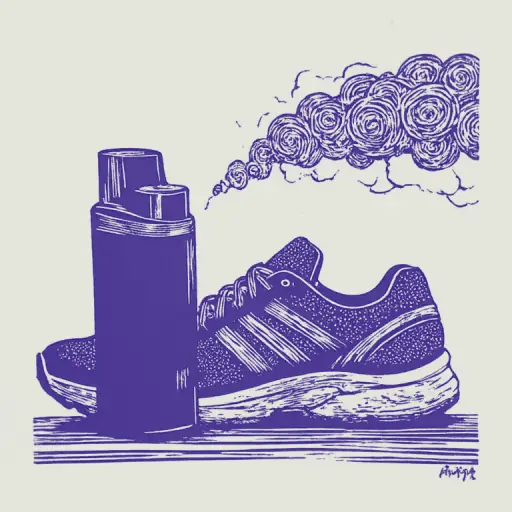
How to Run with Asthma Without Harm to Health
- 15 min read
- 61
For a long time, it was believed that bronchial asthma and cyclical sports were incompatible. However, modern medicine proves the opposite: proper physical exercise in bronchial asthma is not just safe, but therapeutically beneficial.
Regular and moderate running helps to:
- Strengthen the respiratory system: Intercostal muscles and the diaphragm are trained, which facilitates lung ventilation.
- Increase endurance: The body learns to absorb oxygen more efficiently, reducing overall fatigue.
- Reduce sensitivity to triggers: Gradual adaptation of the bronchi reduces the risk of spasms in daily life.
The main condition is that training is only permitted in the stable phase, when reliable asthma control has been achieved. Running should heal, not provoke shortness of breath.
I. Golden Rules of Safety: Preparing for Running with Asthma
Deciding to start running with bronchial asthma is an important step toward improving health, but it requires a conscious and systematic approach. Safety is always the top priority here. Before lacing up your sneakers and heading out for the first run, you must lay a solid foundation that will protect your bronchi from unwanted spasms and make your workouts exceptionally beneficial.
The preparatory stage is not just a formality, but a strategic action plan. It includes assessing the current state of the body, coordinating loads with a specialist, and choosing the most gentle regimen to start. Adhering to these basic rules will allow you to control asthma through physical activity, rather than adapting your life to sudden attacks.
1. Initial Consultation: Doctor's Clearance and Action Plan
The first and most important step toward safe running is a visit to your attending physician—a general practitioner or pulmonologist. Only a specialist can objectively assess the current state of the respiratory system and give official permission for physical activity in bronchial asthma.
During the consultation, be sure to discuss the following key points:
- Asthma Control Assessment: The doctor will perform spirometry to determine the forced expiratory volume (FEV1).
- Therapy Adjustment: It may be necessary to adjust the dosage of maintenance medications or prescribe a short-acting bronchodilator 10–15 minutes before starting.
- Individual Action Plan: A written algorithm detailing exactly what to do if the first signs of bronchospasm appear during running.
Remember: running without prior medical approval is an unjustified risk. Once you have the 'green light,' you can train confidently and safely.
2. Diagnosis and Monitoring: When Can You Run? (Stable Phase)
Going for a run is permitted exclusively during a phase of stable disease control. The main tool for daily monitoring of lung condition is the peak flow meter—a portable device that measures peak expiratory flow rate (PEFR).
Before every workout, perform a test and check against the 'traffic light system':
- Green Zone (80–100% of personal maximum): Excellent control. Running is fine in the usual manner.
- Yellow Zone (50–80%): Mild bronchospasm. It is better to replace the training with a calm walk.
- Red Zone (below 50%): Danger! Running is strictly contraindicated; immediate use of a bronchodilator is required.
The stable phase is also characterized by the absence of nocturnal symptoms such as shortness of breath, coughing, and the need for a rescue inhaler more than twice a week.
3. Choosing a Training Plan: From Zero to Minimal Load (Gradualness and Moderation)
Based on the peak flow meter readings, proceed to planning the loads. The main principle for a beginner runner with asthma is the interval training method (alternating running and walking).
Start with the simplest scheme:
- 1 minute of very light running (at a pace that allows for free conversation);
- 2–3 minutes of calm walking for complete respiratory recovery.
Repeat this cycle 5–6 times. The total duration of the first workout will only be 15–20 minutes. Follow this schedule 2–3 times a week. Only move on to increasing running intervals after 2–3 weeks of stable, symptom-free training. Gradualness is your main shield against bronchospasm.
II. Running Specifics: Technique and Physiology for Asthmatics
The transition from planning to practice requires understanding exactly how your body reacts to running load. With bronchial asthma, the key is not overcoming the distance against all odds, but finely tuning physiological parameters. Correct technique and control of internal indicators transform running from a potential trigger for bronchospasm into an effective rehabilitation tool.
In this section, we will examine the applied biomechanics and physiology of safe running. You will learn how to adapt the training intensity to the specific characteristics of your respiratory system to strengthen your lungs and avoid shortness of breath attacks.
1. Ideal Pace and Heart Rate: How to Run Without Getting Out of Breath?
For safe running with asthma, the key factor is maintaining intensity within the aerobic zone. This prevents hyperventilation of the lungs, which most often triggers bronchospasm.
- Heart Rate Control: Keep your heart rate (HR) in the range of 120–140 beats per minute (not exceeding the 150 bpm threshold). In this zone, the body receives enough oxygen without overstraining the respiratory system. Using a heart rate monitor is mandatory for controlling asthma through physical activity.
- Conversational Pace: Your ideal pace is the speed at which you can freely hold a full conversation without breaking into gasps. If speaking becomes difficult, immediately switch to walking.
- Interval Approach: Start by alternating (e.g., 1 minute of light running and 2 minutes of walking). This reduces the load on the bronchi and helps you train without breathlessness.
2. Special Attention to Breathing: How to Breathe Correctly While Running?
Proper breathing is the main shield for the asthmatic runner against bronchospasm. Dry and cold air entering the bronchi directly triggers attacks, so basic technique is critical.
- Breathe through your nose. The nasal passages act as a natural conditioner: they warm, humidify, and filter the air. If you feel you don't have enough air and have to breathe through your mouth—immediately reduce your pace.
- Engage your diaphragm. Breathe with your 'belly,' not your chest. This allows the lungs to expand fully, improves ventilation of the lower parts, and reduces strain on the shoulder girdle.
- Control the rhythm. Use the '2-2' pattern (two steps for inhalation, two for exhalation) or '3-3' for a light pace. A uniform rhythm prevents hyperventilation.
- Exhale through pursed lips. If you feel slight chest tightness, exhale through slightly pursed lips. This creates resistance on exhalation, helping to keep the bronchi open.
3. Optimal Duration: How Often and How Long Can You Train?
Remember that the main rule is gradualness. Do not try to run a marathon right away if your body is just beginning to adapt to the load. Start with a routine that you can maintain steadily, even if it is only 15–20 minutes for now.
How to structure your training schedule:
- Frequency: It is better to train more often, but shorter. For example, 3–5 times a week for 20–30 minutes, rather than trying to run too far once a week. Regularity helps maintain endurance and prevents the bronchi from 'forgetting' the load.
- Progression: Increase the load not by distance, but by time and intensity. If today you ran for 20 minutes at a comfortable pace, next week try 25 minutes. This should feel like a small but noticeable improvement, not an exhausting marathon.
- Listen to your body: If you feel your symptoms worsening, or if your shortness of breath becomes uncontrollable, immediately shorten or stop the workout. It is better to take a break and return to training the day after than to trigger an exacerbation.
Important to remember: The optimal duration is the one that allows you to hold a conversation while running (the so-called 'talk test'). If you are gasping for breath and cannot utter a full sentence, it means you are overloaded. The goal is not a record, but a stable improvement in quality of life and endurance.
III. Prevention and Attack Prevention During Exercise
Once you have determined a comfortable pace and training schedule, it is important to protect yourself from external factors that could trigger bronchospasm. Running safety with asthma depends not only on the body's internal readiness but also on external conditions and your equipment. Preventing an attack is much easier than managing it mid-run.
To do this, you need to develop a clear algorithm for preparing for every time you go outside. The correct choice of location, time, and mandatory respiratory preparation ritual will help minimize risks and make every run as comfortable as possible.
1. Training Hygiene: What to Carry (Inhaler and First Aid Kit)
The main safety rule for a runner with asthma is never to go out for a workout without a portable first aid kit. Your 'survival kit' must be easily accessible, even if you are planning a short run near home.
What to definitely take with you:
- Emergency inhaler (bronchodilator). Keep it in the pocket of your windbreaker or in a waist pack, but not at the bottom of your backpack. In cold weather, keep it closer to your body so the medication does not get too cold.
- Spacer (if necessary). Helps deliver the medication more effectively to the lungs during running.
- Mobile phone and medical ID. Set up a card on the lock screen with your diagnosis, emergency contacts, and a list of medications you take.
- Bottle of warm water. A few sips will help moisten a dry throat and prevent bronchospasm.
2. Location and Time Selection: Avoiding Triggers (Cold, Dust, Allergens)
Choosing the right place and time for a run is 80% of the success in preventing bronchospasm. The environment directly affects the state of the airways, so training requires strategic planning.
Key safety rules for choosing location and time:
- Temperature regime: Avoid running outdoors when the temperature is below -5°C. Cold and dry air instantly provokes spasms. In cool weather, always use a buff or sports mask to warm your inhalation.
- Allergy factor: During the blooming season, refrain from running in parks and forests on dry, windy days and in the morning hours when pollen concentration is highest. The best time to train is right after the rain.
- Location ecology: Plan routes away from highways. Exhaust fumes and suspended dust particles irritate the bronchi more strongly than any natural triggers.
If the ecological or weather conditions are unfavorable, move the training to a treadmill in a well-ventilated gym.
3. Proper Warm-up and Cool-down: Minimizing Bronchial Spasm Risk
A proper warm-up and cool-down are the main physiological shield against bronchospasm. A sudden start forces the lungs to rapidly pump dry air, which instantly provokes a spasm.
- Warm-up (10–15 minutes): Start with joint exercises in place. Then move to walking, gradually accelerating to a light jog. This smoothly adapts the bronchi to increased oxygen demand.
- Cool-down (5–10 minutes): Never stop abruptly. Transition to walking, recover your breath, and perform light stretching. A gradual decrease in heart rate prevents a sudden cooling of the airways—a common trigger for delayed attacks.
This careful approach makes safe running for asthmatics a reality, minimizing health risks.
IV. Expanding Activity: What to Do If I Want to Run More?
When the basic running routine is mastered without symptoms, the desire to move further naturally arises. However, expanding activity with asthma requires a systematic approach: simply increasing mileage is not the only, and often not the safest, path. To develop endurance without risking the bronchi, it is important to act comprehensively.
In this section, we will discuss how to harmoniously scale up your training. We will discuss integrating alternative sports, special breathing practices to strengthen the lungs, and how to adjust your lifestyle so that the body can cope more easily with increasing loads.
1. Transitioning from Running to Other Activities: Swimming, Walking, Gymnastics
To avoid overloading the respiratory system with constant running, alternate it with other safe activities. This will help strengthen the lungs without the risk of bronchospasm.
- Swimming. An ideal choice for asthmatics. The warm, moist air in the pool prevents the drying out of the airways, and the horizontal body position eases lung function.
- Health walking. An excellent alternative on days off from running. It maintains vascular tone and allows for easy control of the heart rate within a safe zone.
- Light gymnastics. Stretching and strengthening exercises for the shoulder girdle improve chest mobility, facilitating lung ventilation.
This diversity reduces monotonous load and makes the training process maximally safe.
2. Strengthening the Respiratory System: Breathing Exercises as Part of the Program
Strengthening the respiratory system is not just 'breathing exercises'; it is targeted work to increase the volume and efficiency of the respiratory muscles, including the diaphragm. For an asthmatic, this is critically important, as muscle weakness often accompanies chronic airway inflammation. However, it is important to understand: exercises do not replace medication and should not be used as the sole strategy.
- Diaphragmatic Breathing (Belly Breathing): This is the foundation. Instead of just lifting the chest, try to direct your inhale so that your abdomen visibly rises. This activates the diaphragm, the primary breathing muscle. Perform this exercise when calm, and then incorporate it into your warm-up before running.
- Exhale Control: With asthma, there is often a tendency toward shallow, rapid breaths. The goal is to learn to take a longer, controlled exhale. This helps to "clear" the airways and reduce resistance. You can use the "counting breath" technique (inhale for a count of 3, exhale for a count of 5).
- Resistance Exercises: As your condition improves, you can include light resistance exercises (for example, using special bands or simply clenching your fists during exhalation). This trains the muscles that support the breathing cycle.
Important Safety Rules:
- Start Slowly: Do not attempt complex exercises while short of breath. Begin with 5–10 minutes a day at a relaxed pace.
- Listen to Your Body: If an exercise causes coughing, wheezing, or discomfort, stop immediately and use your inhaler.
- Holistic Approach: Remember that breathing exercises should complement, not replace, regular consultations with a pulmonologist and taking prescribed medications.
3. The Role of Nutrition and Lifestyle: How to Support Lungs from Within?
Supporting the lungs from the inside is the basis for long-term progress in running. To reduce systemic inflammation and strengthen the bronchi, adjust your diet and habits:
- Hydration: Drinking enough clean water thins bronchial secretions, easing breathing during runs.
- Anti-inflammatory Diet: Enrich your diet with Omega-3 rich foods (fatty fish, flaxseeds) and antioxidants (berries, citrus fruits). Magnesium, found in nuts and greens, helps relax the airways.
- Home Hygiene: Regular damp cleaning and maintaining indoor humidity at 40–50% reduce the overall allergen load on the body.
V. Responding to Crisis Situations: What to Do During an Attack?
Even with perfect preparation and adherence to all precautions, an asthmatic runner must be ready for unforeseen situations. A sudden bronchial spasm during training is not a cause for panic, but a signal for clear, practiced action. Knowing the first aid algorithm will help you maintain control of your breathing and prevent a severe attack from developing.
1. Emergency Measures: What to Do If Shortness of Breath Starts?
If you feel sudden shortness of breath, wheezing, or chest tightness while running, stop moving immediately. Transition to walking, and then stop completely.
Assume a stable position: sit down or lean on your knees, slightly bending your torso forward—this will ease the work of the breathing muscles. Take out your emergency inhaler (e.g., salbutamol) and take 1–2 puffs. Try to calm down and breathe slowly: inhale through the nose, exhale slowly through pursed lips.
2. Immediate Halt: When is Physical Exertion Contraindicated?
Running must stop immediately, not just slow down, if the following "red flags" appear:
- No Relief: If breathing does not improve after using a fast-acting inhaler for 5–10 minutes.
- Speech Difficulties: Inability to utter a short phrase without pausing to inhale.
- Cyanosis: Bluish discoloration of the lips, philtrum, or nail beds (a sign of acute hypoxia).
- Physiological Markers: Severe retractions (sucking in of the skin between the ribs) when trying to inhale, persistent dry cough.
- Low Peak Flow Readings: A PEF value below 80% of your personal norm before going for a run.
Symptoms of a common cold, elevated body temperature, and the peak period of seasonal allergies are also absolute contraindications to training.
3. Plan B: Actions When Condition Worsens and When to Call a Doctor?
If breathing does not improve after the first dose of the inhaler within 10–15 minutes, activate "Plan B":
- Repeat Inhalation: Take another 1–2 puffs of the short-acting bronchodilator.
- Assume the Coachman's Pose: Sit down, leaning your torso forward and resting your elbows on your knees. This will ease the work of the breathing muscles.
- Call Emergency Services (112) Immediately if:
- Symptoms are worsening despite the repeated medication dose;
- You have difficulty speaking due to shortness of breath;
- Your lips or fingertips are turning blue.
Conclusion: Running as Part of a Healthy Life, Not an End in Itself
Running with asthma is not about chasing sports records or overcoming pain through sheer willpower. It is primarily an effective tool for gently strengthening the lungs, heart, and improving overall physical tone.
The main secret to safe training lies in balance: regular medical monitoring, careful attention to your body's signals, and knowing when to stop. Allow running to become your reliable ally on the path to an active life, not a source of additional stress.