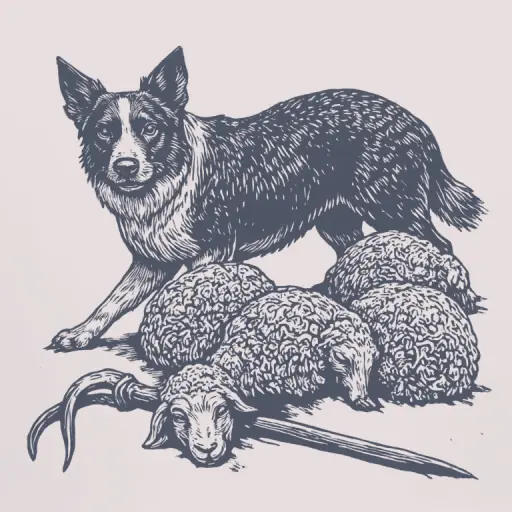
How to Train a Border Collie to Herd Sheep and Control the Flock?
- 15 min read
- 81
Border Collies are rightfully considered unsurpassed leaders in the world of herding. Watching them work in the field is a true pleasure: the dog moves smoothly, like a shadow, instantly reacting to the slightest movements of the animals. At the heart of this magic lies a unique herding instinct that has been shaped over centuries. The legendary ancestor of the breed, Old Hemp, established the standards for silent work, where the main tools were the famous hypnotic gaze and the characteristic crouching.
But how do you turn this innate potential into a controlled skill? Can a city dog be trained from scratch? In this practical guide, we will cover the entire preparation process: from the first introduction to a flock of sheep in a livestock pen to remote control using gestures and whistle commands. You will learn how to unlock your pet's working qualities and establish perfect understanding in the field.
Anatomy of the Border Collie Instinct: How Does It Work?
The phenomenal efficiency of the Border Collie in managing a flock is not the result of mechanical training, but a manifestation of deep genetic mechanisms. Unlike other herding dogs, which often use barking or physical pressure, Border Collies operate on the level of subtle psychology and innate predatory behavior, finely tuned by centuries of selective breeding.
Understanding the anatomy of this instinct allows the handler not to break the dog's nature, but to gently guide its resources toward a working purpose. Before moving on to practice, it is important to understand exactly which innate patterns cause sheep to obey this dog without question and how this unique working style was formed.
The Gaze and Crouching: Mechanisms of Hypnotic Sheep Control
The unique working style of the Border Collie is based on modified hunting behavior, from which the final pounce is completely excluded. Instead, the dog uses two key control mechanisms:
- Crouching (creeping): The dog maximally lowers its silhouette, bending its legs, tensing its body, and extending its neck. For the sheep, this creeping silhouette is associated with the approach of a predator. As a result, the flock of sheep instinctively bunches into a tight group, ready to move.
- "The Eye" (the eye): The Border Collie literally locks the flock leader with its hard, focused gaze. This psychological pressure forces the sheep to follow the dog's trajectory without physical contact.
Thanks to this non-contact method, the Border Collie demonstrates outstanding working qualities, managing the flock quietly, without unnecessary barking or fuss.
When the Herding Instinct Awakens: From Old Hemp to Modern Puppies
The origins of this unique working style lead back to the legendary dog named Old Hemp, born in 1893. Unlike the herding dogs of that time, which managed the flock using loud barking and aggressive nipping, Hemp worked silently. He used only the power of his gaze and precise, creeping movements. His outstanding working qualities proved so effective that he became the progenitor of the Border Collie breed, passing on his style to thousands of descendants.
Today, this innate herding instinct is genetically fixed, but it awakens individually. Usually, the first signs appear in puppies between 6 and 9 months of age, although in some dogs, this happens closer to eighteen months. Recognizing the awakening of the instinct is easy: the adolescent begins to "herd" everything that moves—from household members and cats to bicycles. It circles the target in a wide arc, tries to group the "objects," and freezes, controlling their movements.
Preparation and Capability Testing Before Starting
Understanding the genetic mechanisms and the history of the breed is only the foundation. In practice, every owner faces a very grounded question: how to transfer this theoretical knowledge to the real field? Before releasing the dog to the flock, it is necessary to soberly assess its current condition, level of training, and controllability. Preparation for herding service begins long before the first contact with sheep. At this stage, we need to determine whether dogs raised in big cities can recall the call of their ancestors, and also identify which basic obedience skills and tests will help reveal your pet's hidden potential without risk to its health or the safety of the livestock.
Can a City Border Collie Be Trained to Herd Sheep From Scratch?
Many owners of city Border Collies doubt whether their apartment dog, accustomed to asphalt and parks, can work with live livestock. The answer is unequivocal: yes, it is absolutely possible. The herding instinct in Border Collies is genetically fixed. Even if the dog has not seen sheep for several generations, the basic behavioral patterns—focus, circling, and balancing—awaken almost instantly upon first meeting the flock.
However, training a city dog from scratch has its own peculiarities:
- Physical Conditioning: City pets often lag behind farm dogs in stamina. Before going into the field, it is necessary to gradually strengthen the dog's ligaments and develop its respiratory system.
- Excitement Control: In the metropolis, dogs get used to completely different stimuli. The sight of running sheep can cause them to become overly excited, leading to chaotic chasing. The handler's task is to direct this energy into a working purpose.
- Obedience Adaptation: City training (commands like "Come," "Down") is an excellent foundation, but in the field, with strong instinctive drive, these skills must be retrained under conditions of extreme distraction.
The main difference for a city Border Collie is the need for careful and gradual adaptation to the smells and noise of the farm so that the innate working qualities can be revealed without stress to the animal.
Testing Innate Qualities and Basic Obedience
Before releasing a Border Collie to the sheep, it is necessary to conduct a test for the presence of the herding instinct and ensure the dog's impeccable obedience.
Working Quality Testing
The initial check is usually conducted between 6 and 12 months of age. The dog is brought on a long lead into a pen with several calm sheep. Specialists assess key reactions:
- Interest: Does the dog focus its attention on the sheep or get distracted by smells and people.
- Movement Style: Does it try to circle the group to gather the animals together.
- "The Eye": Does it demonstrate the characteristic crouching and fixation on the object.
Basic Obedience
Herding service requires the dog to react instantly to the handler's signals. Before the first contact with livestock, the Border Collie must perfectly execute three skills:
- Emergency Stop ("Down!" or "Stay!"): The ability to freeze instantly on command, even in a state of extreme excitement.
- Flawless Recall ("Come!"): The ability to leave the sheep and return to the owner at the first call.
- Distance Control: The ability to maintain distance and not approach the handler without a command.
Step-by-Step Practical Herding Training
When basic obedience is automated and the innate drive is confirmed by tests, the most exciting stage begins—entering the working arena. Practical training of the Border Collie for herding service is built on the gradual and strictly controlled complication of tasks. Here, it is important not just to release the dog to the livestock, but to channel its natural energy into a working stream where every movement is subject to the handler's will.
The transition from home training to real herding requires extreme concentration and an understanding of the psychology of both animals. At this stage, we will sequentially examine the methodology for safe, non-contact introduction in a confined space, and then move on to practicing key skills in managing a group of sheep in an open area.
First Introduction to the Flock in a Livestock Pen
The Border Collie's first contact with sheep must take place in a safe, confined space—a circular pen (round sand or barrel) with a diameter of about 15–20 meters. This shape prevents the sheep from bunching up in corners and allows the handler to fully control the dog's trajectory.
Before releasing the pet, ensure that the flock (usually 3–5 calm, dog-accustomed individuals) is already in the center. Put a long training lead (5–10 meters) and a regular soft collar on the Border Collie. The use of tight collars or leashes is strictly forbidden.
Enter the livestock pen, keeping the dog close. Your main task is to awaken the innate herding instinct and assess the reaction. Allow the dog to focus its gaze on the animals. As soon as the Collie begins to circle the flock in an arc, trying to group them, slightly loosen the tension on the lead. Any attempts at direct aggression or biting must be immediately blocked by tightening the lead.
The first training session should last no more than 5–10 minutes to avoid overloading the dog's nervous system.
Practicing Gathering and Holding Skills for the Flock
After a successful introduction in the pen, the focus shifts to practicing two basic elements: gathering (fetching) and holding the group. The main goal at this stage is to teach the Border Collie to maintain balance. Instinctively, the dog strives to take a '12 o'clock' position opposite you, keeping the flock strictly in the middle.
To practice gathering, use the following steps:
- Wide Outrun: Give the dog the command to circle the group in a wide arc. The Border Collie must not crash into the center of the flock; its goal is to move behind the sheep.
- Pressure Control: Utilize the innate tendency to crouch. If the sheep begin to panic, command the dog to lie down or slow its pace, easing the psychological pressure of its gaze.
- Group Holding: The dog must move like a pendulum from side to side behind the sheep, gently nudging straggling individuals toward the center.
Regular work with the Border Collie in the field solidifies these skills, transforming chaotic chasing into conscious management of the flock using the Collie.
Remote Dog Control and Coordination of Work
Once the basic skills of gathering and holding the flock near the handler are successfully mastered, the most spectacular and complex stage of preparation begins—remote control. True herding service takes place on vast pastures, where the distance between the shepherd and the Border Collie can reach hundreds of meters. Under such conditions, the ordinary human voice loses its effectiveness, and visual contact is complicated by the terrain.
To coordinate the dog's movements with precision at a distance, handlers use a calibrated system of signals. This system combines both traditional acoustic methods and non-verbal cues. This allows for instant correction of the Collie's running trajectory, timely stopping, or directing it around the flock, maintaining full control over the situation without unnecessary fuss or stress for the livestock.
Vocal Commands and Shepherd Gestures
An international system of traditional commands is used for effective remote control of the Border Collie. Every word must be spoken clearly and confidently, as the dog relies on intonation and rhythm.
Main Vocal Commands:
- “Come bye” — movement around the flock clockwise (to the dog's left from the shepherd).
- “Away to me” — movement counter-clockwise (to the dog's right from the shepherd).
- “Lie down” — immediately lie down or freeze in a half-crouch. This dissipates excessive pressure on the sheep.
- “Walk on” — direct, calm movement toward the flock.
- “That’ll do” — command to stop working and return to the handler.
Shepherd Gestures:
Gestures serve as a visual duplicate of commands at medium range. The shepherd uses their hands or a special crook (staff):
- Arm extended to the side indicates the direction of circling (flanking).
- Staff or arm raised up — signal for immediate stop (“Lie down”).
This duo of voice and gesture allows for coordinating the dog's work before it moves to a distance where only a whistle can be heard.
Using the Herding Whistle for Remote Control
When the flock moves hundreds of meters away, and gusts of wind or terrain obscure the human voice, the herding whistle (usually brass or a plastic lip whistle like a Logan) becomes the main communication tool. Border Collies possess phenomenal hearing and can distinguish the finest sound modulations up to two kilometers away.
Each basic vocal command is matched with its unique sound pattern:
- Circling left (“Come bye”): a series of short, fast, and high whistles.
- Circling right (“Away to me”): one long, smoothly descending whistle.
- Stopping (“Lie down”): one sharp, long, and clear signal.
- Moving forward (“Walk on”): two soft, intermittent medium-pitched signals.
The transition to the whistle begins when the dog flawlessly executes the vocal commands up close. Initially, the whistle signal is given, and a second later, it is duplicated by voice. Gradually, the vocal cue is removed. The main rule is absolute accuracy in reproducing the pitch: for a sensitive Border Collie, the slightest change in pitch means a completely different command.
Error Analysis and Preventing Field Problems
Even with perfect mastery of the whistle and remote commands, real field work is always full of surprises. The high herding instinct of the Border Collie is a double-edged sword: incredible concentration can easily turn into hyperactivity, leading to failures in flock management. Novice handlers often encounter situations where the dog loses composure under stress or tires quickly, both physically and mentally.
To ensure that the grazing remains safe for the livestock and productive for the shepherd, it is important to recognize signs of overload in time and correct undesirable behavior. Let's examine key errors in field work and methods to prevent them, which will help maintain the balance between instinct and discipline.
How to Combat Excessive Excitement and Livestock Biting
Excessive excitement and biting sheep are common problems when training Border Collies, caused by nervous system overstimulation. The herding instinct is closely linked to hunting behavior, so it is important to redirect the dog's energy and control its emotional state in a timely manner.
To prevent injury to the livestock and control the dog's emotions, use the following methods:
- "Lie down!" Command: This is the main tool for emergency braking. As soon as you notice the dog starting to approach the sheep too closely, tensing up, or speeding up, immediately have it lie down. This breaks the adrenaline peak.
- Increasing Working Distance: Excitement increases upon approach. Keep the dog at a greater distance from the flock, using a long training cord in the initial stages.
- Instant Time-Out: If the dog bites a sheep, immediately stop the training. Command "No!" and lead the Border Collie out of the enclosure. The dog must clearly understand: biting means the work ends instantly.
- Working with Calm Livestock: Start training with experienced, non-fearful sheep. The panicked flight of the animals provokes the dog's instinct to chase and grip.
Regularly practice impulse control away from the pasture so the dog can quickly transition from an excited state to a calm state at the handler's first command.
Proper Load Distribution for a Working Dog
Border Collies possess phenomenal stamina and an innate desire to please the handler (will to please). Because of this, a working dog is capable of working until complete exhaustion, ignoring physical fatigue and pain. The shepherd's task is to strictly control the dosage of work to prevent chronic overtraining and injuries.
To maintain the health and high efficiency of a working dog, adhere to the following rules:
- Dose Working Time: For young dogs (under 1.5–2 years), training and field work sessions should not exceed 15–20 minutes at a time. A mature, trained dog can work longer, but it requires regular breaks every 1–2 hours.
- Alternate Mental and Physical Load: Focusing intently and constantly making decisions tires a Border Collie more than running. Allow the dog to simply run without sheep or rest in the shade after a difficult flock management session.
- Warm-up and Cool-down: Before starting field work, conduct a light warm-up (walking, trotting, simple tricks), and after work, allow the dog to cool down and catch its breath before confining it to a kennel or car.
- Hydration Control: Always ensure access to clean water, but do not let the dog drink too much immediately after intense running to avoid stomach upset.
Remember that the first signs of overexertion are loss of concentration, delayed reaction to the whistle, and sudden bursts of irritation or aggression toward the livestock.
Conclusion
Training a Border Collie in herding is not just training; it is unlocking the dog's unique natural potential. Success in managing a flock of sheep is built on three pillars: respect for the innate herding instinct, impeccable discipline, and deep mutual understanding between the handler and their four-legged partner.
To keep your dog's working qualities at their peak throughout its life, adhere to the following rules:
- Regular Practice: Even an experienced working dog requires systematic training to maintain fitness and concentration.
- Intellectual Balance: Alternate sheep herding with mental games and full rest to avoid psychological burnout.
- Flexibility in Control: Perfect the use of the whistle and gestures, adapting commands to changing terrain conditions and flock size.
Remember that every dog is an individual. Patience, consistency, and sensitivity to your pet's condition will turn a city Border Collie or a farm puppy into a reliable, indispensable helper on the pasture.