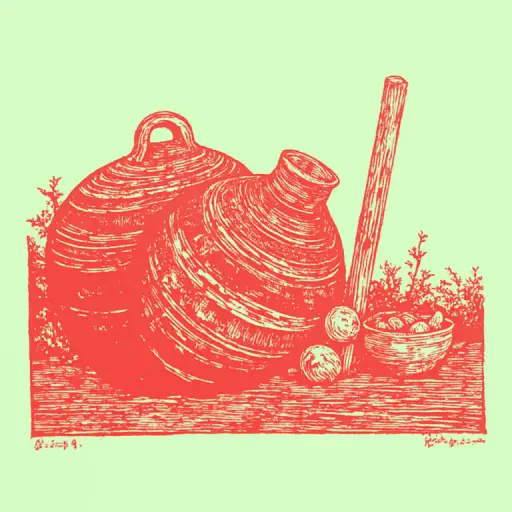
How to understand why and in what vessel the philosopher Diogenes actually lived
- 15 min read
- 69
The image of the eccentric sage living in a wooden barrel in the middle of a bustling square has firmly taken root in world culture. Each of us has heard of Diogenes of Sinope—the most vivid representative of Cynic philosophy, who sought the "man" with a lantern in broad daylight and scorned all the comforts of civilization. But how true is this image?
In reality, classical wooden barrels did not exist in Ancient Greece. Our hero arranged his life in a huge clay vessel—a pithos, which was intended for storing grain and wine. This radical asceticism was not madness or the result of extreme poverty. For Diogenes, his dwelling became a manifesto of absolute freedom, a challenge to social conventions, and a practical embodiment of Cynic philosophy.
In this article, we will conduct a detailed historical reconstruction: we will examine how the philosopher lived, how he coped with the whims of the weather and hygiene in the Athenian agora, and why his radical performance still stirs the minds of historians and doctors.
Debunking the Dwelling Myth: Pithos Versus Wooden Barrel
The image of the eccentric confined in a cramped wooden barrel in the middle of a noisy Athenian square has firmly established itself in European culture and painting. However, this picturesque scene is instantly shattered by dry historical facts: during the time of Diogenes of Sinope, the inhabitants of Hellas were not even aware of the existence of such wooden containers.
To understand what the great Cynic's actual shelter looked like, we must conduct a small historical investigation. We will peel away layers of centuries of translation errors and turn to the material culture of antiquity, which offers a much more surprising and practical alternative to the familiar myth.
Why a Wooden Barrel in Ancient Greece is a Historical Anachronism
The notion that Diogenes of Sinope lived in the wooden barrel familiar to us, bound with metal or leather hoops, is a classic historical anachronism. During the life of the great Cynic (4th century BCE), the technology of cooperage in its modern sense simply did not exist in Hellas.
Historians point to two key reasons why a wooden barrel could not have been the philosopher's home:
- Technological Barrier: The art of bending wooden staves and assembling them into strong, airtight vessels developed much later. This technology was actively used by the Gauls, and in the Mediterranean, it only took hold during the Roman Empire and was finally established in the Middle Ages.
- Economic Factor: There was always a sharp shortage of quality wood in Ancient Greece. Wood was valued like gold and was primarily used for building ships and temples. A wooden barrel in Athens would have been an insanely expensive luxury item, which completely contradicts Diogenes' philosophy of asceticism.
The myth of the barrel arose from translation difficulties: later European authors replaced a specific ancient term with an analogue understandable to the medieval common person.
The Structure of the Clay Pithos and Its Real Dimensions
Diogenes of Sinope's actual "home" was a pithos (Greek: πίθος)—a massive clay jar widely used in Ancient Greece for storing and transporting grain, wine, olive oil, and salted fish.
To understand how an adult could use such a utilitarian container as a dwelling, it is important to assess the real dimensions of this vessel:
- Height: Large pithoi reached from 1.5 to over 2 meters, which easily allowed a person of average height to fit inside.
- Width: The diameter at the widest part was about 1–1.3 meters, providing enough space to sit or lie curled up.
- Wall Thickness: The sturdy fired clay, up to 5–8 cm thick, served as an excellent barrier against external influences.
Life in a pithos was not a metaphor. The philosopher likely inhabited an old, cracked vessel that had been discarded and laid on its side in the area of the Athenian agora. Thanks to the thick clay walls, such an improvised shelter protected excellently from the scorching summer sun and retained relative warmth on cold nights.
Practical Reconstruction of Daily Life: How to Survive in a Vessel
The realization that Diogenes of Sinope lived in a massive clay pithos, not the wooden barrel we are accustomed to, inevitably raises many practical questions. It is one thing to theoretically discuss asceticism, and quite another to face the harsh reality of the ancient metropolis daily. Living in plain sight of hundreds of citizens required not just mental fortitude from the philosopher, but extreme practical adaptability.
How to turn a cold vessel into a relatively safe shelter? How did the marginal thinker cope with the whims of the weather, the scorching Attic sun, and the biting winter wind? To understand the true essence of the Cynic experiment, it is necessary to reconstruct his daily life in the Athenian agora, paying attention to the most down-to-earth, yet vital, aspects of his existence.
Organizing Sleep and Weather Protection in the Agora
Life in the Athenian agora demanded extreme physical endurance from Diogenes of Sinope. His clay abode—the pithos—was not dug into the ground, as was usually done for storing grain or wine, but lay on its side directly on the pavement. This allowed the philosopher to use the vessel as a mobile and transformable shelter.
Sleep organization in such a "home" followed strict rules of Cynic asceticism:
- Bedding: Diogenes completely gave up mattresses, blankets, and pillows. His only bedding was a coarse woolen cloak (trigon), folded in half. At night, it served both as padding to protect against the cold clay and as a protective covering.
- Body Position: Due to the round shape and limited size of the pithos, he had to sleep curled up or semi-sitting. For an unfamiliar person, this would be torture, but for a hardened philosopher—it was normal.
Protection from the whims of the weather in Ancient Greece was a serious challenge. In summer, the thick clay walls of the pithos saved him from the scorching sun, creating a safe shade inside. In winter, when biting winds and cold rains blew through Athens, Diogenes simply turned the vessel's opening away from the wind. If the cold became extreme, the thinker practiced radical hardening—for example, hugging cold marble statues to prove that the mind could subject any physical suffering to its will.
Solving Hygiene Issues and Daily Needs in the Ancient Polis
Living in a clay pithos in the middle of the bustling Athenian agora inevitably confronted Diogenes of Sinope with the harsh prose of daily life. How did the philosopher solve issues of hygiene and natural needs without private space?
Contrary to the popular belief of complete isolation, the ancient polis provided a developed public infrastructure that the philosopher actively used:
- City Fountains: Freshwater sources served Diogenes for quenching his thirst, quick washing, and washing his only cloak.
- Public Baths: Accessible to all social classes for a minimal fee (or free for the poor), they allowed for basic hygiene maintenance.
- Public Latrines: Sanitary areas existed in Athens, although the philosopher often ignored them.
The main paradox of Diogenes's life was his radical Cynicism. The philosopher consciously blurred the line between the private and the public. According to his teachings, all natural bodily needs cannot be shameful. He demonstratively ate in the square, which was considered the height of indecency in Athens, and relieved himself in full view of passersby. This radical asceticism and rejection of the concept of shame were not mere slovenliness, but a conscious protest against the artificial social conventions of the polis.
Analyzing Philosophical Motives: Why Diogenes Chose Asceticism
Life in a clay pithos in the bustling agora was not a result of forced poverty or simple eccentricity. For Diogenes of Sinope, extreme asceticism served as the main tool for the radical "revaluation of values" predicted to him by the Delphic Oracle. By renouncing conventional comfort, the philosopher turned his daily life into a continuous, visible lesson for the citizens of Athens.
At the core of this choice was the pursuit of absolute autarky—complete independence from external circumstances, the artificial laws of the polis, and material goods. By reducing his physical needs to a natural minimum, Diogenes demonstrated that true freedom is achieved not through the accumulation of wealth, but through complete liberation from the power of things over the human mind.
The Essence of Cynicism: How Renouncing Material Goods Led to Absolute Freedom
For Diogenes of Sinope and his teacher Antisthenes, the radical rejection of material goods was not meaningless self-torture. At the heart of Cynic philosophy was the concept of autarky (ultimate self-sufficiency)—a state in which a person's spirit becomes absolutely independent of the external world, social conventions, and the whims of fate.
The Cynics argued that the pursuit of wealth, status, and comfort turns free citizens into slaves of their possessions and fears. The more property a person has, the easier it is to manipulate them. By reducing his physical needs to the natural biological minimum, Diogenes attained absolute freedom. His "home"—the clay pithos—served as a visible proof that a person does not need expensive villas or the recognition of the polis for happiness.
This radical asceticism pursued three main goals:
- Liberation from social masks: refusing to follow artificial rules in order to attain the authentic "Self."
- Parrhesia (freedom of speech): the right to speak harsh truth to anyone, even Alexander the Great, because the philosopher had nothing to lose.
- Living according to nature (physis): contrasting natural needs with imposed societal laws (nomos).
Thus, life in the pithos became not just the forced existence of an exile, but a powerful manifesto of intellectual independence and the triumph of spirit over matter.
Philosophical Performance: The Story of the Cup and the Concept of "Dog-like Life"
The radical asceticism of Diogenes of Sinope was not merely personal eccentricity—it was a conscious philosophical performance designed to expose the artificiality of ancient Greek social norms.
A striking example of such a performance was the famous story of the cup. For a long time, a wooden cup remained the only possession the philosopher carried in his sack. However, one day by a stream, Diogenes saw a boy drinking water directly from his cupped hands. Realizing that nature had already provided man with everything necessary to quench his thirst, the philosopher threw away the cup, saying, "The boy has surpassed me in simplicity of life!". This gesture symbolized a final break with material culture.
It was from this striving for primal simplicity that the concept of "dog-like life" arose. The word "Cynics" itself comes from the Greek kynikos (dog-like). Diogenes proudly accepted this nickname. For him, the dog was the ideal of sincerity and naturalness:
- It knows no hypocrisy or falsehood;
- It sleeps wherever night finds it (for Diogenes, this place became the clay pithos);
- It is indifferent to rank, wealth, and social conventions.
By demonstratively behaving "dog-like" in the Athenian agora, Diogenes of Sinope turned his daily life into a continuous challenge to society, proving that true freedom is attained only through a complete rejection of civilizational conventions.
Cultural Heritage and Interpretations: From Aphorisms to Medicine
The image of Diogenes of Sinope, captured through the ages, long separated itself from the real historical prototype and lived its own life in world culture. The radical gesture of rejecting conventions transformed the Cynic philosopher into an iconic figure whose name became surrounded by myths, aphorisms, and curiosities. However, during the process of centuries-long transmission of ideas, serious distortions arose that changed our understanding of the thinker's life and even entered scientific lexicon. Diogenes's legacy today balances on the edge between philological misunderstandings and clinical terminology. To restore justice, it is necessary to trace how translation difficulties turned the ancient clay vessel into the wooden barrel we are accustomed to, and why modern medicine linked the name of the great ascetic to a severe mental disorder, distorting the very essence of his teaching.
How the Phrase "Diogenes's Barrel" Arose and the Essence of Translation Distortions
The phrase "Diogenes's barrel" firmly entered the world lexicon as a symbol of voluntary seclusion, extreme simplicity, and conscious flight from the benefits of civilization. However, behind this fixed expression lies a massive linguistic error that distorted historical truth for many centuries.
In the original ancient Greek sources describing the philosopher's life (particularly in Diogenes Laërtius), the word pithos (πίθος) is used—a huge clay jar for storing grain, wine, or oil. The distortion began in the late antiquity and medieval periods during the translation of Greek texts into Latin. Roman authors translated pithos as dolium—a large clay vessel used by the Romans for analogous purposes.
The true substitution of concepts happened later, when European humanists of the Renaissance began translating ancient works into new European languages. In medieval and Renaissance Europe, clay pithoi were hardly used. The main container for storing and transporting products there were wooden barrels with hoops. Translators adapted the text to the realities familiar to their contemporaries: the Latin dolium turned into the French tonneau, the English barrel, and the German Fass.
The expression entered Russian specifically through this Western European interpretation. Thus, the Cynic philosopher ended up "locked" in a wooden barrel, although in reality, his temporary shelter was a fired clay vessel. Today, this phraseology is used in two main meanings:
- Voluntary isolation: the desire to distance oneself from society, its fuss, and conventions.
- Extreme asceticism: contentment with little, when the simplest and tightest object serves as a roof.
Diogenes Syndrome in Modern Psychiatry: Why the Name is Unfair to the Thinker
In 1975, the term "Diogenes Syndrome" (also known as geriatric destitution syndrome) was officially introduced into clinical psychiatry. Doctors use this concept to describe a severe condition characterized by extreme neglect of personal hygiene, social isolation, apathy, and pathological hoarding (sylogomania). However, from the perspective of the history of philosophy, such a name is a gross error and an injustice to the thinker.
An analysis of the teachings and lifestyle of Diogenes of Sinope reveals three key contradictions between medical pathology and actual Cynicism:
- Hoarding versus radical minimalism. Patients with Diogenes Syndrome fill their homes with tons of trash and broken items, unable to part with them. Diogenes himself, however, practiced radical asceticism. He strived for complete independence from the material world (autarky) and owned only a cloak, a staff, and a sack. Seeing a boy drink water from a handful, the philosopher even threw away his only clay cup.
- Isolation versus publicness. Those with the syndrome seek to hide from society, leading a reclusive life. Diogenes, however, never hid. His pithos stood in the very center of the Athenian agora. He was constantly in public view, conversing with citizens, giving lectures, arguing with Plato, and staging his famous philosophical performances.
- Conscious protest against cognitive decay. The disregard for social norms among Cynics (the so-called anaideia, or shamelessness) was a conscious intellectual gesture aimed at exposing societal hypocrisy. In a mental disorder, the loss of shame and hygiene skills is a tragic consequence of dementia or severe depression, devoid of any will or philosophy.
Psychiatrists chose Diogenes's name only because of the superficial association with "living in a barrel" and the disregard for accepted standards of living. In reality, Cynic philosophy preached freedom of spirit through self-limitation, whereas Diogenes Syndrome describes a profound lack of freedom in the face of severe illness.
Conclusion
The story of Diogenes of Sinope is a vivid example of how a historical myth can overshadow a deep philosophical essence. By debunking the stereotype of the wooden barrel in favor of the clay pithos, we are not just restoring historical justice, but also beginning to better understand the austere life of the ancient thinker. His life in a vessel was not an act of despair or a consequence of a mental disorder, as the medical term "Diogenes Syndrome" erroneously conveys. On the contrary, it was a conscious, radical manifesto of absolute freedom.
The choice of asceticism and public performance allowed Diogenes to vividly demonstrate the key ideas of Cynicism:
- Autarky (self-sufficiency): reducing physical needs to a minimum for complete independence from external circumstances and power.
- Cosmopolitanism: rejecting the rigid confines of the polis in favor of recognizing oneself as a citizen of the world.
- Living according to nature: shedding social masks, falsehoods, and abandoning the meaningless pursuit of luxury.
Diogenes used his body, his lifestyle, and his pithos as tools for a global "revaluation of values." His famous search for a man with a lantern in broad daylight is an eternal call for sincerity and the search for authentic human essence, unclouded by social conventions.
Today, in an era of excessive consumption and information noise, Diogenes's lessons gain new strength. We do not necessarily have to move into clay jars, but we can learn from the Sinopean sage the skill of cutting away the superfluous, protecting our inner boundaries, and remembering that a person's true wealth is measured not by the size of their dwelling, but by the freedom of their mind.