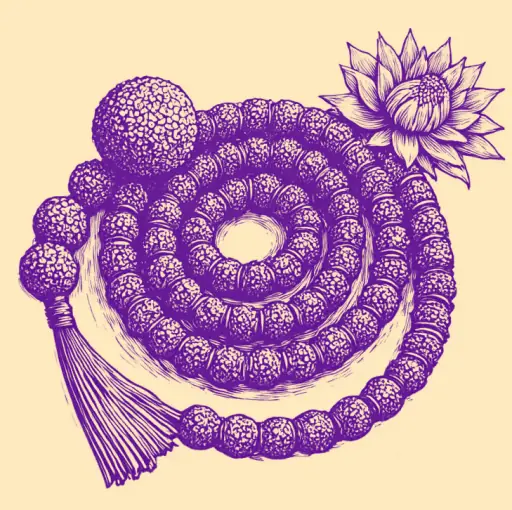
How to Wear Buddhist Prayer Beads According to All Rules and Traditions
- 15 min read
- 65
The Buddhist mala, also known as the Tibetan 'tengwang' (sacred garland), is not merely an aesthetic ornament but a profound symbol of spiritual practice with thousands of years of history. Traditionally consisting of 108 beads, these sacred prayer beads serve to concentrate the mind, count mantras, and harmonize one's inner state. Today, they can be seen not only in the hands of monks but also on the wrists of yoga practitioners and people striving for mindfulness.
However, proper handling of this sacred object requires understanding its essence. In this practical guide, we will cover:
- How to properly wear the beads on the wrist or neck;
- The significance of Bodhi seeds or sandalwood beads;
- The energetic aspects of wearing the mala and care instructions.
This will help ensure that your spiritual tool brings maximum benefit and harmony.
Essence and Symbolism of the Buddhist Mala
The Buddhist mala, also known in the Tibetan tradition as 'tengwang' (sacred garland), is not just an aesthetic accessory or a counting device. It is a deep cosmological and philosophical symbol, reflecting the very essence of Buddhist teachings on the continuity of existence, the interconnectedness of all phenomena, and the path to liberation from suffering. Every element of this ancient tool is imbued with sacred meaning, helping the practitioner maintain focus in the 'here and now.'
Understanding the internal architecture of the mala transforms the simple act of counting beads into a conscious ritual. Before moving on to wearing practices, it is important to understand why the structure of these beads is strictly regulated and how the physical properties of the materials resonate with our inner energy.
The Significance of 108 Beads and the Role of the Guru Bead in Spiritual Practice
The number 108 holds deep sacred meaning in Buddhist tradition. A classic Buddhist mala (or Tibetan tengwang) consists of exactly this number of beads, symbolizing the 108 types of defilements (kleshas) and passions that a person overcomes on the path to enlightenment. Each touch of a bead while reciting a mantra is a step toward purifying the mind from these attachments.
A special place in the structure of the beads is held by the 109th, larger guru bead (usually crowned with a conical element symbolizing wisdom). It represents the spiritual teacher, the Buddha himself, and the non-dual nature of reality.
In spiritual practice, the guru bead performs important functions:
- Starting Point: The meditation circle begins and ends with it.
- Energetic Barrier: Tradition strictly forbids stepping over (passing fingers over) the guru bead. Upon reaching it, the practitioner turns the beads and continues counting in the reverse direction, symbolizing the mind's return to its source.
Materials: From Sacred Bodhi Seeds to Noble Sandal
Choosing the material for a Buddhist mala is not just an aesthetic decision but a deeply symbolic act that lends additional energetic and philosophical meaning to your beads. Each material carries a unique vibration that can enhance your meditative practice.
Wood: Symbol of Purity and Connection to Nature
Traditionally, wood is one of the most revered materials. It symbolizes the life cycle, growth, and spiritual purity. Among wooden materials, the following stand out:
- Sandalwood: Known for its gentle, calming aroma. It is believed that its vibrations help soothe the mind, relieve anxiety, and promote deep concentration. It is ideal for beginners and those needing help achieving inner peace.
- Bodhi: Associated with the tree under which, according to legend, the Buddha attained enlightenment. Wearing a Bodhi mala is a reminder of the path to Enlightenment and the power of the mind. It possesses a powerful, stable energy.
- Other Woods (e.g., Rudraksha): Often used in yogic traditions, symbolizing protection and connection to masculine energy (Shiva).
Stone: Energetic Conductors
Minerals and semi-precious stones in the mala act as natural energy amplifiers. The choice of stone is often based on the specific goal of the practice:
- Lapis Lazuli/Turquoise: Associated with wisdom and mental clarity. They help develop intuition and understanding of higher truths.
- Agate/Jasper: Symbolize harmony and balance. Wearing them helps stabilize emotional states and balance internal contradictions.
- Pearl: Often associated with feminine energy (Shakti), softness, and acceptance. It promotes the development of compassion and tenderness.
Mixed Materials: Synergy of Symbols
Many artisans create malas from a combination of materials (e.g., wood with silver inlays or stones with amber). Such a combination allows for the unification of different aspects of the spiritual path—from earthly stability (wood) to celestial clarity (stone). When choosing, always pay attention to the origin and quality of the material so that its vibration is pure and strong.
How to Properly Wear Buddhist Beads on the Wrist
After deciding on the material and sensing the energy of your mala, it is important to understand how to properly integrate this sacred tool into daily life. Wearing beads on the wrist is one of the most popular and practical ways to keep them with you at all times. In Buddhist tradition, this is not just a matter of convenience but a deep practice of connecting a sacred object with the body, where every wrap of the thread around the arm reinforces your intention and protects the mind from distraction.
Transforming a long Tibetan tengwang into an elegant, multi-strand bracelet requires understanding both subtle energetic laws and purely practical nuances. How the mala touches your pulse points determines the nature of its influence on your inner state throughout the day.
Choosing the Hand: The Energetic Aspect of the Left and Right Wrist
From the perspective of traditional Tibetan and pilgrimage culture, the choice of hand for wearing a mala is not a strict religious canon, but it can be determined by personal comfort and energetic perception. Some teachings distinguish between the left and right sides of the body, which reflects concepts of passivity and activity.
- Right Hand (Activity and Action): Traditionally, the right side is associated with the active world, action, receiving blessings, and interacting with the external world. Wearing a mala on the right hand can symbolize your active involvement in spiritual practice and using the beads as a tool for conscious, daily action.
- Left Hand (Reception and Calm): The left side is often associated with the inner world, reception, tranquility, and introspection. For those who prefer a meditative, more secluded approach, wearing a mala on the left wrist can serve as a reminder of the need for inner balance and calm.
Practical Advice: The most important thing is mindfulness. Do not tie your spiritual experience to a specific hand. Choose the hand with which you are physically most comfortable interacting during meditation and bead counting. Your personal connection to the mala and your intention (sankalpa) is more important than observing the “correct” side.
Step-by-Step Guide: How to Beautifully and Securely Wrap 108 Beads Around Your Wrist
To transform a long Tibetan trangwa of 108 beads into a comfortable and aesthetic bracelet, follow this simple instruction:
- Preparation. Take the mala in your free hand. Start wrapping by securing the guru bead—place it on the outer or inner side of your wrist.
- Gentle Tension. Begin wrapping the string around your wrist. Typically, a standard mala (with 6–8 mm beads) fits in 4–5 wraps. It is important not to pull the cord too tightly, so as not to deform the elastic base or break the silk thread. Your pinky finger should pass freely between your skin and the beads.
- Using a Sliding Knot. If your beads are equipped with an adjustable sliding knot, slightly loosen it before wrapping, and after securing all the wraps, gently tighten it to a comfortable fit.
- Finishing Touch. Tuck the tassel tail under the wraps or let it hang freely at the base of your palm.
This method will preserve the elasticity of the string and protect the beads from friction.
Wearing Beads Around the Neck and in a Pocket: Etiquette and Traditions
After mastering the technique of wearing the mala on the wrist, it is important to understand that these sacred items can also be worn in other places. Beads are not just a ritual tool but also part of one's personal spiritual appearance. However, like any sacred object, they require adherence to certain etiquette rules so that wearing them does not contradict traditions or diminish their sacred significance.
Therefore, before moving on to practical advice, let's clarify the nuances: can the mala be used as ordinary jewelry, or must it always be connected to spiritual practice? Also, how should one properly store and wear them when not using them in meditation—whether under clothing or in a pocket? These rules will help you wear your beads with due respect and understanding of their true symbolism.
Can Sacred Mala Be Used as Ordinary Neck Jewelry
Wearing Buddhist beads (mala) around the neck is a deeply rooted tradition. In Tibetan Buddhism, it is believed that such wearing keeps the sacred guru bead close to the heart, protecting the practitioner and reminding them of compassion. However, using the mala as ordinary fashion accessory requires observing certain ethical boundaries.
If you wish to wear the mala around your neck, it is important to remember the following rules:
- Mindfulness of Intention: Treat the beads not as simple costume jewelry, but as a symbol of spiritual seeking and inner peace.
- Respect for Symbolism: One should not wear a sacred object to noisy parties or in places where it might be defiled.
- Contact with the Body: Traditionally, practitioners prefer to wear the mala under clothing to hide their practice from idle eyes and protect the beads from external contamination.
Using the mala as an aesthetic element is permissible if the basis of this choice is sincere respect for Eastern philosophy, rather than fleeting adherence to trends.
Rules for Wearing Beads Under Clothing and Their Careful Storage in a Pocket
Wearing Buddhist beads under clothing is not just a way to protect them from dirt, but also an important spiritual aspect. By concealing the mala from prying eyes, you preserve the accumulated energy of recited mantras and protect it from external influence. It is traditionally recommended that the guru bead touches the chest area, nourishing the heart center.
If you prefer to carry Tibetan beads in a pocket, observe strict etiquette rules:
- Above the Waist Only. Place the mala in the breast pocket of a shirt or jacket. Wearing a sacred object in the back pockets of trousers is considered a profound disrespect.
- Using a Pouch. To prevent the Bodhi seed or sandalwood beads from being damaged, always place them in a clean cloth pouch.
- Cleanliness. There should be no extraneous items, coins, or trash in the pocket with the mala.
Interacting with Beads: Rules and Taboos
So, we have covered how to properly wear the mala—whether on the wrist, around the neck, or discreetly in a pocket. But wearing is only half the story. Beads are not just an ornament; they are a powerful tool that requires conscious and respectful interaction. Their power is revealed not only in the material but in how you work with them. Understanding the rules for handling the mala is the key to not just wearing, but truly utilizing this sacred attribute in your spiritual practice.
These rules apply to both deep meditative practices and daily etiquette. We will examine how to properly count the beads during mantra recitation so that it is maximally effective and meditative. Furthermore, it is important to know how to behave with beads in secular life, especially if you are not a practicing Buddhist. Adhering to these simple yet important rules ensures that your connection with the mala is harmonious and respectful.
How to Properly Count Beads During Meditation and Mantra Recitation
Counting beads is not merely a mechanical action; it is a meditative act that helps keep the mind in flow and prevents it from wandering. When you use a mala to count mantras, you are effectively training your attention (samadhi). This physical action becomes an anchor for your consciousness.
Rules for Counting During Meditation:
- Conscious Attention: It is important that your attention is fully focused on the counting process. Every touch of a bead should be accompanied by an internal or external recitation of the mantra (e.g., “Om Mani Padme Hum”). This transforms the physical movement into a form of meditation.
- Rhythm and Smoothness: Movements must be smooth, measured, and rhythmic. Avoid sharp, nervous, or jerky movements. The beads should “flow” across the hand, mimicking a natural, calming rhythm.
- Using the “Guru Bead”: In traditional practice, when you reach the special “Guru Bead” (or “Buddha Bead”), you must pause, recognize its symbolic meaning (it represents the teacher or the Buddha himself), and then begin a new cycle of counting. This symbolizes the acknowledgment of the mentor and the renewal of the practice.
Etiquette and Taboos:
- Do Not Distract: Do not use the mala as a toy or a distraction from conversation. Its function is concentration. If you lose focus, simply take a deep breath and gently return your attention to the beads, starting the count anew.
- Respect for the Mala: Never throw, tap, or use the prayer beads as an object for display or contempt. They are a sacred tool.
- For Non-Religious People: If you wear the mala as an accessory, remember that its original function is spiritual. It is not necessary to count them in everyday situations, but doing so mindfully, as if you were meditating, will maintain respect for its symbolism.
Main Prohibitions and Etiquette for Non-Religious People
For those interested in Buddhist prayer beads not from the perspective of religious practice, but as a cultural or aesthetic accessory, it is important to understand their original purpose. Prayer beads (mala) are primarily a tool for meditation and mantra counting, not just jewelry. However, if you wear them as a style element, observing basic etiquette demonstrates respect for the culture and philosophy behind the object.
Key Rules for Respectful Wearing:
- Avoid Overemphasis: Do not use the mala as a constant prop to attract attention. Let it complement your look, not become the main focus. This helps maintain its sacred status.
- Contextual Appropriateness: In places where it is not possible or desirable to wear religious attributes (such as in a noisy shopping mall), it is better to remove them. This is not only practical but also respectful to others who may not understand their meaning.
- Respect for the Material: Never treat the prayer beads like ordinary costume jewelry. Avoid sudden movements that could damage the beads, and do not use them for games or jokes. Remember that each bead can carry energetic memory and symbolism.
- Understanding Symbolism: Knowing what 108 beads symbolize—for example, 108 bodhisattvas or 108 desires—helps the wearer not just 'wear' them, but carry the awareness of that symbolism within them. This transforms the accessory into a personal meditative anchor.
Remember: even if you do not practice Buddhism, wearing the mala with an awareness of its history and meaning is an act of cultural respect and personal meditation in motion.
What to Do in Unexpected Situations and How to Care for the Mala
Even if you have perfectly mastered the rules of wearing and caring for it, life is unpredictable. Prayer beads are not just a ritual, but part of your spiritual practice, which can face physical damage or energetic disruptions. Therefore, it is important to know how to act in unexpected situations. We will look at what to do if the mala breaks, and how to ensure its long service life and cleanliness.
Proper care and knowledge of emergency procedures ensure that your sacred attribute remains a source of peace and concentration for many years.
What to Do If Buddhist Prayer Beads Break
If your Buddhist mala breaks, do not panic: in tradition, this is not considered a bad omen, but a sign of the completion of a karmic cycle or a reminder of impermanence (anicca).
Your Actions:
- Gather all the beads, paying special attention to the guru bead.
- Clean them using incense or mental practice.
- Re-string the beads onto a new, strong cord.
If some beads are lost, you can assemble a shortened version (with 54 or 27 beads) or carefully replace the missing elements with new ones.
Cleaning, Energetic Care, and Maintaining the Appearance of the Beads
To maintain the power and beauty of the Buddhist mala, observe two key rules:
- Physical Care: Regularly wipe the beads with a dry, soft cloth. Avoid contact with water and household chemicals, especially if they are made of bodhi seeds or sandalwood. Wood can be treated occasionally with natural oil.
- Energetic Cleansing: Smoke the beads with incense (sandalwood or juniper) and cleanse them with the vibrations of a singing bowl.
Store the mala in a special clean pouch, away from prying eyes.
Conclusion
The Buddhist mala is not just an aesthetic accessory, but a living bridge to your spiritual practice and inner peace. Whether you wear it on your wrist, neck, or carefully keep it in your pocket, the main thing is to do so with sincere respect and awareness. May your prayer beads become a reliable companion on the path to inner harmony, reminding you of compassion, mindfulness, and wisdom in every moment of your life.